If you’re a regular reader you may recall my review of McManis Petite Sirah a couple months ago. I was so thrilled with it that I had to try another varietal from them and I wasn’t disappointed.
Since I already gave a little background on McManis in my previous post, I’ll keep this post brief and won’t repeat the details. If you’re really interested, check out the McManic Family Vineyard website.
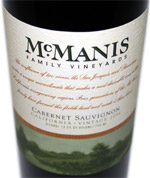 I really enjoyed this Cabernet Sauvignon. In addition to Cabernet Sauvignon grapes, this has a bit of Petite Verdot.
It showed herbal features on the nose, made up of tea leaf and eucalyptus. It was a bit dusty and very jammy on both the nose and palate. The palate is almost a fruit bomb with dark berries galore. Particularly it has strong blackberry and currant flavors. Critics may say that it has too much fruit for a Cabernet Sauvignon, but I though it was reasonable. The finish is silky, although a bit short.
All told I gave it an 89 and would recommend it at $9.99.
Wine: McManis Family Vineyards
Varietal: Cabernet Sauvignon
Vintage: 2006
Alcohol: 13.5%
Rating: 89
Price Paid: $9.99
 Once again, it’s Wine Blogging Wednesday. The one day each month when wine bloggers around the world all write about a common theme. The theme this month is Just Seven Words, hosted by Andrew at Spitoon.
The idea with Just Seven Words is to limit the tasting notes to seven words. Here’s how Andrew clarified the rules:
The finished tasting note must make sense, be grammatically correct(ish), punctuation will help of course. The wine name, type, producer, vintage do not have to be included in the 7. But a reference to aroma, flavour, length, food matching etc etc should be considered. Inventiveness is the key.
When I first heard about this, I thought it was right up my alley. Concision is something I greatly appreciate and learned how to deliver early in my professional career. I used to work in television creating commercials and most of my clients wanted to say 20 things in 15 seconds. Those days gave me a lot of practice at cutting out the garbage and refining language to say a lot in as few words as possible.
It’s what has to be done in commercials, and frankly the same thing applies to writing online. People just don’t like to read a lot, they scan web pages for the stuff they’re looking for. While some of my critics might say that my posts are too short, I can’t tell you how many times I pull up articles that others write and just say “too many words” then I move on to another website. So… concision is my style.
One other rule for the theme this month: It must be about an Italian Wine.
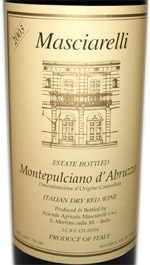 My choice is Masciarelli Montepulciano d’Abruzzo 2003. Once I’ve finished my series on Cabernet Sauvignon and posted the big summary for that, Montepulciano d’Abruzzo is the next varietal in the queue. Look for an upcoming short series on this style.
My initial notes for this wine were over 40 words:
Slightly smokey and dusty nose with dark berries and leather. Very good concentration in the palate. Cherries, blackberries and chocolate. There is a lot of fruit, but the fruit is a touch young tasting. Smooth tannis and a hint of chocolate.
Here goes, Just Seven Words
Leather clad cowboy embraces innocent luscious berries.
I don’t know if this is breaking the rules, but I have to include my at-a-glance rating summary.
Wine: Masciarelli
Varietal: Montepulciano d’Abruzzo
Vintage: 2003
Alcohol: 13%
Rating: 87
Price Paid: $8.99
Yet again a Chilean Cabernet found its way home with me. I’m tempted to do an overview of all the Chilean Cabs I tried… and I may yet do that.
This one is from Veramonte. You may recall that Veramonte Chardonnay was one of my top picks when I did a review of several Chardonnays last summer.
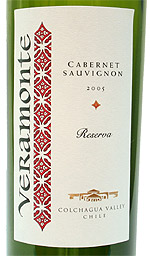 The Cabernet didn’t fair quite as well as the Chardonnay, but it still was OK. This Cabernet is from the Cholchagua Valley, an area from which I’ve already found a couple nice Cabernets. Root 1 and Los Vascos both were quite tasty, but interestingly both also were very intense—if not somewhat peculiar—on the nose. I didn’t find quite that same intensity—nor intrigue—on the nose of the Veramonte. It was basically just a simple, and rather typical bouquet with tobacco and hints of fruit. Call it cherry tobacco if you will. When you smell this wine, you can almost imagine the sweet smell from an old man puffing his pipe of cherry tobacco.
I will say that this is a very earthy Cabernet. The palate has enough oak to drive a nail into. I like oak, but I felt like I was drinking it right out of the barrel. Black cherries, currant and plum also make up the palate. It may have a little bit more fruit than you would expect from a Cabernet Sauvignon. The finish is long and dry.
It ended up scoring an 84 and at $9.99 I think you can do better than this one. But if you’re really into Chilean Cabernet you might give this one a shot.
Wine: Veramonte Reserva
Varietal: Cabernet Sauvignon
Vintage: 2005
Alcohol: 13.5%
Rating: 84
Price Paid: $9.99
I’ve been wanting to get some Washington State wine on this site and I finally have my first with this Washington State Cabernet from Red Diamond.
Red Diamond is still a relatively new brand to see on the shelves. They released their first wine, a Merlot, in 2003 and they now have four varietals available: Merlot, Chardonnay, Cabernet Sauvignon and Shiraz. The Cabernet is the first one I’ve tried from this producer and I’m quite impressed.
 From time to time I comment on the marketing behind the wines that I taste and I have to say that I love the packaging design from Red Diamond. It quickly caught my eye and now stands out every time I pass it on the shelf. It has a very bold and masculine look. And it’s masculine in a modern, Generation X kind of way—it’s not an old man/Hemingway masculine. The artwork has a dramatic, tribal tattoo style. And the label is printed with a raised ink technique that gives it an embossed feel. It’s a simple yet bold look, and an nontraditional design for a wine label—fitting for a wine as bold as this one.
Enough about the label, let’s get on to the tasting notes. The wine has a deep, rich ruby color. The nose features cherry cola, vanilla, blackberry and tobacco. The palate is rich with intense jammy blackberry, cherry and dark chocolate. It is silky smooth with a toasted oak finish and sufficient acidity.
After I take my notes often I like to see what the producer put in their notes and I usually find their notes to be total bullshit, but the notes for this one actually came it surprisingly close to my own: “Aromas of black cherry, blackberries, liqueur and hints of tobacco and smoke precede a rich, silky palate of cherry, chocolate and black fruits with a touch of toasty oak on the finish.”
I gave it an 89 and at $8.99 that makes this a great deal. I’d say enjoy it now as I expect the price on this one to creep up over the next few years if they can maintain this level of quality.
Wine: Red Diamond
Varietal: Cabernet Sauvignon
Vintage: 2005
Alcohol: 13.5%
Rating: 89
Price Paid: $8.99
Something that some wine reviewers and bloggers debate is whether they should write up the bad reviews or not. As far as I’m concerned, if a producer puts a bottle on the shelf and wants my dime for it, well… it’s fair game. I also consider it a responsibility to frugal wine drinkers everywhere to let them know that when they see these ones on the shelf they should leave them there.
As they say at Quaffability, “We taste it, so you don’t have to.” Or even more eloquently stated at Spitoon, “We spit, so you can swallow.”
And so, I start with the somewhat disappointing and work my way down to the awful.
Pepperwood Grove Cabernet Sauvignon
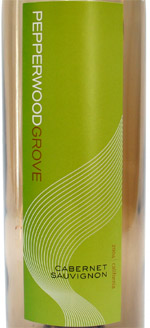 The nose on this California cabernet from Pepperwood Grove is very fruity… raspberry and cherry and that’s a good thing. But there is something else in the nose, a bit of epazote (that’s a Mexican herb in case you don’t know it). This is probably the first cabernet sauvignon review in history to use epazote in it, and for good reason. It smells a bit funky—kind of a petroleum type funk.
The palate isn’t as odd as the nose, but is quite fruit forward—more so than most cabs. Jammy blackberries, raspberries and vanilla fill your mouth with this one. Soft tannins and a bit of spice close it out in a rather short finish.
It’s drinkable, but a bit disappointing and the funky aspect on the bouquet knocked a couple points off the score, which ended up at an 83. Some folks may say an 83 is good, and like I said it’s drinkable… but 85+ is preferable to me. That said, this one is an affordable one at $6.99.
Wine: Pepperwood Grove
Varietal: Cabernet Sauvignon
Vintage: 2004
Alcohol: 13.5%
Rating: 83
Price Paid: $6.99
Concannon Cabernet Sauvignon
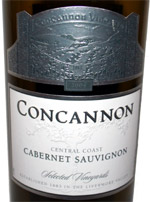 This was a rather disappointing Central Coast California cabernet from Concannon. It’s a bit too acidic and just not very well balanced.
The nose is dominated by leather and wet rock, plus has some black cherry and a hint of strawberry. It’s mostly black cherry on the palate with some vanilla. The tannins are soft, but the acidity pokes you like a knife.
Overall it was just kind of thin too. Although the alcohol level is 13.5%, the viscosity is more like I would expect from a 12.5%.
Wine: Concannon
Varietal: Cabernet Sauvignon
Vintage: 2004
Alcohol: 13.5%
Rating: 79
Price Paid: $8.99
San Andre’s Cabernet Sauvignon
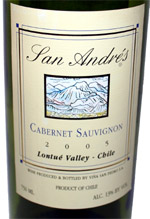 This Chilean cabernet from San Andre’s was a Trader Joe’s find and it feeds my on-going rant: “The so-called bargains at Trader Joe’s are crap. You can find better deals at your local wine shop!” The other thing this wine did was ground me and my recent elation about Chilean cabernets. I now know that they are all great.
The first thing that struck me about this wine was its peculiar smell… indescribable. It had an equally peculiar taste. It was drinkable, but not enjoyable. In other words, I didn’t gag. I can’t spend any more time thinking about this wine and I’m not going to pontificate the nuances on this one. Ugh.
Wine: San Andre’s
Varietal: Cabernet Sauvignon
Vintage: 2004
Alcohol: 13.5%
Rating: 71
Price Paid: $8.99
My exploration of inexpensive cabernet sauvignon has given me an affinity for Chilean wine. I’ve found a number of good, affordable bottles of cabernet from Chile, and this review reveals yet another example.
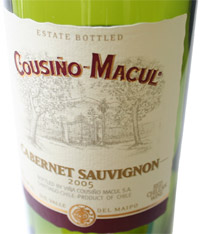 The Cousiño Macul winery was founded in 1856 by Matías Cousiño and has remained in the Cousiño family since its inception. It is now owned and managed by its sixth generation of Cousiños.
The vineyards reside in the Maipo Valley—the oldest wine growing region in Chile. The soil is well drained and rich with minerals. The Maipo Valley is known to have a long growing season, with conditions that are ideal for grapes. These conditions and years of winemaking experience are apparent when you taste this wine.
This is a nice earthy, full-flavored cab. Tobacco, leather and a little cherry make up the nose. The palate is luscious with strawberry, cherry, pepper and mineral flavors. Nice, silky tannins make it all go down smooth. The only real drawback was that it had a rather short finish. But I can live with that if everything else is in order. I gave this one an 88 and that’s not bad for $8.99.
Wine: Cousiño Macul
Varietal: Cabernet Sauvignon
Vintage: 2005
Alcohol: 14%
Rating: 88
Price Paid: $8.99
“Sorrow can be alleviated by good sleep, a bath and a glass of wine”
– St. Thomas Aquinas
Aquinas wines are named after St. Thomas Aquinas, but not because of that quote. Producer Don Sebastiani & Sons chose the Aquinas name as a metaphor. St. Thomas Aquinas united science and religion at a time when the two were at odds. Similarly, the mission of Aquinas wines is to bridge the prestige of the Napa Valley with approachable wines without snobbery.
Personally, I think they should use the quote.
I first tasted Aquinas Napa Valley Cabernet in a casual setting. I wasn’t taking notes or calculating a rating. I was just enjoying some wine. And I enjoyed it a LOT! It had great concentration, abundant ripe fruit, rich tobacco and chocolaty smoothness. It was good. You could say it “alleviated my sorrow.”
But, as I said, I wasn’t taking notes. Other than the mental note that I need to pick up another bottle of this wine and write it up on Cheap Wine Ratings.
So I went to the wine shop and I found 2004 and 2005 sitting on the shelf. “Oh crap… what vintage was it?” I pondered. “I know, I’ll just pick up both. After all, it was good and you don’t find a $10 Napa Valley Cabernet very often.”
And so, you get a double-vintage post today.
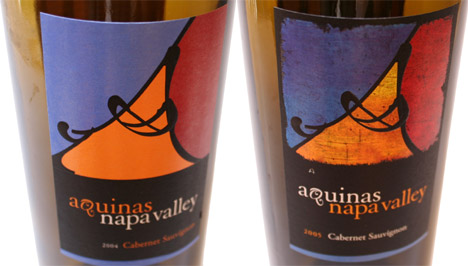
One thing I noticed when I picked up this wine was a minor change in the label design. Although the 2004 is older, the 2005 label was revised to make it look older. Kudos to the marketing department for that one.
But the next thing that I noticed after tasting these, is that I wasn’t quite as wowed as I was the first time around. This disappointed me and perplexed me. So I picked up a couple more bottles to confirm. And it was consistent. They are both decent, but didn’t blow me away.
I don’t know if my taste was off the first time I tried this or if there was some bottle inconsistency. That’s something I often worry about with mass produced wine. I’m just not convinced that quality / consistency is scalable. In other words, when you’re producing tens of thousands of cases I expect that the first bottle tastes quite different from the last bottle.
Nonetheless, here is what I found in my “official tasting.”
2004 Aquinas Cabernet Sauvignon
The 2004 was the better of the two. The nose was nice with tobacco, cherry and a hint of raspberry. The palate featured black cherry, raspberry and chocolate, but it lacked the concentration I recalled from my first experience. It did have a nice velvety finish. It was decent, but a bit lackluster compared to my first impression and ended up with an 86.
Wine: Aquinas Napa Valley
Varietal: Cabernet Sauvignon
Vintage: 2004
Alcohol: 13.5%
Rating: 86
Price Paid: $9.99
2005 Aquinas Cabernet Sauvignon
The 2005 wasn’t as exciting as the 2004. It had a very oak-y/cedar-y aroma and the palate was mostly tannic and smoky. It had some blackberry and currant, but the fruit lacks intensity. I ended up giving it an 82.
Wine: Aquinas Napa Valley
Varietal: Cabernet Sauvignon
Vintage: 2005
Alcohol: 13.5%
Rating: 82
Price Paid: $9.99
Researchers at the California Institute of Technology hypothesized that marketing factors, such as the price of a product, could have an impact on experiential perceptions such as pleasantness. And they put the idea to the test with wine.
In the study, recently published by the National Academy of Sciences, researchers told participants that they would be tasting five different Cabernet Sauvignons. Using functional MRI, the researchers measured neural indicators of pleasantness which showed that subjects experienced higher levels of “flavor pleasantness” when they were told that wines were more expensive.
In reality, the subjects were given only three different Cabernets. Two of them were presented twice, at different price levels. A $90 bottle of wine was presented at both its original price and at a $10 price level, and a $5 wine was presented at its original price and a $45 price level.
In both cases, the testers’ brains showed higher levels of pleasure at the higher price point than at the lower price point.
The results of this test don’t surprise me at all. I know when I’m served a glass of wine that I know is more expensive there is a heightened level of excitement—even before I taste the wine! I feel as though I’m taking part in something special, but that doesn’t mean that the wine really tastes any better than a less expensive bottle.
This is one of the reasons “professional tasting” is done blind. It’s hard to put aside your perceptions about a wine and judge it in an unbiased way.
I also find it interesting because I think that people are often afraid to look stupid by saying an expensive wine tastes bad, or a cheap wine tastes good. What’s great about this study is that it eliminated those social factors and measured brain activity.
But those social factors need to change. Let go, my friends. Cheap is OK. Quality is what matters—and you don’t always have to pay a lot to get good quality.
I’d like to see a follow up study where they present participants with a bill for the wine, then see if levels of pleasure go up when the bill is higher versus lower.
Here’s my advice: Buy a high-quality, low-price wine but tell your friends that it’s a bit more expensive when you serve it. Or, do a blind tasting where you serve them the same wine three times at three different price levels. It’s sure to be entertaining.
2½ bottles of wine a week can save your life
That’s the headline from a story published in The Times today. According to this article, those who drink up to 14 drinks each week have a lower risk of death from heart disease than than both heavy drinkers and non-drinkers.
“A weekly moderate alcohol intake reduced the risk of all-cause mortality among both men and women, whereas the risk among heavy drinkers was similar to nondrinkers.”
Additionally, those who exercise regularly and consume 14 drinks weekly were the healthiest with a magnified health benefit from the exercise. Would you care for a bit of pinot grigio in your exercise water bottle?
The article is based on a study published in the European Heart Journal in which some 12,000 Danish men and women were evaluated over several years in the 1970s and 1980s.
I love reports like this that make me feel a little less guilty about enjoying my wine. And lucky for me, I exercise for over an hour every day.
While I’ve seen numerous reports like this that highlight the heart-health benefits of wine, I still struggle with the calories and the impact on metabolism. I’ve never seen a report on wine’s effect on metabolism, but I’ve always been suspect that it does have a slowing effect. I’ve personally cut back my consumption just so that I can keep the spare tire at bay. Of course that’s also why I exercise.
In a similar story, Wired Magazine recently reported on a “red wine drug” that combats aging. The drug is a derivative of resveratrol (an ingredient found in red wine known for anti-aging qualities) and it reportedly is showing promise to lower blood sugar in diabetic patients.
Yay! Good more good news for wine drinkers!
My search for good cheap Cabernet Sauvignon continues with another selection from the Colchagua Valley region in Chile. I’ve been finding a number of interesting Cabs from Colchagua Valley and with good reason. It has been characterized as the next Napa Valley as its characteristics are very similar to Napa Valley 50 years ago. The soil, water and climate create near-perfect conditions for vineyards.
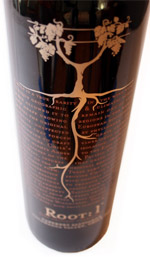
Root:1 from Viña Ventisquero is a great example of the exciting yet affordable wines coming from the Colchagua Valley.
The first thing you’ll notice about Root:1 is one of the most striking and memorable bottle designs I’ve seen in ages. There is no missing this one on the shelves. The deep, ruby-red color of the wine is just as striking as the bottle design.
I’ve heard a lot of people talking about Root:1 Cabernet Sauvignon and it is very popular, although the 2005 vintage seems to be a love it or hate it wine. Specifically, I think this is all due to the nose—which is very intense and a bit different from what you’re probably used to.
It’s different in that there is a strong spearmint aroma on the nose. I found it interesting, but a bit too intense at first which is why I would recommend decanting this one for a half hour or so before drinking it. That will take the edge off of the intensity. You’ll also find currants, vanilla and a bit of leather on the nose.
The palate is supple and creamy with plum, cherry, dark chocolate and cinnamon flavors. The concentration on the palate is outstanding for an $11 bottle of wine. It has a nice, long and silky finish with hints of cedar.
I enjoyed this bottle of wine and gave it a 90, but I can see why some people would be put off my the nose. I’d recommend getting one bottle to try and if you like it, get some more.
Wine: Root:1
Varietal: Cabernet Sauvignon
Vintage: 2005
Alcohol: 14%
Rating: 90
Price Paid: $10.99

 Prev
Prev