With the presidential primary elections quickly approaching I started pondering: If I were to describe the 2008 presidential candidates by comparing them each to a type of wine, which wines would I pick?
I tried to do this in a non-partisan way (i.e. I lambasted both dems and republicans, although a few got off clean). You might be able to figure out my personal picks, but then again you may be surprised—my wine preferences don’t necessarily mirror my political picks. I also tried not to get too obscure with the wine choices, although there may be better picks for some of these candidates if I did.
This won’t make or break the campaign for anyone, but it may influence the wine choices for a few ardent supporters of the candidates.
Joe Biden: Merlot
Generic red wine sums up the personality of Merlot. It’s proven and impressive, but overly familiar. Merlot is often compared to Cabernet Sauvignon, but its flavor is less distinctive. Similarly, Joe Biden makes a strong effort and he has some good ideas, but there’s nothing really exciting about him.
Hillary Clinton: Chardonnay
Fans of Chardonnay think of it as elegant, complex and cheery. A well made Chardonnay features bold, ripe, rich and intense fruit flavors. As a grape, Chardonnay tends to be fairly neutral and can be manipulated by winemakers to take on different characteristics—just as critics of Hillary accuse her of being manipulated by popular opinions and polls.
Chardonnay is a popular wine with a broad base of supporters. In fact, I believe it’s the most consumed wine in the US. But those that don’t like Chardonnay totally friggin hate it!
John Edwards: Riesling
The first impression most people have of Riesling is its sweetness, which is also the first impression many have of John Edwards. But Riesling doesn’t always have to be sweet. When Riesling is really great it’s about clarity. That is a characteristic where you can clearly taste the wines flavors in a simple way versus the thick and creamy personality that many other white wines have.
Riesling is fluid and can take on different characteristics, making it an interesting and versatile varietal.
Rudy Giuliani: Cabernet Sauvignon
Cabernet Sauvignon is a remarkably steady and consistent performer. It has a lot of character with great intensity and depth of flavor. It’s such a bold wine that it’s almost arrogant. Similarly, some appreciate Rudy Giuliani for being strong but he can be disturbingly smug.
Cabernet Sauvignon is one of the most “marketable” wines, as many people are familiar with it and have been impressed by it at one time or another.
Mike Huckabee: Chenin Blanc
It is pleasant and refreshing, but subtle and understated. Think light tones of melon, peach and citrus. The characteristics of Chenin Blanc vary from dry and fresh to sweet. Although it’s often overlooked or disregarded, Chenin Blanc is a strong performer with a lot of potential. It has proven itself a strong contender in many ways: dry, sweet and sparkling.
Dennis Kucinich: Beaujolais Nouveau
Impatient, uncomplicated and quirky, Beajolais Nouveau is a very unique wine. It makes a bold statement by being the first to scream, “I’m here!” But it hasn’t taken the time to mature and refine its characteristics. There are a few die hard fans, but most people really don’t like it. If you still have some around by spring you might as well toss it because it won’t be any good by then.
John McCain: Zinfandel
Red Zinfandel, to be specific. Not the sweet, fruity White Zinfandel style of wine. The popularity of Zinfandel fluctuates. At moments everyone’s excited about it, and then suddenly nobody’s buying it. Zinfandel gives you an appreciation for old vines. It’s often thought of as being spicy, which is when it is most interesting.
Barack Obama: Syrah
Oh, Syrah is a smoooooth wine. Syrah (or Shiraz as it’s known in Australia) has grown in popularity in recent years, but may have not reached its peak yet. Its combination of rich character and approachability make it first choice for many. It can be very complex and a bit spicy, yet always silky smooth and comforting. Syrah is a a majestic wine and it should age well.
Ron Paul: Gewürztraminer
Those who like Gewürztraminer really think it’s something special. But it tends to be a wine that either you like it or you don’t, which gives it somewhat of a cult following. It can be seen as a bit off the wall and unpredictable. Its aromas—floral, spices and tropical fruit—are insistent, if not exaggerated, and won’t go unnoticed. It probably has the most distinct flavor profile of any grape, but that doesn’t mean it will be appreciated by everyone.
Bill Richardson: Grenache
Grenache is a medium-bodied, very approachable and pleasing varietal. It’s typically thought of as a rather simple, fruity wine, but at times it’s unpredictable which adds a little spice. Grenache is a popular blending grape. I like the way Appellation America puts it, “Grenache you’re the most famous backup guitarist.” Similarly, I’ve heard many pundits characterize Bill Richardson as a Vice Presidential candidate (i.e. the backup guitarist).
Mitt Romney: Cabernet Franc
Some Americans find Cabernet Franc a bit mysterious as they are not yet strongly familiar with it, but it has some impressive characteristics. While many are distracted by the boldness of Cabernet Sauvignon, Cabernet Franc offers softer tones that are more aromatic and fruity than Cabernet Sauvignon. Graceful and elegant, Cabernet Franc is a great compliment to a Cabernet Sauvignon and when blended the two create wonderfully complex and exciting wines.
Fred Thompson: Muscat of Alexandria
Muscat or Alexandria is not particularly aromatic and as such can be considered not very cerebral—just like Fred Thompson. It’s considered an ancient vine and it commonly used for producing raisins. It tends to be a sweet, simple wine. In fact so simple that unlike other varietals you might say it just tastes like grapes.
Final Thoughts
There were a few candidates about whom I don’t know very much and I left them off this list: Chris Dodd, Mike Gravel, Duncan Hunter and Tom Tancredo. And frankly I think they are hardly in this race anyway.
You may disagree with some of my assessments of the candidates (or of the wines) but hey… it’s all just for fun anyway. Cheers!
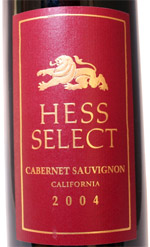 Let’s say you typically spend under $10 per bottle and you’re in the store and come across Hess Select Cabernet Sauvignon. It has this bold red label with a very regal looking lion figure. It’s a very impressive label and looks like it must be a good bottle of wine. It says “Select” on the bottle. That must mean it’s a premium product. And it’s $13—that’s $3 over your typical limit. Ohhh… it has to be good, it’s $13!
So you make your move, “I’m going to splurge today and get a really good bottle of wine!” You grab the Hess Select and head on your way. (Paying before you leave the store of course.) Then when you open the bottle you feel like you got robbed.
I think a lot of wine drinkers find themselves going through this scenario. They typically buy bottles under $10 and find themselves wanting to spend a few dollars more to get something a little bit better. But that’s where wine gets tricky. Spending more doesn’t always mean that you’ll get a better bottle of wine. Particularly if it’s only a couple bucks more.
In a way, wine is like fashion. Sometimes you pay more for a brand name, even though you could get something of higher quality for less money if you went with a lesser known name. There are some wine producers who consistently produce high quality year after year and have real credibility to their name, while with some others you’re just paying more for the name.
This bottle of Hess Select is a great example of a wine that’s bad for business if wine producers want to reward consumers for spending more and encourage them to increase their wine budgets. That’s right… it’s not worth the extra $3. In fact I wouldn’t pay more than $7 for this bottle of wine.
Overall, this is a fairly run of the mill cabernet. There’s nothing extraordinary about it. The nose is rather peculiar with dusty, herbal and vanilla nature to it. The palate has reasonable concentration of blackberry and vanilla flavors. The best part is the velvety smoothness of the tannins. It has a fairly long finish, but again there’s nothing extraordinary about it.
I gave this wine an 84. It’s not awful, but you can spend less and find something better.
Wine: Hess Select
Varietal: Cabernet Sauvignon
Vintage: 2004
Alcohol: 13.5%
Rating: 84
Price Paid: $12.97
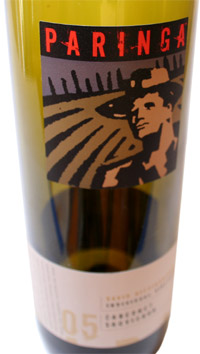 I noticed that Paringa Cabernet Sauvignon 2005 was mentioned in the New York Times 10 Wines Under $10 article that I highlighted a while back and I thought I should include it in my search for good, cheap cabernet sauvignon.
Paringa wines are produced by David and Dena Hickinbotham in South Australia, where the Hickinbotham family has been involved in wine production for decades. This wine is a great example of how that experience enables them to produce great wines at affordable prices. This bottle cost me $9.99.
In my review of Paringa “Individual Vineyard” Cabernet Sauvignon 2005, I found that it has nice complexity in the nose ant the palate. To start with I found a bit of oak, tobacco, asparagus and blackberry on the nose. The palate is nice and fruity with blackberry and black currant. It also has rich, velvety tannins and nice cayenne pepper spiciness. The finish is relatively long, so you can really savor this one. I gave it an 89 and I would say it’s worth your $10.
Wine: Paringa “Individual Vineyard”
Varietal: Cabernet Sauvignon
Vintage: 2005
Alcohol: 14%
Rating: 89
Price Paid: $9.99
Wine Blogging Wednesday #40
 Once again, it’s my favorite day of the month: Wine Blogging Wednesday. For those who don’t know, Wine Blogging Wednesday is a day that happens once a month when wine bloggers from around the world all write about a common theme. The theme this month is Petite Sirah, one of my favorite types of wine. There is a host each month who summarizes all the contributions and this month the host is Sonadora at WannabeWino.
Petite Sirah, also known as Durif, tends to be a dark, concentrated, tannic and spicy wine with jammy fruit. I find it to be an absolutely voluptuous and luxurious wine. Drinking Petite Sirah is akin to draping yourself in velvet robes and lounging on silky pillows.
Petite Sirah was originated as a varietal in 1880 by Dr. François Durif in Southern France from a cross pollination of Syrah and Peloursin. Although Syrah is in its genes, Petite Sirah should not be confused with Syrah. It is a new and different grape. I’m always frustrated when I go to the wine shop and find the Petite Sirah mixed in with the Syrah. It just leads to confusion about this wonderful wine varietal.
Petite Sirah Meets World of Warcraft
 World of Warcraft is something I don’t expect you’ll hear about from any other wine bloggers today. But there’s a connection with WoW and Petite Sirah for me. “WoW” is the abbreviation for World of Warcraft for those who don’t know.
Yep… I’m a gamer. I play WoW a lot—although not as much as I used to. I would probably spend more time posting wine reviews if I weren’t wasting my time on WoW. But hey, it’s a lot of fun and I’ve been playing since the game first came out three years ago. If you care, my main character is a Troll Shaman named Hellworm (see pic on the right).
 Anyway, I was first introduced to Petite Sirah when I started to plan for this website back in September 2006. I was playing WoW one night, getting ready for a raid on Blackwing Lair, and I was chatting with my fellow Shamans about my plans for this website. It turned out that Auriga, one of my best friends in the game, was also really into wine. That’s him on the left.
Auriga recommended Bogle Petite Sirah as the best $9.00 I would ever spend. I went out and picked up a bottle and sure enough, it was some damn good stuff. I subsequently tried several other brands of Petite Sirah and soon dubbed it a favorite varietal.
Since that time, Auriga and I have moved our toons to different servers and aren’t able to play together anymore. 🙁 But I raise my glass to him and say, “thanks for turning me on to Petite Sirah.”
McManis Family Vineyards Petite Sirah 2006
I considered doing Bogle Petite Sirah for Wine Blogging Wednesday, but most folks already know about Bogle and I figured someone else would take care of that one. Plus, I found another brand that I’m really excited about and I wanted to share it with all of you: McManis Family Vineyards.
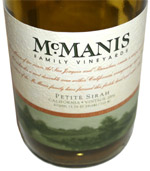 I haven’t come across McManis wines in many shops in my area. In fact, the only place I’ve found it is at Chateau Pomije (I’d link them up, but their website appears to be offline) in Cincinnati, where there is some buzz about McManis. The McManis Pinot Noir was so popular that they were sold out before I could get there to pick up a bottle. And I expect the Petite Sirah will sell quickly too when the word gets out. I better stock up as soon as I publish this!
McManis Family Vineyards are located in Ripon, California, at the confluence of the San Joaquin and Stanislaus Rivers. This area is known as the “River Junction” appellation. Although the vineyard was founded in 1990, the McManis family has been growing grapes in the region since 1938.
The McManis Petite Sirah has a beautiful, purple color. Most Petite Sirah that I’ve had is very dark in color. While the McManis is dark, it seems to have a lot more color saturation than other Petite Sirah I have tried.
Leather, black pepper, blackberry and smoke give this wine an interesting bouquet. The palate is fairly concentrated with abundant ripe fruit, such as blackberry & cherry. It’s smoky on the palate as well—there’s no missing the oak in this one. The tannins are like comfortable silky pajamas giving you a relaxing and sensuous mouth feel. And it has a nice, long finish.
I picked this bottle up for $11.99 and I gave it a 90. It’s very good stuff.
Wine: McManis Family Vineyards
Varietal: Petite Sirah
Vintage: 2006
Alcohol: 13.5%
Rating: 90
Price Paid: $11.99
It is holiday party season and you’ll probably find yourself wondering what wine to bring to a holiday party. There are a few approaches you can take:
- You can be careless and just pick up some cheapie and hope for the best
- You can splurge on a really expensive bottle and hope to impress
- You can research websites like Cheap Wine Ratings for an inexpensive gem
- You can bring something unique that will get people talking
I don’t really recommend the first two options. Even if you spend a lot on an expensive bottle, chances are it will soon be forgotten, or just get lost in the mix. Option 3 is OK… you can find something good, without spending a lot. But hey, it’s a party! That’s why I’d suggest you find something unique to bring. And this is the perfect choice for Christmas parties, New Year’s Eve parties, or whatever the occasion.
 Paringa Sparkling Shiraz isn’t a high-brow wine, but it still tastes very good and more importantly it’s a lot of fun. It is truly a different wine that is a great conversation starter and will be remembered. I say that from experience too. I’ve been to many holiday parties over the years, and this is the only wine I remember from one. I discovered it last year when a friend brought it and I’m still delighted from the experience.
You’ve been to those boring holiday parties where you hardly know anyone and don’t have much to talk about. Bring a bottle of this wine, pop it open and the conversation will start flowing—along with the wine. Most people have never tried sparkling red wines and when they see it they are all intrigued. In fact, you may have to bring a couple bottles because everyone will want to try it. But that shouldn’t be too difficult as it sells for a reasonable $9.99.
The wine itself is a bit sweet, but not overly so. It tickles your palate with bubbles that burst with raspberry and blueberry flavors. The tannins are creamy and smooth, giving this wine a bit more sophistication than I had expected. I gave the wine an 87 on flavor, but a 95 on fun!
Wine: Paringa Individual Vineyard
Varietal: Sparkling Shiraz
Vintage: 2004
Alcohol: 12.5%
Rating: 87 for flavor 95 for fun!
Price Paid: $9.99
Casa Lapostolle is owned by the Marnier-Lapostolle Group in France, best known as the producers of Grand Marnier liqueur. They have been involved in wine production for many years and founded Casa Lapostolle in Chile in 1994. Casa Lapostolle currently represents 370 hectares in three different vineyards.
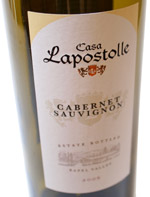 The Casa Lapostolle Cabernet Sauvignon 2005 come from vineyards in the Rapel Valley of Chile. The year showed low yields but climatic conditions ideal for an exceptional wine.
The nose of this cabernet sauvignon is very pleasing with tobacco, cherry and cassis. Blackberry, currant and a hint of strawberry make up the palate with a silky mouth feel and a rather long, slightly smoky finish.
It has a rather high alcohol level, 14.5%, for those who feel higher alcohol makes a better wine.
I gave it an 88, Wine Enthusiast gave it an 89 and Wine Spectator gave it an 85. At $9.99, it’s definitely worth a try.
Wine: Casa Lapostolle
Varietal: Cabernet Sauvignon
Vintage: 2005
Alcohol: 14.5%
Rating: 89
Price Paid: $9.99
The folks at Asti Winery in Sonoma, CA did a nice job on the 2005 Cellar No. 8 Cabernet Sauvignon.
Cellar No. 8 is named after a cellar in the Asti Winery in Sonoma County, California, which was founded by Italian immigrant Andrea Sbarboro in the early 1880’s. Sbarboro named the winery after the Asti region in Northern Italy and incorporated Italian winemaking methods in the winery. The winery was later bought by Beringer, which was subsequently bought by the Foster’s Group from Australia.
Currently little-to-no marketing behind the Cellar No. 8 brand. At least I haven’t come across any. So I’m not sure what Foster’s is planning for this brand. The only current online promotion is on the Foster’s corporate site.
While they figure out how they want to market this brand, I’ll just enjoy it.
The Cellar No. 8 Cabernet Sauvignon 2005 shows tobacco, Bing cherries, leather and a hint of strawberry on the nose. There’s a nice presence of fruit, but it’s not a fruit bomb. Cherries, blackberries and plum are well blended on the palate. It’s very well balanced. The finish is silky smooth with a bit of pepper.
I gave it a 90 and bought some more to enjoy.
Wine: Cellar No. 8
Varietal: Cabernet Sauvignon
Vintage: 2005
Alcohol: 13%
Rating: 90
Price Paid: $9.99
I’ve been seeing more and more organic wine in stores lately, but I haven’t been motivated to try much of it. Why? Because they tend to be unstable and I’ve never really found a good one—by current US “organic” standards anyway. The reason is that sulfites cannot be used in the production of wines labeled “organic.”
Sulfites protect wine from acetic bacteria and give it stability and consistency. But they aren’t permitted in organic wines. That means that the entire grape farming process can take place without using any pesticides or other chemicals, but once sulfites are added it can no longer be considered organic. And without adding sulfites, there’s a good chance that the taste of the wine will change rather quickly in the bottle and it just won’t be very good.
That was the point of an article published today on salon.com titled, Does Organic Wine Taste Bad? I totally agree with the perspectives shared in the article. Sulfites are necessary to ensure the quality of the wine and I’ve never been concerned about consuming sulfites.
The article notes that sulfites are mostly a concern for asthmatics. I expect that the alcohol in wine is more detrimental to my health than the sulfites—of course I’m no scientist. I’ve heard some people state that they don’t drink wine because the sulfites give them a headache or a hangover. Again, I have a hunch that it’s the alcohol that’s doing that.
I think it’s also important to note that sulfites occur naturally in wine. The natural levels are typically too low to give the wine stability, and so additional sulfites are added.
I recently did a review of Melania Colleccion Cabernet Sauvignon, which is produced with organic grapes but isn’t labeled as an organic wine because they still used sulfites in the production. “Eco-friendly” is an area where I think there is opportunity for the wine industry. I am a fan of organic farming and minimizing the use of pesticides on crops, but I also concede that there are benefits from chemistry. It’s a matter of finding the right balance and using chemistry to our advantage where needed, but minimizing over-use.
To learn more about eco-friendly viticulture check out Low Input Viticulture & Enology, the California Sustainable Winegrowing Alliance, Vinewise and VineBalance.
For now, I’m sticking with my sulfite-laden wines. But I may pick up some wines “made with organic grapes” from time to time.
If you’re a Seinfeld fan you probably remember the episode where Kramer wanted to create a cologne that smelled like the beach. This bottle of Cabernet Sauvignon reminded me of that episode with an interesting seaweed aroma. It smells like the beach! It makes this an interesting wine to explore, but not a top pick.
It looks to me as though Marlena Wines are produced as a second label by Tupun winery in Mendoza, Argentina. They don’t market it that way, but it appears to be the case. In the US, it’s imported by Marco and Sons and in Canada by Celestial Brands.
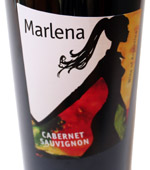 The 2006 Marlena Cabernet Sauvignon looks beautiful with a rich ruby color and opaque depth. It has an interesting, herbal nose, as I mentioned, with hints of seaweed, violet and eucalyptus. But the palate is less interesting, or perhaps less thrilling. The seaweed theme continues—it’s not bad, but it’s different. The fruit is restrained, but once you let the wine open up you’ll find a bit of cherry. The tannins are light, giving it a smooth mouth feel and acid is sufficient. It’s almost a good wine, but I would have liked more abundant fruit. I gave it an 84.
The tasting notes they publish cite nuts and green pepper. I didn’t really find either. Perhaps they’re trying to spin the seaweed characteristic as green pepper because it sounds more appealing. Who knows?
Wine: Marlena
Varietal: Cabernet Sauvignon
Vintage: 2006
Alcohol: 13%
Rating: 84
Price Paid: $8.99
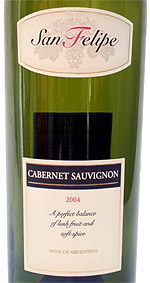 Here’s a quick review for an Argentine Cabernet Sauvignon. This one comes from Mendoza and is imported by Billington Wines, although you won’t find any mention of it on their website. I’m not sure if they’ve discontinued it or if it’s just not an important brand to them. I found this bottle stacked up in cases of bargain wines at a local wine shop.
The 2004 San Felipe Cabernet Sauvignon is a decent wine for the price: $5.99. It features a very earthy nose – wet rock, leather and cherry – and a nice mouth feel. It has some blackberry and currant flavors, but they are overpowered by the tannins which finish a little harsh although quite silky at first. I gave it an 86.
If you stumble across this one, it might be worth the six bucks to give it a try, but I wouldn’t go out of my way to hunt for it.
Wine: San Felipe
Varietal: Cabernet Sauvignon
Vintage: 2004
Alcohol: 13.5%
Rating: 86
Price Paid: $5.99

 Prev
Prev