Ortega Fournier, better known as O. Fournier, is an international wine group, currently producing wines from Spain, Argentina and Chile. As far as wine companies go, they are relatively young, having only been founded ten years ago, in 2000. And it’s even more recently, in 2007, that they’ve begun operations in Chile, where they have properties in San Antonio Valley and Maule Valley. But you don’t have to be an old company to produce great wine, and O. Fournier is proving that.
For those who’ve been reading Cheap Wine Ratings for a while, it should come as no surprise that we’re reviewing another Chilean wine. We’re big fans of Chile because you get outstanding bang for your buck with the wines coming out of this part of the world. And I’m adding Urban Cabernet Sauvignon to the list of outstanding options when it comes to Chilean wine.
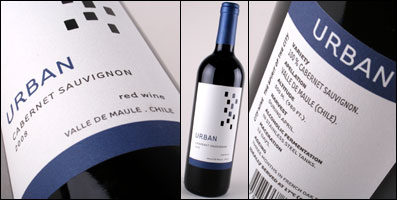
This wine comes from the Maule Valley region. Overall, It’s a great Cabernet Sauvignon. The area were I’d like to see some improvement is in the intensity of the nose, but otherwise this is a beautiful wine. Black cherry, blackberry and a smoky floral aroma give the nose depth and character. The palate has firm tannins and perfect acidity, with plenty of blackberry and raspberry flavors, without being jammy. There’s an interesting nutmeg spiciness to it that comes in mid-palate and lasts into a long and elegant finish. We gave this wine that unfortunate score of 89—only one point away from a 90 and had it a touch more intensity on the nose it would have been a 90 for us.
Try this wine with a pepper crusted ahi tuna. I have a hunch you’ll like it.
Wine: O. Fournier Urban
Variety: Cabernet Sauvignon
Vintage: 2008
Alcohol: 14%
Rating: 89
Price: $12.00
Find Urban Cabernet Sauvignon with Snooth
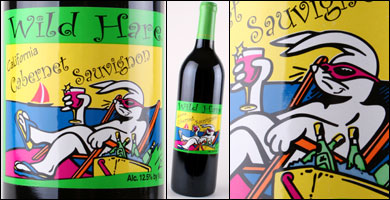
It should come as no surprise that the label on a wine can have a significant impact on sales. I know I’ve seen some wines where the label totally “wowed” me and other labels that have made a wine appear unappealing to me. But this is a wine with a label that I just don’t get at all. It features a cartoon rabbit chilling on the beach with sunglasses, a cooler full of bottles on ice and a glass of wine in hand. This is not a label that makes me want to buy—or even taste—this wine.
 The first thing I thought when I saw this label was, “can they do that?” If you’re as old as I am, you may remember the Hamm’s Beer Bear from many years ago. You don’t see this advertising icon around anymore because it was made illegal for beer companies to use cartoon characters in their advertising. But does the same law not apply to wine??? I assume someone at the winery must have looked into that before approving this label… at least I hope so.
But ultimately, it’s not the label that matters. It’s all about the wine. Considering the fact that I know I would be biased against this wine if I saw the label before tasting it, I should note that this one was tasted blind—as most wines reviewed here are.
Simple, but pleasant on the nose with black cherry, cola and a touch of tobacco. The palate has good fruit with cherry and blackberry flavors, but not a lot of depth. A strawberry flavor comes into play on the finish. It’s an OK and drinkable wine, but not one I would geek out about.
Wine: Wild Hare Cabernet Sauvignon
Variety: Cabernet Sauvignon
Vintage: 2008
Alcohol: 12.5%
Rating: 82
Price: $6.99
Disclosure: This wine was received as a sample.
We’re doing something a little different tonight… a book review.
Friends of mine frequently ask me how they can become better at tasting wine. While there are a lot of exercises and studying that you can do to improve your wine knowledge, there’s one piece of advice that I always give to people: take notes. If you want to better understand the wine you’re drinking, taking notes on it forces you to think more about it and really have an opinion. The more you do it, the more you’ll see some patterns emerge. Some of those patterns will help you understand varieties and regions and some will just help you figure out—and remember—which wines you like the best.
And although the idea of taking notes about the wine you’re tasting seems like a simple idea, once you start doing it you may wonder if you’re taking notes the right way. Well… you would wonder that if you’re neurotic, like me. It’s good, particularly when you first start to take wine notes, to have some type of a “framework” to make sure you’re capturing as much information about the wine as possible and evaluating different characteristics/aspects of the wine. That’s where tasting note books come in handy… they give you a nice framework for your tasting notes. And that’s exactly what you’ll find in 33 Bottles of Wine.
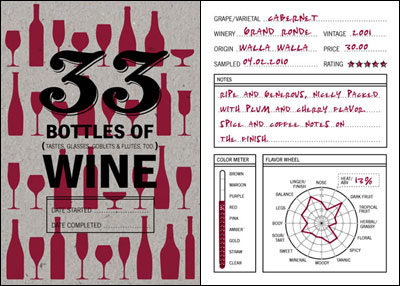
It starts with the basics: Varietal, winery, vintage, region, price and date tasted. It has a space for a 1-5 star rating, which is cool if that’s your thing, but if you prefer a 20 or 100 point system I’d suggest just writing your rating over the stars. Then there’s a space for general notes, a must for any tasting note book. There’s a color meter, which is fairly self-explanatory.
And then there’s the Flavor Wheel. This is the most controversial part of the book for me, as I have mixed feelings about it. First of all, don’t confuse this with an Aroma Wheel, as it’s a bit different. At a glance, it looks a little bit like the Wine Spider system, but it’s also different from that. It’s really just a wheel of possible characteristics, for the most part, but there are a few things on the wheel that I would consider “qualitative measures” versus characteristics, such as Balance, Finish, Nose. I guess that was what made me question the wheel a bit, the combination of qualitative measures and characteristics. Damn, I can be overly finicky and analytical sometimes. But, as a reviewer, I guess that’s my job.
Anyway, in terms of providing a framework, I guess I like the flavor wheel—although it doesn’t mirror the framework I use for reviews. But for someone who is learning about wine and wanting to take notes, the Flavor Wheel guides your thought process through a number of qualitative and characteristic evaluations.
I’ve seen a few different tasting note books over the years and one complaint I’ve had about most of them is that they don’t fit in all my pockets. But that’s one thing I LOVE about 33 Bottles of Wine… it fits in my front shirt pocket, my jeans pocket or my jacket pocket. Wherever I want to tuck it away, it seems to fit perfectly.
You might have guessed by the name that there’s enough pages for notes on 33 different wines. And to top it all off, it’s made from recycled paper and there’s a little Cabernet Sauvignon mixed in with the ink.
All told, this is a handy little wine note book. They are priced at $4 a pop if you buy just one, but less if you buy multiples. You can buy them online at 33wines.com.
Disclosure: This book was received as a sample.
Dancing Bull was established 8+ years ago as a brand focused on Zinfandel, and to this day that’s the wine for which I assume they’re best known. We’ve reviewed reviewed their Zinfandel in the past, and it was pretty good. But that’s not all they’re producing. After their success with Zinfandel, they’ve branched out into other varieties and today we’re tasting the Cabernet Sauvignon.
If you’ve spent much time browsing the wine isles at you’re local shops, the bull icon on this label may look familiar—not just from Dancing Bull wines, but from Rancho Zabaco wine. That’s because Dancing Bull is part of the Rancho Zabaco family, which is owned by wine giant E.&J. Gallo.
This is not an appellation-specific wine, but is a bulk-produced wine with fruit from a couple different regions in California. Cabernet Sauvignon actually only makes up about 78% of the fruit in this wine and about half of the Cabernet comes from Sonoma County while the other half comes from the Central Coast. The rest of the fruit is a combination of Merlot, Syrah, Zinfandel and “mixed reds.”
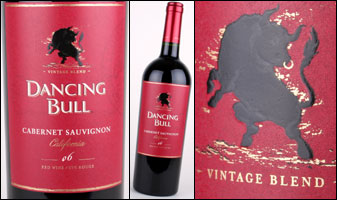
This is a nice Cabernet Sauvignon for 12 bucks. It has good intensity and concentration. There’s a good bit of dark chocolate on the nose, along with blackberry, strawberry and leather. There’s a touch of smoke too. It’s a little on the fruit-forward side on the palate, so I would only recommend this to those who like a lot of fruit in their Cabernet. Big blackberry, plum and strawberry flavors. It could use a touch more acid, but I wouldn’t call it flabby. It has a touch of spice to it too. The finish is medium in length and enjoyable.
I would classify this as a nice Cabernet for your cook out. The dark fruit flavors will go will with burgers or grilled meats.
Wine: Dancing Bull Cabernet Sauvignon
Variety: Cabernet Sauvignon
Vintage: 2006
Alcohol: 13.5%
Rating: 86
Price: $12.00
Find Dancing Bull Cabernet Sauvignon with Snooth
Disclosure: This wine was received as a sample.
It has been a while since I’ve reviewed a Petite Sirah. If fact, it’s been way too long and as I tasted this wine, I was reminded of how much I love Petite Sirah. The rich flavors, deep color and silky feel are incredible. And who better to revisit this variety with than Concannon. After all, they were the first winery to varietally label Petite Sirah in the US back in 1961.
The name on this particular release from Concannon, “Conservancy,” is a nod to the efforts the winery has made to protect their vineyards from urban sprawl. In 1996, Concannon was the first Livermore Valley vineyard to place its land into a permanent conservation easement. Other vineyards have since followed suit to ensure that urbanization doesn’t threaten Livermore Valley as a wine producing region.

This wine has the inky, purple color with, blood red highlights at the edges, that make Petite Sirah fun to gaze into—for me, anyway. Pronounced toasted oak and cherry aromas invitingly greet your nose to this wine. It’s so toasted, that it’s almost smoky. The alcohol aromas also come through a tiny bit harsh and that is my only complaint (and it’s really a minor complaint). Robust black cherry flavors pop on the palate, followed by plum and chocolate covered strawberry in the mid-palate. Silky tannins give a nice mouthfeel to the wine. It finishes with crisp, acidic cherry and plum flavors.
This is a beautiful wine and an outstanding bargain at $15.
Wine: Concannon Conservancy Petite Sirah
Variety: Petite Sirah
Vintage: 2007
Alcohol: 13.5%
Rating: 87
Price Paid: $15.00
Find Concannon Conservancy Petite Sirah with Snooth
Disclosure: This wine was received as a sample.
Over the past few weeks we’ve been focused on Zinfandel and it’s finally time to do the wrap up. The majority of these Zins are from California, but one Italian Primitivo is thrown into the mix just for fun, and that’s the only one that came in with a price under ten bucks.
The classic pairing for Zinfandel is barbecue, but these will also go well with other grilled meats and strong cheeses. Pizza or pasta could also be a possible match for Zinfandel, but don’t bother with lighter foods.
Top Zinfandel Pick
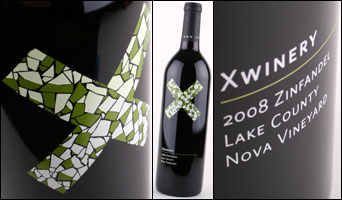
Our favorite in this Zinfandel Roundup is the X Winery Lake County Nova Vineyard Zinfandel. This has some classic Zinfandel cola characteristics and a whole lot more. Luscious berry flavors abound on the palate, entwined with spicy white pepper notes. The mouth feel is pure velvet magic. This is an awesome Zinfandel!
Best Bargain Zinfandel
In this round-up I would not say there was an uber-bargain priced Zinfandel. But then, I should reiterate the point that we didn’t taste many that were under $10. Perhaps we’re getting too snobbish for our own good. But when it comes to quality-to-price ratio (QPR), it’s actually a tie between the Four Vines – Old Vine Cuveé and the Francis Ford Coppola – Director’s Cut.
The Four Vines is full of red fruit flavors and black pepper. It’s a bright and lively Zinfandel with vibrant acidity. The Francis Ford Coppola Director’s Cut also has great acidity, but is more of a dark fruit Zinfandel. It shows some blackberry, chocolate and complex spices. Both are tasty. But truth be told, I wouldn’t turn down any of these ten Zins:
This isn’t the first time we’ve reviewed the Edmeades Mendicino County Zinfandel. In fact, the 2006 vintage of this wine was the top pick, earning a solid 92 points, the last time we did a big series on Zinfandel. Today, we’re checking out the 2007 vintage.
Edmeades only produces Zinfandel, and has been doing so since 1963. The winery is part of the Jackson family “wine empire,” which includes other wineries such as Kendall-Jackson, Murphy-Goode, La Crema, Freemark Abbey and several other brands.
This is truly one brand that I’ve grown to trust for really good Zinfandel. However, this isn’t a ten dollar bargain bottle… you’re going to pay upwards of $20 to enjoy some Edmeades. I was lucky to find this bottle for $18.
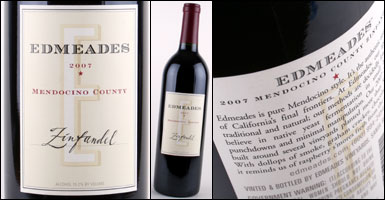
Occasionally I pick up on apple-like characteristics in red wines, and this is one of those times. There’s a very distinctive red apple peel aroma from this wine, along with blackberry, caramel and black pepper. On the palate, it’s blackberry, cherry, and the apple peel comes through here too. It also has a nice, but not overpowering, spiciness and a touch of smoke. The finish is exceptionally long and reminiscent of blackberry jam on toast. Overall, it’s a very nice Zinfandel.
Wine: Edmeades Mendocino County Zinfandel
Variety: Zinfandel
Vintage: 2007
Alcohol: 15.2%
Rating: 89
Price Paid: $18.00
Find Edmeades Mendocino County Zinfandel with Snooth
Disclosure: This wine was received as a sample.
The vast majority of Zinfandel that I come across is from California, but to mix things up I thought I’d include a review of an Italian Zinfandel. If you look at wines in the Italian section of your favorite wine shop you may not even know that some of the wines you’re looking at are Zinfandel. That’s because in Italy it’s often referred to as Primitivo.
Stylistically, Primitivo is quite different from California Zinfandel. While those from California tend to be big, powerful and fruity, Primitivo typically has lower alcohol levels and more earthy characteristics. This one from Villa Brondello is a great example of that, and an outstanding bargain to boot.
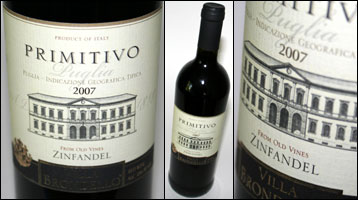
The nose has a dusty nature to it. I would describe the bouquet as cherry, dusty tomato, sage and coffee. The palate is soft, compared to California Zinfandel. It’s full of rich tannins, dark cherry, blackberry, oak and cocoa. It is not at all jammy (something you might expect from a domestic Zinfandel). It’s fairly well balanced and very approachable. In my opinion, it could use a little less oak, but it’s still good.
Wine: Villa Brondello Primitivo
Variety: Zinfandel
Vintage: 2007
Alcohol: 13%
Rating: 85
Price: $8.00
Find Villa Brondello Primitivo with Snooth
What’s better than a tasty Zinfandel on a spring day? A tasty Zinfandel for which half the profits go to charity.
And what could be a more enjoyable way to give to charity than by drinking wine? Well, I really can’t think of one.
Agent for Change isn’t just a clever name for a wine, but it’s a clever name with a meaning behind it. This wine really is an “agent for change” as 50% of the profits go to non-profit organizations, such as community-based organizations that deliver healthcare to uninsured and under-insured workers in the wine industry. This Zinfandel is one of three different wines released under the Agent for Change name since the brand was established in 2008. Agent for Change was created in partnership with Big Hammer Wines and are available for sale online through them.
I like the idea of buying products that give significantly to charities, but hey… the wine still needs to be good. Right? Well, this Paso Robles Zinfandel doesn’t disappoint.
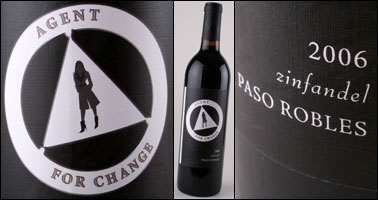
Cola and toasted oak are the first aromas that stand out to me. It’s oaky on the nose and on the palate. There are also some dark berry aromas. On the palate, the fruit comes through more prominently, but it’s still soft — in a way that I like. Sometimes Zinfandel can be too jammy, but this one isn’t jammy at all. It’s very approachable. It has a nice mouthfeel and a little bit of spice on the finish. It’s a pleasant Zinfandel.
Wine: Agent for Change Zinfandel
Variety: Zinfandel
Vintage: 2006
Alcohol: 13.5%
Rating: 86
Price: $15.00
Disclosure: This wine was received as a sample.
One way that you can save some scratch on your wine is to buy wine produced in regions other than the really popular ones. When most people think of California wine, they think of Napa or Sonoma. But in most cases you’ll end up paying a premium for wines from those regions. Montevina Winery is in Amador County, California—a perfectly good wine growing region, but a little less know than some other parts of California. Amador County lies in the Sierra Nevada, about 45 miles southeast of Sacramento.
Montevina has been producing wine since 1970 and is best known for their Zinfandel, but they also produce some other varieties. Some of the varieties they grow are rather unique for California, like Barbera—a wine I don’t see much of other than that from Piedmont, Italy. I haven’t tasted the Montevina Barbera yet, but I hope to do so one day. However, we’re not here to talk about Barbera today, we’re here for Zinfandel!
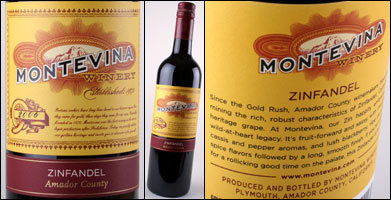
I like the nose on this wine, although it skews toward the “high notes” on my scent/sound scale. For the record, I often think of aromas in wine like notes and tones in music. It has a sharp clove aroma, which I find interesting. I also find black pepper, dusty blackberry and new leather. There is a ton of fresh fruit flavor on the palate, mostly ripe plum but also some blackberry. This is only a wine for fans of a “fruit forward” style Zinfandel. It’s so fruity, it’s almost sweet. The finish brings a hint of strawberry, followed by oak. I wouldn’t call this an elegant wine, but I still enjoyed sipping on it.
Wine: Montevina Zinfandel
Variety: Zinfandel
Vintage: 2006
Alcohol: 13.5%
Rating: 84
Price: $11.99
Disclosure: This wine was received as a sample.

 Prev
Prev