In the wine world, everything is relative. Case in point, I present to you Jacob’s Creek 2008 Cabernet Sauvignon Reserve. The term “Reserve” is typically utilized for the best juice of the vintage, often seeing a little more time in the winemaker’s best oak. But one winemaker’s best juice is another winemaker’s jug wine. And not all oak barrels are made equal. So while a winery may use the term “Reserve” to describe their best effort for the vintage, it simply may not measure up to another winery’s table wine. So how does Jacob’s Creek measure up? Well, the answer is relative.
When you’re presented with a wine with deep rich color, and heavy oak with strong tight tannins, it’s easy to get impressed with the wine’s “big-ness”. But if you spend some time really concentrating on the depth of fruit, integration of tannins, and overall complexities in what the wine is offering, you can pick out the posers from the real-deals.
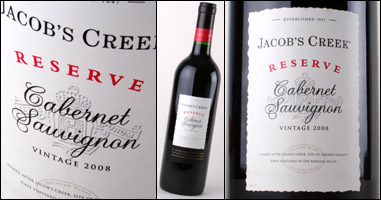
The Jacob’s Creek Reserve certainly fits the aforementioned description, but is it a poser or the real-deal? On the nose, it initially serves up blueberry and hints of tropical notes, turning to cassis and then pine and cedar. The color is a deeply opaque violet. On the palate there’s more cassis and cedar, and the wine finishes with tight, and slightly bitter tannins. As the wine begins to open the tannins subside slightly and become better integrated with the fruit. But the wine continues to remain a little tight.
So what’s the verdict? Is this reserve cab a poser, or the real-deal? Well in this price range, I’d say the Jacob’s Creek Reserve is certainly no poser. But compared to other well-crafted, well-integrated higher end wines, the Jacob’s Creek can’t be called the real-deal. But if you’re looking for a big wine at a value price, check out this wine. Again, it’s all relative.
Salute!
Wine: Jacob’s Creek Reserve
Variety: Cabernet Sauvignon
Vintage: 2008
Alcohol: 14.5%
Rating: 87
Price: $12.99
Find Jacob’s Creek Reserve Cabernet Sauvignon with Snooth
Disclosure: This wine was received as a sample.
Last night we reviewed a boxed wine, so let’s crack into another box tonight. This one is produced by Bota Box, a brand that I’ve never reviewed on this site before. However, I have given their old vine zinfandel kudos in my column in Mutineer Magazine in the past.
There’s nothing too fancy about the Bota Box packaging, it’s a basic bag-in-box package. But I did notice that when opening this box, it was much easier than most boxed wines. If you’ve ever opened a boxed wine, you’re probably familiar with the perforated section of cardboard that you need to open to get the spigot out. Well, on most boxed wines, it’s nearly impossible to tear that section by hand, so you end up getting a knife and hoping that you don’t puncture the bag — or puncture yourself! But that wasn’t an issue at all with Bota Box.
The box itself is made of 100% post-consumer recycled paper, but that’s not all there is for you tree huggers to get excited about. The packaging weighs much less than bottles, which means less fuel is used in shipping it. If you’re looking for a wine with a low carbon footprint, this may be your pick.
OK, enough rambling about the packaging and let’s get to the juice. After all, who wants to buy a wine just for the box? Although I do know many people who’ve bought wine just because of the cool bottle it came in (points at self in embarrassment).

One thing I didn’t notice until I took a second look at the label is that this wine is from Lodi, California. That’s right folks, California has seen the success Argentina has had with malbec and they want a piece of that action. The last time I was out in California wine country I came across several vineyards that were experimenting with malbec and this is just one example.
This malbec is a dark red color, bordering on purple but it’s not as purple as many Argentine malbecs I’ve tasted. Deep mocha and blackberry aromas erupt from the nose of this wine, with additional layers of blueberry and spice. The palate is super-fruity — perhaps too fruit forward for some consumers but it’s good if you like that style. Plum and blackberry flavors hit the front of the palate with mocha coming in mid-palate. It’s a touch bitter on the finish, but not so much that it’s a turn off. The tannins are soft and the acidity is adequate. It’s a good malbec. And for the price, I’d say it’s a great malbec.
Wine: Bota Box
Variety: Malbec
Vintage: 2009
Alcohol: 13.5%
Rating: 85
Price: $19.99 for 3 liters (equivalent to 4 bottles)
Find Bota Box Malbec with Snooth
Disclosure: This wine was received as a sample.
One the heels of the red blend review we did yesterday, tonight we’re checking out another red blend called Seven. This one comes from Spain and is produced by Bodegas Osborne, one of the oldest wine producers in Spain dating back to 1772. And today, after all those years, the company is still run by descendants of founder Tomas Osborne Mann.
Seven comes in a three liter bag-in-box package. But it’s not just your average box, it’s an “Octavin” which is an octagon shaped package that looks a little nicer than a square box. It’s also not your average boxed wine juice inside the bag. Skeptics of boxed wine will be pleasantly surprised by this one.
The box holds three liters of wine and is said to keep the wine fresh for up to six weeks after opening. I can attest that I’ve had bag-in-box wine a few weeks after opening it and it has been as good as the first day.
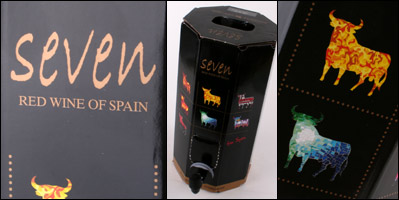
Guess how many grape varieties are in Seven. It should be obvious, and if you guessed seven, you got it right. This wine is a combination of 24% shiraz, 24% cabernet sauvignon, 11% graciano, 11% garnacha, 10% tempranillo, 10% merlot and 10% petite verdot.
The nose of this wine is a nice medley of red and blue fruit, with cherry, blueberry and raspberry aromas, but it doesn’t stop there. It also shows some interesting spice notes, chocolate and a hint of leather. In the mouth it’s lively with cherry and raspberry flavors, which are abundant in fruitiness but don’t have a lot of concentration. In other words, it’s a little watered down — but just a little, it’s not totally thin. The finish is a blend of red fruit, nutmeg and mineral. It’s not bad for a light, fruit-forward wine.
Wine: Seven
Variety: Red Blend
Vintage: 2008
Alcohol: 13.5%
Rating: 84
Price: $21.99 for 3 liters (equivalent to 4 bottles)
Disclosure: This wine was received as a sample.
The wine world is paying close attention to Colchagua Valley. Topographically and geographically, it’s quite similar to Napa in many respects. Many fine producers have, and continue to emerge from this growing region. Recently we had an opportunity to taste an example from Colchagua – Calcu’s 2008 red blend. Calcu (Magician in the native Mapuche language) is a Meritage-style blend consisting of 45% Cabernet Sauvignon, 25% Carmenere, 15% Cabernet Franc, and 15% Petite Verdot.
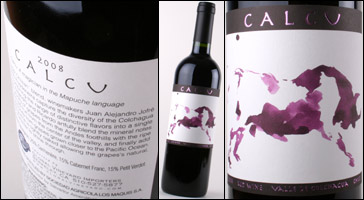
The first thing you notice with Calcu is the color. It’s a beautiful and brilliant ruby, just translucent enough at the edge to give the wine a rich sheen. This is actually a pretty wine that looks delicious. Fresh out of the bottle the nose if very candied with vanilla and some tropical notes. With a little air the nose subsides to cassis and cherry with some char notes weaved throughout. It settles into a very integrated nose.
On the palate, the wine is decently balanced with good fruit and a solid backbone of lush tannins. The tannin levels here offer a really nice mouth feel up until the wine finishes and the aftermath of all that tannic acid unfolds. It doesn’t spoil the experience, but it does seem like a flaw on a very appealing wine. So it’s not the perfect quaffer, but with it’s nice balance of acid, fruit and oak, it’s actually very good with food, particularly proteins like beef and cheese.
So serve some Calcu at your next dinner or cookout. And, impress your friends with your discovery of Colchagua Valley before the secret is completely out.
A Salute!
Wine: Calcu
Variety: Red Blend
Vintage: 2008
Alcohol: 13.5%
Rating: 86
Price: $12.00
Find Calcu Red with Snooth
Disclosure: This wine was received as a sample.
In days past there was a regular monthly occurrence called “Wine Blogging Wednesday” when wine bloggers from around the world would all write about a common theme. There was also a “host” to the event who would write up a summary of all the participants so that you could go to one place to find all the contributions to that theme. It was a fun time of collaboration, community and sharing. I was fortunate enough to participate in a few of these events and I’ve even hosted one. But as time passed, somehow the event fell into obscurity.
My read on the dissolution of Wine Blogging Wednesday is that the organizers just got busy and burned out on organizing it. Although there were still people interested in participating, in fact there was a lot of interest, nobody wanted to “steal” the idea even though the originators had lost energy for it. So, it fizzled. I also theorize that the rise of Twitter and Facebook were part of the fall of WBW since a big part of WBW was the community factor and social media replaced that community activity. But all of that is just speculation.
And so, today Wine Blogging Wednesday returns thanks to our gracious hosts Ryan and Gabriella at Catavino. The theme for this return of WBW is Spanish wines, and Ryan and Gabriella have challenged participants to find something that we’ve never had before.
First, I’ll confess that I didn’t put as much time into preparing for this one as I did in the old days. I used to spend days hunting down something that I thought would be really unique for these challenges. But life has just been busy for me lately and I didn’t have a lot of time to prepare. And while I was tempted to just right a review of a garnacha/tempranillo blend and pretend I didn’t notice the rules of the challenge, I lucked out. When I searched through the wines I had on-hand, I just happened to have a verdejo… and it just so happens that this is the first verdejo that I’ve tasted. That’s one more entry for my Wine Century Club application — which I can’t believe I haven’t finished yet.
Verdejo is a white wine varietal that produces light, fresh wine similar to sauvignon blanc. While most verdejo is grown in the Rueda region in Spain, the Tapeña Verdejo is from the “Tierra de Castilla”, outside of the D.O. system.
The bottle I happed to have is from the 2008 vintage, which you can still find on the market in some locations. But the 2009 has also been released, so you may find a different vintage if you go looking for this.
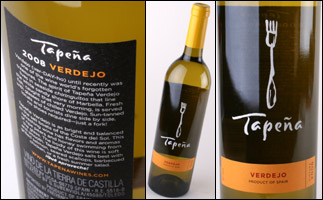
The nose of this wine at first glance is similar to a sauvignon blanc, but with less intensity and not quite as tropical as many SBs. The aromas are like lemon drenched pears and peaches with a wisp of nuttiness weaving through it. The palate has plenty of crisp apple and pear flavors with reasonable concentration and sufficient acidity. It finishes with a touch of lime. This is a really nice, light wine that would go well with a light fish.
If you like sauvignon blanc, this is worth a try for something different.
Wine: Tapeña
Variety: Verdejo
Vintage: 2008
Alcohol: 12.5%
Rating: 86
Price: $10.00
Find Tapeña Verdejo with Snooth
Disclosure: This wine was received as a sample.
Alright, I’m going back to a theme we had going last week… checking out new vintages of wines we’ve previously reviewed. Last year we checked out the 2008 Apothic Red and it was a very interesting wine, so we were glad to be able to revisit it with the 2009 vintage, which we like even more!
This wine is a blend of zinfandel, syrah and merlot, but there’s a strong influence from the winemaking (not just the grapes) that make this a tasty wine. Perhaps that’s why they subtitled this wine “Winemaker’s Blend.”
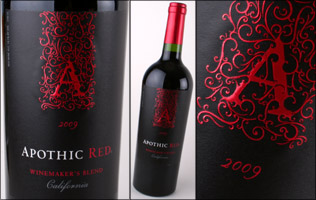
When I first opened the bottle and poured a glass the oak was overpowering on the nose. It gave you a slap in the face with smoky oak and vanilla aromas — and that vanilla is a clue that the wine saw American oak. And although I like these characteristics in a red wine, it was too strong at first. So, I decanted it and let it rest for an hour. When I came back to it, it was a beautiful wine.
It has quite a bit of complexity on the nose, with aromas of nutmeg, vanilla, black cherry, blackberry and dark chocolate. The palate is brimming with ripe fruit flavors like black cherry, plum and a hint of strawberry toward the finish. A touch of vanilla also comes in on the finish. The mouth feel is fantastic, with tannins that are just enough to give a slight velvety texture to the wine and the acid is just enough to balance the sweetness of the fruit.
Although it appeared unbalanced at first, a bit of decanting was all it needed to shine. I expect another six months in the bottle will also help this wine come together. This is a very nice blend that won’t disappoint you.
Wine: Apothic Red Winemaker’s Blend
Variety: Red Blend
Vintage: 2009
Alcohol: 13.1%
Rating: 90
Price: $14.00
Find Apothic Red Winemaker’s Blend with Snooth
Disclosure: This wine was received as a sample.
Pinot Grigio gets a bad wrap. And I think I’m partially to blame. Having run an Italian restaurant with a very comprehensive wine list, I was compelled to offer a pinot grigio (or even two) on our list. But, man it was hard. Pinot grigio is, in all honesty, my least favorite wine on the planet. And this is coming from a wine lover that has an appreciation for all wines, no matter the level of concentration, or complexity. But that’s a very relative statement because even on a wine lover’s list, some wine needs to be last, right? My issue with pinot grigio is based on it’s tendancy to lack balance in acid and fruit, often focused too much on the former. Many other Italian varietals, such as vernaccia di San Giminiano, garganega and cortese di Gavi, all offer good quality AND more importantly, some character. Why did I need to offer our customers a pinot grigio?
But pinot grigio has improved dramatically since the mid-nineties and these days, there are more than a few pinots offering really good quality at compelling price-points. And now, there are numerous domestic offerings, providing equally high quality. So we decided to review some of these domestic offerings and see if they could offer up a quality pinot grigio experience.
I was hoping for some unique wines offering some of the traits that you should expect from quality pinot grigio, such as acidity and crispness, mild apple and pear, with a lingering, finish. We had six entries, and the wines were all tasted blind. Let’s see what we found.
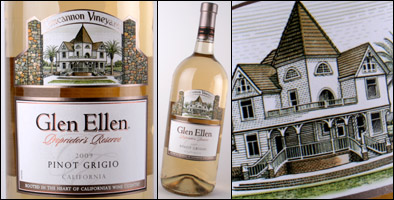
Glen Ellen, Proprietor’s Reserve
This wine actually surprised me. As the wines were revealed I didn’t expect much from the Glen Ellen. But when I matched up my scores with the wines the Glen Ellen actually scored fairly well. None of these wines offered any real intensity, and the Glen Ellen was no exception there, but it did offer up a nice crisp yeasty nose, mild tropical notes, bell pepper and lemon grass. It actually has some interesting dry Riesling qualities. It’s a decent wine, and when you factor in the price, it represents a nice value.
Wine: Glen Ellen, Proprietor’s Reserve
Variety: 100% Pinot Grigio
Vintage: 2009
Alcohol: 12%
Rating: 83
Price: $9.99 for 1.5L
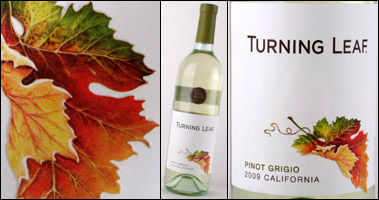
Turning Leaf
I found the Turning Leaf mildly perfumed as well, with pear notes, honey, and a nice acidity. But where the Glen Ellen offered some distinct qualities, the Turning leaf came off rather simple and focused. Again, you have a decent wine here, but at $8.00 a bottle, it’s not quite the value that the Glen Ellen is. I will say that if you like a crisper style of wine, you may prefer the Turning Leaf over the Glen Ellen.
Wine: Turning Leaf
Variety: 75% Pinot Grigio
Vintage: 2009
Alcohol: 12.73%
Rating: 82
Price: $8.00
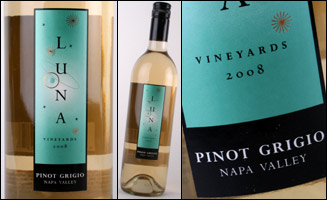
Luna
The Luna was one of the disappointments of the bunch. I’ve had Luna’s wines before, and they usually offer richer interpretations of their respective Italian varietal equivalents. This wine offered a bit more body than the others, but it wasn’t pleasant. I found some mild bitterness in the wine and the fruit was masked. Maybe it was the age, maybe it was the lack of acidity, or maybe it was that this wine ventures a bit too far from the traditional interpretation of Pinot Grigio. Whatever the reason, I’ll pass.
Wine: Luna
Variety: 95% Pinot Grigio, 5 % Chardonnay
Vintage: 2008
Alcohol: 14.1%
Rating: 79
Price: $18.00
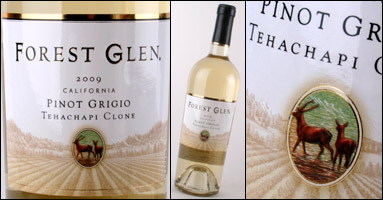
Forest Glen, Tehachapi Clone
The Forest Glen made a decent showing as well, but it finished about mid pack in this group. It offers up some perfumed notes, along with some honey, mineralization and mild acidity. But it had a very mild chemical note that came and went. I didn’t sense anything really wrong with the wine, but I preferred others in this group.
Wine: Forest Glen
Variety: Pinot Grigio
Vintage: 2009
Alcohol: 12.5%
Rating: 81
Price: $18.00
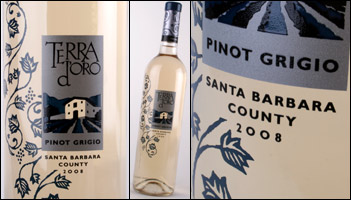
Terra D’Oro
This may have been the biggest disappointment of the bunch. I’ve had Terra D’Oro’s wines before and I’ve enjoyed them. But this wine didn’t really offer anything for me to enjoy. It was very muted, both in the nose, and the palate. It had a yeasty quality, but very mild acidity. It lacked any structure and fell off further in the nose. It could have been a victim of age as well.
Wine: Terra D’Oro
Variety: Pinot Grigio
Vintage: 2008
Alcohol: 12.5%
Rating: 78
Price: $15.99
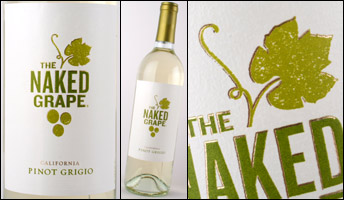
The Naked Grape
Ladies and gentlemen, we have our winner. I actually liked this wine, and of all the wines here, I’d buy this one for myself. It offers a nice balance of acidity, and fruit. On the palate, it offers bell pepper, mild honey and a grassy note. A little more intensity and you’d have a very nice wine.
Wine: The Naked Grape
Variety: Pinot Grigio
Vintage: NV
Alcohol: 12.9%
Rating: 84
Price: $9.00
Find The Naked Grape Pinot Grigio with Snooth
So, overall, not bad, but I came away a bit disappointed. Having tasted so many Italian pinot grigios that are now flirting with outstanding quality, I found the majority of these wines uninspiring.
So if it were my money and I was in the mood for pinot grigio, I’d be checking out The Naked Grape. The wine offered up really nice acidity, indicative of what Italian pinot grigio offers. But the wine also offered up a good balance of fruit. In fact I would probably choose this wine over some average quality Italian pinots. And at this price point, it offers up a fairly good value.
A Salute!
Disclosure: These wines were received as samples.
We tried one of these last week and it was fun, so we’re going to try another. Of course if you missed the first wine pairing challenge, Blackstrap Molasses Shrimp, you can still add your two cents on the best pairing here.
I’ll re-explain the background to this challenge, for those who haven’t seen the first one we did. A friend of mine is The Cheating Gourmet at a website called Man of the House where he’s doing a bunch of recipes with videos on how to make foodie-worthy dishes with minimal effort. We wanted to collaborate somehow between what I’m doing here and what he’s doing but realized that most of the recipes he’s done so far aren’t really ones that I would typically serve with wine. So, I thought it would be fun to do a wine pairing challenge to see how all of you would pair wine with his dishes.
And to be transparent, I’m trying to get more people to check out his stuff. He just started doing these videos a month or so ago and I think he’s doing an outstanding job with them. So, please check them out.
On with the challenge. What we want you to do is check out the video/recipe for the Ultimate Omelette and then tell us your recommendation for a wine pairing in the comments section.
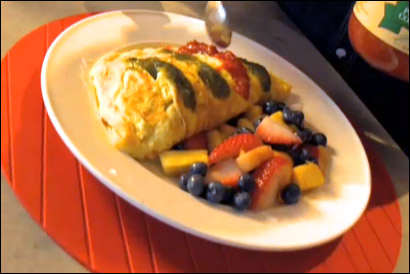
Typically I’m not a wine with breakfast kind of guy, but occasionally I will have an omelette with other meals. So pairing a wine with an omelette isn’t that far fetched. In fact, in my opinion this pairing is not as challenging as the first one we did, but it still could go in a number of directions. Of course one variable is what you put in the omelette, since Todd does give you some options. If your pairing is dependent on what you’re putting in the omelette, please be sure to specify that. Otherwise, just make a recommendation based on the way Todd prepared the recipe.
Game on!
Since the last review we did was an updated vintage of a wine we’d previously reviewed, I thought we would continue that trend this week with another. Not too long ago we reviewed the 2009 Peñalolen Sauvignon Blanc and we’re already checking out the 2010 vintage of this wine.
How can that be? A 2010 Sauvignon Blanc on the market in early February of 2011. Well, remember that this one is from Chile and their seasons are opposite of ours. Therefore the grapes for this wine were actually harvested in spring of 2010 rather than fall. Or was it fall in spring? … I mean is April called “fall” in Chile? Now that I think of it, I don’t think I’ve ever been south of the equator to find that out. I need to plan a trip to experience this.
Anyway, getting back to reviewing this wine. The 2009 version of this wine was loaded with citrus and that continues in the 2010 vintage. But the 2009 also showed an interesting vegetal component on the nose that takes on more of a classic “cut grass” expression in the 2010.
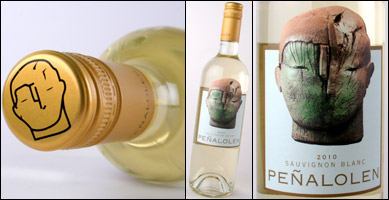
Grapefruit, mineral, lemon and cut grass aromas give this wine the nose of a classic Casablanca Valley sauvignon blanc. The palate is loaded with citrus flavors, like grapefruit and lime. There’s also some melon flavor on the palate. The acidity is just right. The finish is medium-long and teaming with citrus and mineral flavors.
If you’re looking to explore Chilean Sauvignon Blanc, I highly recommend checking out those from Casablanca Valley. And this Peñalolen is a nice example of what you can expect from this region. To be clear, I’m not ruling out SB from other regions of Chile, but Casablanca Valley is pretty consistent and reliable for this varietal.
Wine: Peñalolen
Variety: Sauvignon Blanc
Vintage: 2010
Alcohol: 12.5%
Rating: 87
Price: $12.00
Find Peñalolen Sauvignon Blanc with Snooth
Disclosure: This wine was received as a sample.
About a year ago we reviewed the 2007 Tercos Bonarda and now we’re checking out the 2008 vintage of this wine.
If you’re not familiar with bonarda, you should introduce yourself. It’s one of the most grown varieties in Argentina. It’s an interesting wine with good complexity and medium structure. This variety is also known as charbono in some regions, such as California.
As I mentioned in review of the 2007, Bonarda can take on a variety of characteristics depending on the vineyard and the vinification. And comparing my notes from last year with this one even shows some evolution in this wine, but some similarities at the same time. Both vintages show a smoky/grilled aroma and blackberry characteristics. But I think the 2008 shows a bit more fruit than the previous vintage. In terms of overall quality, I think the 2008 is on par with the 2007, it has a slightly different expression.

The nose has good intensity, with powerful aromas of smoky/grilled meat, soy sauce, blackberry and plum. The palate has a nice mouth feel, with the tannin and acidity levels being just about ideal. The flavors are slightly jammy with concentrated cherry and blackberry flavors. The finish is nice and long, with a slight apple skin flavor mingling with the berry flavors. This is a young and fruity wine, but not an over-the-top fruit bomb. It’s nice.
Wine: Tercos
Variety: Bonarda
Vintage: 2008
Alcohol: 13.9%
Rating: 86
Price: $12.00
Find Tercos Bonarda with Snooth
Disclosure: This wine was received as a sample.

 Prev
Prev