We’re trying something a little different tonight. I have a wine pairing challenge for you.
A friend and colleague of mine, Todd Jessee, is the Cheating Gourmet at a website called Man of the House. The idea of the Cheating Gourmet is to take what may seem like complicated recipes and find shortcuts, or cheats as he calls them, to turn them into a simple recipes. I love what he’s doing with it and as we were talking about it he suggested we try to do something to connect my wine stuff with some of his recipes. But when I looked at the recipes he’s done so far, most of them aren’t necessarily foods I would pair with wine.
So, I thought it would be fun to turn it into a pairing challenge. I’m going to try a few of these over the next few weeks, so put on your thinking caps and give me your best pairing.
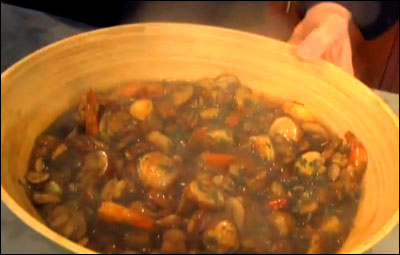
The first one up is Blackstrap Molasses Shrimp. At first glance this may seem like an easy pairing. It’s shellfish, right? But give it a little more thought. Blackstrap molasses is going to add a sweet layer to this dish that might have you reconsidering your goto wine for shrimp. And there’s a couple other ingredients in the recipe too that may lead you in another direction.
I have an idea of how I’d pair it, but I’m going to hold back for now because I want to hear what you think. So check out the recipe and then let me know what you think the perfect wine pairing is.
This is the second time we’ve reviewed Clif’s The Climber Red Blend. The 2006 version we reviewed was comprised of the same 5 varietals (zinfandel, cabernet sauvignon, syrah, merlot and petite syrah); however, in similar fashion to how Clif’s winemakers have managed The Climber white, they’ve made some significant changes to the percentages. In the 2009, Zinfandel dominates the blend at 63%, followed by cab and syrah at 21% and 12 %, respectively. Petite syrah and merlot make up the difference at 2% each.
Consequently the characteristics of the wine have changed, although only slightly. On the nose the wine hints at the rich blueberry and black fruit the wine offers on the palate. But the wine also offers up mild aromas of licorice, gingerbread and coffee. On the palate, the wine is a bit jammy, with blueberry dominating the fruit profile. There are cedary notes and pepper that lead to a finish that is ever-so-slightly hot (alcoholic). But it doesn’t compromise the wine. Actually, I think it adds some much needed character and distinction.
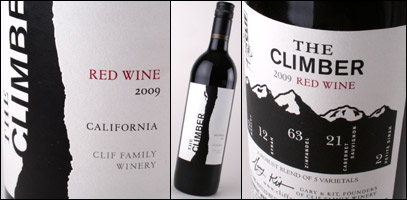
Overall, this is a well-made wine that offers a lot of forward fruit for the money. But the wine is a bit deficient in structure and acid, which leaves it a bit out of balance. Clif’s white wine offering does a better job of maintaining that balance. Just a hint more of oak or acid would make for a more memorable experience. I have confidence that Clif’s winemaker’s will eventually find that balance. Keep your eye on this one.
Wine: Clif – The Climber
Variety: Zinfandel blend
Vintage: 2009
Alcohol: 14.1%
Rating: 87
Price: $14.00
Find Clif – The Climber Zinfandel Blend with Snooth
Disclosure: This wine was received as a sample.
One of the highlights of my trip to Austria this past fall was the grüner veltliner (pronounced GROO-nah velt-LEE-nah, with your best Germanic accent). We traveled up the Danube river one day and tasted grüner veltliner from the Wachau and Wagram regions, which are beautiful areas with terraced vineyards along the shores of the Danube. There wasn’t a single wine on that trip that I would turn down, they were all quite nice — of course, some were more enjoyable than others. But one thing that disappoints me is that many of those wines don’t have distribution in the US. So, rather than write about a bunch of wines you can’t find here, I’m glad to be reviewing a couple you can.
Both of these wines are produced by Laurenz V. and the grapes come primarily from the Kamptal and Kremstal regions, which lie between Wachau and Wagram. The wines from these regions are influence by both the warm air from the Danube and cooler airs from the north, creating full ripeness from the warmth and crisp acidity from the cooler airs. The wines of this region are also strongly influenced by the minerals in the soils, which add subtle nuances to the characteristics of the wine.
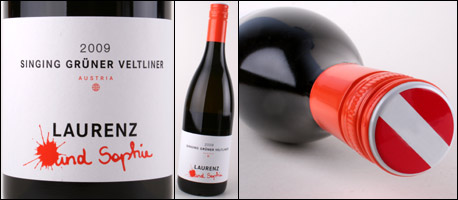
Laurenz und Sophie Singing Grüner Veltliner
The grapes in the Singing Grüner Veltliner come mostly from Kremstal, with some coming from Weinviertel to the northeast of Kremstal. It is 100% grüner veltliner.
Mineral is the most prominent feature on the nose of this wine. It also shows some melon, some lemon and a hint of yeast. The palate has an outstanding, crisp acidity with delicate citrus and melon flavors. And did I mention the acidity? Well, it’s worth mentioning again. It’s just right — intense enough to give the wine a crisp characteristic, but not so much that it makes you pucker. It finishes with mineral and lemon. This is a simple and elegant wine.
It’s not only a reasonably priced introduction to grüner veltliner but it’s also good enough to make a regular appearance at the dinner table. It’s a very nice wine.
Wine: Laurenz und Sophie Singing Grüner Veltliner
Variety: Grüner veltliner
Vintage: 2009
Alcohol: 12%
Rating: 89
Price: $15.00
Find Laurenz und Sophie Singing Grüner Veltliner with Snooth
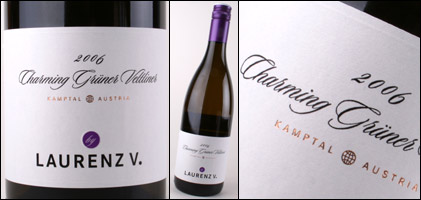
Laurenz V. Charming Grüner Veltliner
The Charming Grüner Veltliner is 100% grüner veltliner from the Kamptal region. It’s a more expensive than the Singing Grüner Veltliner, and quite honestly more expensive than what we typically cover at Cheap Wine Ratings. But I thought it would make a good comparison, so here goes.
This is a really interesting grüner veltliner to me. The nose shows honey, melon and some herbal / floral characteristics that really give it character. The intensity of the aromas is good too. A lot of grüner veltliner that I’ve tasted is very subtle on the nose, but this has good intensity without losing elegance. The palate begins with ripe apple flavors, followed crisp acidity with herbal and spicy notes on the mid-palate. It finishes with a salted apple flavor. Although it may be a little pricey for the budget-minded, this is an excellent wine.
Wine: Laurenz V. Charming Grüner Veltliner
Variety: Grüner veltliner
Vintage: 2006
Alcohol: 13%
Rating: 91
Price: $27.00
Find Laurenz V. Charming Grüner Veltliner with Snooth
Disclosure: These wines were received as samples.
This is an intriguing wine. It’s classified as a Sauvignon Blanc, and at 80% of the blend, that is technically accurate. But Clif’s winemakers, Sarah Gott and Bruce Regalia blend in 4 additional varietals to create a wine that offers layers, complexity, and distinction. Those expecting typical sauvignon blanc characteristics won’t be disappointed, but The Climber offers some not-so-typical characteristics that distinguish this wine from others in it’s category.
CheapWineRatings.com had great things to say about the 2008 Climber Sauvignon Blanc, but Clif has adjusted the blend from last year. First the percentage of SB has been reduced down from 88%, and pinot gris replaces chardonnay, while pinot munier replaces chenin blanc. Riesling and Muscat remain in the blend, but their percentages have been adjusted to 5% and 1% respectively. What’s notable is the percentage of pinot gris used in the 2009 vintage – 13%.
We’re not quite sure if Clif will adjust this blend again next year, but we assume they plan on tweaking it for each vintage. What we do know is that this is the second vintage of The Climber white we’ve tasted and reviewed, and we continue to be impressed with Clif’s execution of this wine. It’s also important to mention that Clif claims to source grapes from “sustainable or organic vineyards”. While that’s not necessarily a guarantee that the wines are organic, I’ll assume that factors in to how the blend shapes up.
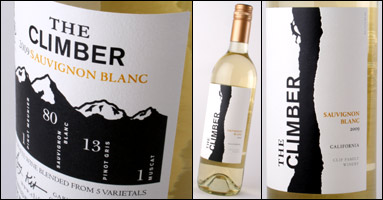
No part of the blend is taken through malolactic fermentation, so the wine retains a nice crispness. I’m particularly impressed with the wine’s complex layers of fruit. You’ll find loads of grapefruit, along with some pineapple, lemon and tangerine. But the unique blend is also responsible for layering on touches of honey, melon and sage. The wine has good acidity, and offers a long finish. Enjoy it with food or enjoy it alone.
A Salute!
Wine: Clif – The Climber
Variety: Sauvignon Blanc blend
Vintage: 2009
Alcohol: 13.7%
Rating: 88
Price: $12.99
Disclosure: This wine was received as a sample.
Over the years I’ve been fortunate enough to have tasted many barrel samples with some really experienced winemakers. With almost every visit I’ve gained some valuable perspective to help me identify what wines are revealing, and more importantly what they have the potential to reveal.
Sampling the Jacob’s Creek brought me back to one tasting in particular. That day I heard the winemaker use a very interesting term to describe his barrel sample. As he dispensed the wine into my glass with the thief, he enthusiastically offered up a prelude to what I was about to experience, with one very interesting caveat. He said his barrel sample was “still a bit angular”. With one eyebrow now standing firmly at attention, I replied “angular?” He said, “yea, angular”. He went on: “sometimes young wines, particularly ones still in the barrel, offer up a lot of complex fruit and nuance, but the elements are not integrated yet”. I knew exactly what he meant, but I had never heard wine described as having any rectilinear qualities.

So as I was tasting the Jacob’s Creek and determining what the wine was offering, the term angular came right back into memory. On the nose the wine is more integrated, initially offering hints of banana and other tropical notes, turning to rich plum and ripe cherry. On the palate, the wine is quite jammy, offering loads of plum and cherry. There is some mild pepper and spice, but I was a little disappointed that these typical shiraz traits were not as prominent in the Jacob’s Creek.
But what had me comparing this wine to other young barrel samples was the way the wine offered up it’s flavor nuances. The wine shows it’s fruit in chunks, and then offers up other details in not so subtle ways. This wine hasn’t integrated yet. A mature, well integrated wine is a lot like a well-conducted orchestra. No one musician or instrument stands out. You just hear beautiful music. It would be fair to expect these traits right out of the barrel, but not after a few years in the bottle. Which makes me wonder what a little more time will do for this wine.
Now, all that being said, I still rated this wine a very respectable 85. There is some very potent fruit, that is currently overwhelming any spice or pepper. I would actually suggest laying this wine down for maybe 6 months to a year. It’s not built to age over the long haul, but I think it would benefit from just a little bit more time. Time for the conductor to do his thing.
A Salute!
Wine: Jacobs’ Creek
Variety: Shiraz
Vintage: 2008
Alcohol: 14%
Rating: 85
Price: $12.99
Find Jacob’s Creek Shiraz with Snooth
Disclosure: This wine was received as a sample.
Although the label of this wine says that it’s a nerello mascalese, that’s not the only grape that’s in here. There’s also prosecco in this wine and I really think of it as a rosé prosecco because nerello mascalese is primarily used for color. The nerello mascalese grapes in this wine come from Sambuca, Sicily while the prosecco comes from the Veneto region in northern Italy.
To be honest, I don’t taste a lot of rosé wines. It’s not that I’m too manly to drink pink, in fact I really like a good rosé every now and then. It’s just that there are so many options when it comes to wine that rosé often doesn’t make it to the top of that list. But still, I was excited to try this wine.
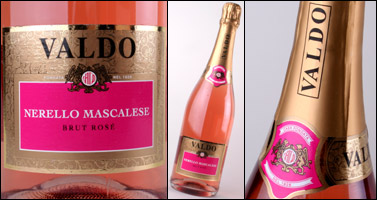
The nose is pretty tight, not giving much intensity to the aromas. But there is some apple and a slight floral frangrance to it. The palate also suffers from some over-subtlety. It offers soft apple and pear flavors with a bit of yeast and salt on the finish. There aren’t any off flavors, so I wouldn’t say it’s a bad wine it’s just that it’s such a subtle wine that it doesn’t have much wow effect. If you prefer a more delicate bubbly, you may enjoy this one. But for me, it was just “meh.”
Wine: Valdo Nerello Mascalese
Variety: Nerello Mascalese & Prosecco
Vintage: Non-vintage
Alcohol: 12%
Rating: 83
Price: $13.00
Find Valdo Nerello Mascalese with Snooth
Disclosure: This wine was received as a sample.
Tonight we’re checking out an inexpensive, yet tasty, prosecco from Villa Sandi. When I hear a name like Villa Sandi, I often assume that it’s just some name given to the wine that the producers thought would sound elegant. But in this case, there is a real villa where the company is headquartered, and it dates back to 1622. By looking at pictures of it, it’s quite impressive and looks like a fabulous place to visit. An image of it also made its way onto the labels of their wines.
Like many wine producers, Villa Sandi produces a wide selection of different wines. In the case of Villa Sandi, they produce both still and sparkling wines – including a number of different proseccos. The Il Fresco is their entry-level prosecco.
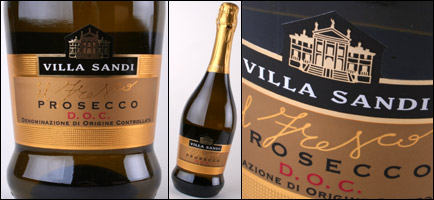
This is a beautifully vibrant prosecco on the nose, with well balanced aromas of yeast, apple and mineral. The palate is equally well-ballanced with apple, citrus, melon and mineral. The acidity is perfect. It finishes very clean – no lingering sweet flavors, but just a bit of citrus and mineral. This is a good prosecco, and for the price it’s outstanding!
Wine: Villa Sandi Il Fresco Prosecco
Variety: Prosecco
Vintage: Non-vintage
Alcohol: 11%
Rating: 87
Price: $12.99
Find Villa Sandi Il Fresco Prosecco with Snooth
Disclosure: This wine was received as a sample.
Years ago, I turned my wife on to sauvignon blanc from New Zealand. It’s now her white wine of choice. In fact, when white wine ends up on the grocery list there usually isn’t any second-guessing. So tonight as I was in the process of making dinner, my wife said she was up for a glass of wine. So I checked the fridge, and then the cellar, and sure enough, we were fresh out of SB. So I decided to improvise. I took the opportunity to review one of the white wines we recently received – the 2009 Martín Códax albariño. I figured I’d at least get a review in, but maybe, just maybe, broaden my wife’s white wine horizons. So I poured us both a glass, and went back to getting dinner ready.
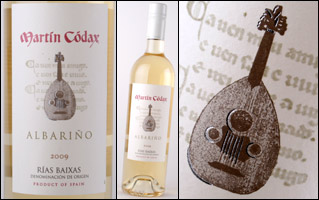
Martin Códax produces this albariño from fruit grown in the Rías Baixas region in Northwest Spain. Because the region gets an abundance of rain, a pergola system is used to keep the vines high and dry. Winemaker Katia Alvarez allows the grapes to ferment in stainless steel for 3 weeks. Additionally, 40% of the juice undergoes malolactic fermentation to, as the winemaker’s notes suggest, “increase flavor complexity without sacrificing acid freshness”. On the nose, the wine offers up intense bell pepper, pear and honey. On the palate, the wine is surprisingly balanced offering good acidity, crispness and well integrated tropical fruit. The finish is also nice, but I’d prefer a bit more intensity.
Overall, this Martín Códax is a good example of the richness and intensity that albariño offers. Although it’s not exceptional, at this price point, it does represent a good value. If you haven’t tried albariño before, this is a great example with which to discover the varietal. Just ask my wife. I think albariño just made it on her grocery list.
A Salute!
Wine: Martín Códax
Variety: 100% Albariño
Vintage: 2009
Alcohol: 12.8%
Rating: 85
Price: $15
Find Martín Códax Albariño with Snooth
Disclosure: This wine was received as a sample.
If you haven’t sampled an Argentine malbec recently, you’re really missing out on a unique wine experience. It shouldn’t be any surprise that a country that produces so much juice – Argentina currently ranks 5th in global wine production – should be able to produce high quality wines across every price range. But the quality of Argentina wines has only been a recent phenomenon, due in large part to their increased emphasis on exports. They now rank right behind Chile among South American wine exports, and this has had a significant impact on the quality of their wines.
When you think of wine from Argentina, you think first of malbec. Malbec is the most prominent vine in cultivation, and some of the best comes from the Mendoza region. To give you a sense of how important and prominent the Mendoza region is, consider that Mendoza has more acreage under planting then some other prominent wine producing nations like New Zealand and Australia. But quantity doesn’t guarantee quality.
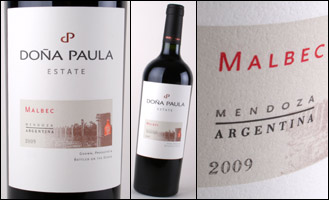
Doña Paula Estate’s 2009 malbec comes with the right credentials. A malbec from Mendoza, it originates from the Lujàn De Cuyo sub-region, the first sub-region in Mendoza to receive appellation status. Doña Paula Estate claims that the majority of their juice comes from more adult vineyards planted at elevation. The first sampling of the wine certainly supported this claim as the wine offers a nice lushness and concentration that I think belies its price.
On the nose, the wine initially offers intense black fruit and hints of vanilla, turning herbaceous with cedar notes and black licorice. On the palate the wine reveals black cherry and plum, lush cedary tannins, along with more herbal notes and more black licorice. I particularly enjoyed how balanced this wine was on the palate, offering a good breadth and depth with a lush, lingering finish. To some the wine may seem a little dry (tannic), but it’s nothing that a hunk of Parmigiano Reggiano can’t mitigate. That’s exactly what I did, and I thoroughly enjoyed the experience. In fact I recommend enjoying this wine with a nice steak topped with Gorgonzola. A little more forward fruit would make this wine an absolute steal.
A Salute!
Wine: Doña Paula Estate
Variety: Malbec
Vintage: 2009
Alcohol: 14%
Rating: 88
Price: $17.00
Find Doña Paula Estate Malbec with Snooth
Disclosure: This wine was received as a sample.
The Russian River Valley isn’t in Russia, it’s an AVA in Sonoma County, west of Healdsburg. This is a cool climate region, due to the influence of the Pacific Ocean, and as such is an outstanding area to produce both pinot noir and chardonnay. This is where the grapes for this Picket Fence pinot noir are grown.
Picket Fence is marketed by 585 Wine Partners, which is a division of the wine giant Bronco Wine Company. But even though they are ultimately part of this large company, Picket Fence wines are created in small lots.
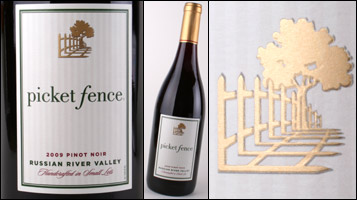
This is a rather interesting pinor noir, with aromas of bacon fat, cola, beets and cherry. The palate has a good dose of cherry flavors along with some raspberry and a touch of spice in the mid-palate. The intensity is reasonable and the acidity is adequate, although a touch more would have helped it. It has a medium-length finish with cherry and black pepper flavors. It’s a decent pinot noir.
Wine: Picket Fence – Russian River Valley
Variety: Pinot Noir
Vintage: 2009
Alcohol: 13%
Rating: 85
Price: $17.99
Find Picket Fence – Russian River Valley Pinot Noir with Snooth
Disclosure: This wine was received as a sample.

 Prev
Prev