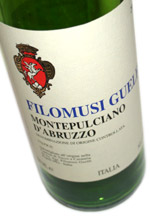
 The Filomusi-Guelfi family in Abruzzo, Italy are the producers of this Montepulciano. The family has been in the region since the 16th century where they have a vineyard of over 9.5 hectares. The majority of the vineyard (78%) is Montepulciano grapes. There is so much history behind the vineyards producing Montepulciano d’Abruzzo that it makes me want to visit the Abruzzo region of Italy. Abruzzo isn’t a common vacation destination, but with everything from 14th century castles to beaches to mountains and national parks it is my kind of place to visit. And of course vast vineyards and an abundance of wine attract me as well.
Perhaps someday I’ll visit Abruzzo. In the mean time, I’ll try to be satisfied by buying the wine that gets exported. This bottle, from Filomusi Guelfi, is exported by Marc De Grazia Selections who represents over 90 small Italian producers.
This is one of the more expensive examples of Montepulciano that I have tried, at $15.99. And while it was good, the quality wasn’t any better than some lower priced bottles I have tried.
The nose is very herbal. I get mostly tea leaf, rhubarb and sour cherry aromas. The palate has a crisp acidity. It’s perhaps a bit too acidic but it’s not overwhelming. The flavors are spicy sour cherry, plum and a hint of caper. The finish is long and dry. There is also a hint of a metallic aftertaste, although it is very subtle. Overall, this is a decent example of varietal characteristics for Montepulciano D’Abruzzi but it’s not exceptional and in my opinion is over priced for the quality.
Wine: Filomusi Guelfi
Varietal: Montepulciano d’Abruzzo
Vintage: 2003
Alcohol: 13.5%
Rating: 85
Price Paid: $15.99
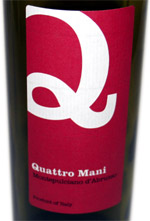 Quattro Mani translates to mean “four hands” which supposedly represents four celebrity Italian winemakers who produce wines from indigenous Italian varietals, such as Montepulciano. I tried to find out who these “celebrities” are but I couldn’t find any info on them. If anyone knows, please post a comment.
I also tried to visit the website of the bottler, Velenosi and that too was unavailable. I’m having no luck on the research behind this bottle. It was imported by Domaine Select in New York, but all they say is that it’s produced by four celebrated Italian winemakers. That doesn’t help me either. Sigh. All I can give you on this is my tasting notes.
Barley and vanilla aromas with blackberry and cherry cola on the palate. This is a very soft, simple and approachable wine filled with a nice abundance of fruit. The finish is fairly long and it is well balanced. It’s a decent and enjoyable pizza or pasta wine, but it’s not extraordinarily elegant.
Wine: Quattro Mani
Varietal: Montepulciano d’Abruzzo
Vintage: 2006
Alcohol: 13%
Rating: 85
Price Paid: $8.99
The 2008 Cincinnati International Wine Festival is just days away, March 28 & 29. I’m looking forward to the event and recommend you check it out if you’re in the area. Even if you’re not from the area, it may be worth the trip as it’s quite an event.
The festival brings over 600 wines from 130 wineries to the Cincinnati Convention Center. This is one big room filled with booth after booth of wineries, each with a few different bottles for you to sample. You hold up your glass (which you’re given on the way in) and point to the bottle you would like to try, taste away and then move on to try another wine. If they’re not too busy you can chat for a while and get the story behind the wines too.
There are three different tasting sessions lasting 2 – 2 1/2 hours and admission costs $55-65 (depending on which session you want). And for an additional $35 you can attend a special high-end wine tasting prior to the general Grand Tasting. Your admission is partially tax deductible too, as the event raises money for local charities. If you plan to attend, I would suggest arranging transportation or booking a room in a downtown hotel. If you don’t spit and dump you’ll be in no condition to drive afterwards.
When you first arrive it’ll seem crowded and people will be a bit annoying as they are all clamoring to “get their money’s worth.” But step back and you’ll see that the majority of people are following the same route and the first booths when you enter the room are the most congested. Start somewhere in the middle and you’ll be much better off. You’ll also find that after an hour or so everyone starts to loosen up and get a lot more friendly. Hmmmm… I wonder why?
There is also a wine competition that is part of the festival so you can track down the medal winners to see what the judges liked the most. I spoke with Dick Fruewald, who co-chairs the competition with Kevin Neal, to get the low down on the competition. Dick has been involved in coordinating the wine festival judging for some 11 years.
All told, 45 judges tasted 417 wines in over 30 varietals. That’s a record number of wines for this competition. Chardonnay and Cabernet Sauvignon were the most popular varietals entered. Pinot Noir and Spanish wines had a higher number of entries than usual, while entries for Merlot and Shiraz were down.
Fruewald recruits the judges, based on a pool of previous judges and recommendations from within the wine trade. And he puts them through a training to test them out and make sure that all judges approach the competition objectively. The judging is done blind in varietal-specific flights and a 20 point system is used.
The scoring system they use is an adaptation of the American Wine Society Evaluation Chart. The adaption is moving 2 points from “appearance” to “overall impression” so that you end up only giving 1 point based on appearance (it’s correct or not) and have 4 points to work with for overall impression. The judges worked in panels of 5 and multiple panels tasted each wine to ensure scoring consistency.
You may be envious of the judges but while it sounds like fun, it’s a lot of work. The judges spent over 6 hours evaluating 50+ wines each. That make for an exhausting day for the judges. If you want to see what it’s like to judge you can do so at the festival. The program this year includes a chart where you can enter your own evaluation of the wines using the same system that the judges used. You can download the chart here ahead of time: Wine Festival Rating Chart A (3MB), Wine Festival Rating Chart B (8MB).
Which wines did the judges pick as winners? Well, the scores are still being tabulated. You’ll have to attend the festival to find out who the winners are.
Montepulciano d’Abruzzo is often thought of as a table wine. Something that is not sophisticated and meant for casual drinking. Because of that fact it is sometimes not given the attention it deserves in production resulting in a less enjoyable product.
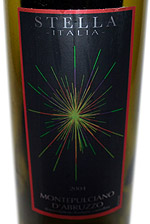 This isn’t the case with all Montepulciano d’Abruzzo. In fact there are some very interesting and enjoyable bottles out there and I hope to highlight them in this series. This was not one of those exceptional bottles.
Low alcohol content and overall lack of concentration make this a mild, subtle wine. Some might call it “flabby.” The dominant feature on the nose is tobacco. It’s hard to find anything beyond that, except maybe a hint of plum. The palate is plums and spice. It has surprising heat for the alcohol level, but it’s an acidic heat. Too acidic in my opinion. The finish is quick. I can’t recommend this one and it only got a 69.
Wine: Stella Italia
Varietal: Montepulciano d’Abruzzo
Vintage: 2004
Alcohol: 12%
Rating: 69
Price Paid: $7.99
The next series of wine I am tasting is an Italian varietal called Montepulciano d’Abruzzo. If you know anything about Italy, you’ve probably guessed that this varietal comes from the Abruzzo region along Italy’s Adriatic coast. And if you know your wine grapes you probably guessed that it’s made from the Montepulciano grape, which is believed to be native to the Abruzzo region.
Montepulciano d’Abruzzo tends to be a soft, fruity and approachable wine. It’s less acidic than other popular Italian wines like Chianti and its tannins are bit sweeter. It is typically a “drink it now” type of wine. While there are some producers who make pricey bottles, there are plenty of value-priced ones available.
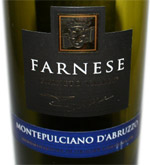 The first wine in this tasting comes from Farnese, a producer that’s been in wine making for over four centuries. Farnese was founded by Princess Marguerite of Austria, daughter of Emperor Carlo the fifth and wife to Prince Octavio Farnese. So you can tell yourself that you’re royalty when you drink this wine… that what I did.
This is a very approachable wine. It’s a little bit old world in it’s overall characteristics, but not too much. It has smoke and cherry on the nose and a touch of vanilla. The palate is a bit grapey. It’s soft, yet interesting with smooth tannins, blackberry, cherry and a hint of black pepper. It is a good example of varietal character at a very good price if you’ve never tried Montepulciano d’Abruzzo. I picked this bottle up for $6.99 and the rating came in at an 86—pretty good, but not extraordinary.
Wine: Farnesse
Varietal: Montepulciano d’Abruzzo
Vintage: 2005
Alcohol: 13%
Rating: 86
Price Paid: $6.99
According to an article published yesterday in the Financial Times, Amazon.com is gearing up to enter the online wine sales market.
Amazon is currently recruiting a Senior Buyer “responsible for the acquisition of massive new product selection, as Specialty Foods is an emerging segment and the Sr. Buyer will work to build out entirely new selection from the ground up.”
This isn’t the first time they’ve tried to get into wine sales. In 1999 they invested $30m in wineshopper.com, which failed a year later. Bad timing?
What does Amazon entering the wine market mean for all of us? We can only speculate, but here are my predictions.
Incredible Selection – Amazon is known for being big… very big. If I need something and I can’t find it locally, I go to Amazon and it’s usually there. I would expect that they will bring the broad selection they provide in other categories to the wine space. After all, the job description does say “massive new product selection.”
Unmatched Online Experience – Everything Amazon does, they do well. Well, almost everything. They are leaders in online usability and information architecture. I can’t wait to use their interface to search for wine.
Free Shipping – They have it for everything else, why not wine? This alone is a barrier that will bring in loads of business for them. I think a lot of people are intrigued by online wine sales—until they see the shipping charges.
Competitive Prices – Let the price wars begin!
Changes in Wine Shipping Laws – Money talks and Amazon has it. State legislators don’t give a hoot about the dull roar of wine consumers who want open shipping to their state. It takes big business to make legislative change happen and Amazon has the clout to get folks to the table. I don’t think this will be an immediate change, but I expect Amazon will chip away at it over the next few years.
Who knows if my predictions will come true, but one thing is for sure: It will be interesting.
It seems as though I’ve been reviewing Cabernet Sauvignon for ages. But to tell the truth, I really don’t mind. Cabernet Sauvignon is one of my favorite varietals. It’s considered the King of wines for a reason. Strong-bodied and elegant with complexity and intensity. Who could not love Cabernet?
All together, I tasted 27 different Cabernets and it’s time to summarize the results. Why not go on to 30 and have an even number? Because I like to be different. If you’re a value wine consumer and Cabernet Sauvignon is your preference, this is the reference for you.
Top Picks
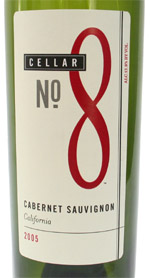 My top pick goes to Cellar No 8 2005 from Asti Winery in California. This wine has good complexity, concentration and varietal character. It’s very well balanced and has abundant ripe fruit but isn’t a fruit bomb. It’s quite smooth and has a perfect touch of spice, earning it a 90 rating.
Unfortunately I haven’t seen it in many shops. In my area (Cincinnati, OH) I’ve only found it at the Fresh Market for $9.99. I’m sure it’s in other shops too, but I haven’t come across it yet.
A close second place goes to a Chilean Cabernet, Root:1 2005. (Interesting that the top 2 picks both have numbers in their names.) Although the ratings for Root:1 and Cellar No 8 both came out to 90, I picked Cellar No 8 as my top choice for two reasons:
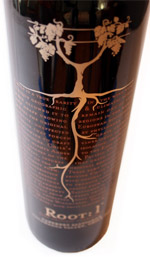
- Root:1 is not quite as approachable as Cellar No 8. It has a very intense bouquet that definitely benefits from decanting, but even then may be too much for some.
- Root:1 costs $1 more and we are about finding the best values at Cheap Wine Ratings.
I do recommend that if you try this one, you only buy one bottle until you know that you like it. Not because I want you to leave more for me on the shelves. Rather, this does seem to be a love it or hate it wine and I am not kidding when I say the nose is intense.
Others Worth Mentioning
There were a number of good wines at reasonable prices. Some of the others I was impressed with:
Hats Off to Chile
For a while during this series I was at risk of needing to change the name of the site to Cheap Chilean Wine Ratings. I found so many good Cabernets from Chile that I kept trying more. Six wines from Chile scored over 85 and I would recommend trying any of them:
Prior to these Cabernet reviews I avoided Chilean wine due to a bad past experience, but Chile has been redeemed and I am now a huge fan of Chilean wine. I look forward to discovering more great gems.
Ultimate Bargain
 If finding the lowest price is your priority, then go with either Fish Eye 2004 from California or San Felipe 2004 from Argentina. Both are $5.99, but you’ll have a much easier time finding the Fish Eye.
As I noted in my original review of Fish Eye, it needs to open up. When I first tasted it I was quite underwhelmed, but I decanted it and let it rest and it opened up to become a very nice wine. Give it a couple hours to open up. If you’re serving for a party, open a few bottles early (before the party starts) and let them breath. Its characteristics are strawberry, vanilla and leather, although the viscosity is a bit low with an alcohol level of only 12.5%. It may not be the best example for true varietal character, but it’s tasty for the price.
The Rating Chart
|
Brand
|
Year
|
Region
|
Rating
|
Price
|
|
Cellar No 8
|
2005
|
California
|
90
|
$9.99
|
|
Root:1
|
2005
|
Chile
|
90
|
$10.99
|
|
Five Rivers
|
2004
|
California
|
89
|
$8.99
|
|
Red Diamond
|
2005
|
Washington State
|
89
|
$8.99
|
|
McManis Family Vineyards
|
2006
|
California
|
89
|
$9.99
|
|
Paringa
|
2005
|
South Australia
|
89
|
$9.99
|
|
Cousiño-Macul
|
2005
|
Chile
|
88
|
$8.99
|
|
Casa Lapostolle
|
2005
|
Chile
|
88
|
$9.99
|
|
Melania Colleccion Especial
|
2004
|
Chile
|
87
|
$8.99
|
|
Ste. Chapelle
|
2001
|
Idaho
|
87
|
$8.99
|
|
Los Vascos
|
2005
|
Chile
|
87
|
$9.98
|
|
San Felipe
|
2004
|
Argentina
|
86
|
$5.99
|
|
Fish Eye
|
2004
|
California
|
86
|
$5.99
|
|
Twin Fin
|
2004
|
California
|
86
|
$6.99
|
|
Carmen
|
2005
|
Chile
|
86
|
$7.99
|
|
Aquinas
|
2004
|
California
|
86
|
$9.99
|
|
Santa Rita 120
|
2005
|
Chile
|
84
|
$6.99
|
|
Marlena
|
2006
|
Argentina
|
84
|
$8.99
|
|
Veramonte
|
2005
|
Chile
|
84
|
$9.99
|
|
Hess Select
|
2004
|
California
|
84
|
$12.97
|
|
Pepperwood Grove
|
2004
|
California
|
83
|
$6.99
|
|
Aquinas
|
2005
|
California
|
83
|
$9.99
|
|
Alice White
|
2006
|
South Eastern Australia
|
82
|
$6.99
|
|
Bear’s Lair
|
2003
|
California
|
79
|
$3.99
|
|
Concannon Central Coast
|
2004
|
California
|
79
|
$8.99
|
|
Trader Joe’s French Market
|
2004
|
France
|
75
|
$4.79
|
|
San Andre’s
|
2005
|
Chile
|
71
|
$3.99
|
I saw an article in the Cincinnati Enquirer today about a new wine restaurant opening in Cincinnati, named Lavomatic. It’s yet another establishment backed by Cincinnati restaurant mogul Jean-Robert de Cavel. The wine bar / restaurant sounds like something worth checking out. I particularly like the fact that they aren’t marking up wine prices as significantly as many restaurants do.
So, it sounds like an interesting place but the article amused me—and perhaps annoyed me. Here are some examples.
“The wine bar and bistro focuses on the future, too, said chef Joanne Drilling. The floors and tables are bamboo, and the bar is made of cork – a nod to sustainability and to vino.” I’m all for environmental conservation and sustainability, but we need to move beyond the bamboo. It’s a nice first step, but give me more. Otherwise, it sounds kind of pretentious to me.
“Ductwork and exposed brick give the narrow, bright restaurant an urban feel.” Did I just step into a time machine and land in 1991?
“We’re really committed to trying to be green as much as possible.” Really? You’re really committed to trying? As much as possible? It sounds like you’re not really committed to being green.
“It must be like the SoHo of the late ’60s early ’70s in New York City,” de Cavel said of Over-the-Rhine. Hmmm… I’ve been in Over-the-Rhine and I’ve never thought to myself that I might be in SoHo. Please don’t try to hoodwink me with that garbage.
Anyway, hooray for another wine bar & restaurant. Boo for an annoying article about it.
EDIT: Since I originally wrote this article I have gone to Lavomatic and I do have to say that it was quite good. They have a nice wine list with plenty of good ‘wine by the glass’ options and the food I had was good. The service was a little slow at times, but not too bad. I didn’t really get the sense that I was in an environmentally friendly oasis, but I wasn’t too surprised by that fact.
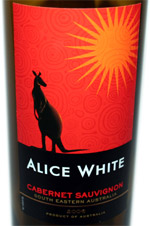 G’day! Today’s wine takes us down under to South Eastern Australia as we check out the 2006 Cabernet Sauvignon from Alice White. We’re also getting down under $7 in price, which is always tricky. Now and then I’ll find an incredible bottle of wine for about $5, but that doesn’t happen very often.
While my mission is to find the gems in low cost wines, I know that not every bottle I try is going to be exceptional. And with this bottle, “banal” is the word that comes to mind when I taste it. It just lacks anything to make it special. It’s drinkable, but nothing to get excited about.
It has vanilla, strawberry and tobacco on the nose, plum and strawberries on the palate. It’s a touch on the overly fruity side for a Cabernet. It does have nice, smooth tannins but they are understated. For $6.99 it’s decent, but you can do better without spending much more. I gave it an 82.
Wine: Alice White
Varietal: Cabernet Sauvignon
Vintage: 2006
Alcohol: 13.5%
Rating: 82
Price Paid: $6.99
Surprise, surprise… I’m off to Chile again to try another Cabernet Sauvignon. This one from the Maipo Valley region in Central Chile, just south of Santiago. The Maipo Valley appellation is rather small in size but well regarded as a wine growing region, particularly for Cabernet Sauvignon. Due to its reputation for producing excellent wine, the vineyards are dense in this region.
This is the second Cabernet I’ve reviewed from this region. The first was from Cousiño Macul and garnered an 88 rating. When I wrote about that one, I touted the age of the Cousiño Macul winery—having been founded in 1856—well, Viña Carmen is even older as it was founded in 1850 and it’s the first vineyard in Chile to cultivate grapes organically.
 Viña Carmen has been showered with accolades lately. They were awarded 2007 Winery of the Year by Wine and Spirits Magazine, and the 2005 vintage of Cabernet Sauvignon was given a “Best Value” status with an 87 rating from Wine Spectator Magazine.
While I enjoyed the 2005 Carmen Cabernet Sauvignon, I didn’t find it quite as exceptional as some other Chilean Cabernets I’ve tried. On the nose it’s cherry, tobacco and currant. It has good concentration on the palate, with cherry, blackberry, and currant. It has very smooth tannins, giving this a nice mouth feel. I gave it an 86 and definitely recommend this wine, particularly at the price $7.99.
Wine: Carmen
Varietal: Cabernet Sauvignon
Vintage: 2005
Alcohol: 13.5%
Rating: 86
Price Paid: $7.99

 Prev
Prev