Enjoy this wine while you can as I don’t expect you’ll be seeing a lot or wine from Belvedere Winery on the shelves. Why? Because the Belvedere Winery is gone. Poof! It’s been replaced by the C. Donatiello Winery. The new winery is backed by Bill Hambrecht, the former owner of Belvedere.
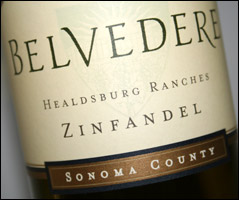 I was lucky enough to find a bottle of the 2001 Belvedere Healdsburg Ranches Zinfandel still sitting on the shelf at a local wine shop and I scooped it up. I’d recommend you too scoop this up if you run across it. It’s a great Sonoma County Zinfandel for $15.
Cedar, blackberry, black cherry and mushroom make up the nose. The palate is slightly jammy with blackberry, black cherry and plum. There is also some mid-palate chocolate and lots of black pepper. The tannins are silky smooth.
Wine: Belvedere Healdsburg Ranches
Varietal: Zinfandel
Vintage: 2001
Alcohol: 14.4%
Rating: 88
Price Paid: $14.98
Find Belvedere Zinfandel with Snooth
Today is Wine Blogging Wednesday number 47 and the theme is the letter “S.” For those who don’t know what Wine Blogging Wednesday is, it’s a monthly event when wine bloggers around the world all write about a common theme. The theme typically revolves around a specific type of wine or wine region, but every now and then it’s just something fun and creative. That’s the case this month, with a theme that brings back memories of Sesame Street.
Every Wine Blogging Wednesday comes with a host who is responsible for providing the round-up of all the contributions. This month’s host is Grape Juice, a Canadian wine blog.
With a theme that is brought to you by the letter “S” things are pretty wide open to do whatever I want. Many wine bloggers will take the strategy of trying to find a wine that includes as many “S”es as possible. They’ll find a wine like Syrah or Sangiovese, produced in Sonoma, Spain, or South Africa, by a producer with an “S” name. I too did a bit of that, but I wanted to find a couple “S”es that others may not focus on. The first one is sneek peek.
Yep, this Wine Blogging Wednesday I am giving you a sneek peek at the next series (there’s another “s”) that will be featured on Cheap Wine Ratings. If you’re a regular reader you know that we’ve been doing a series on California Zinfandel for what seems like forever. Well, that is almost complete and the final summary is fast approaching. Once that is done we’ll be featuring Côtes du Rhône wines and today we’re revealing the first wine in that series.
Saint-Esprit Côtes du Rhône from Delas
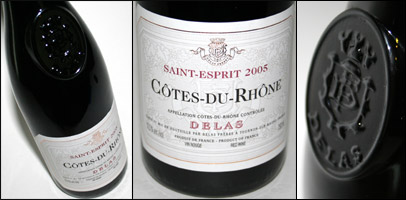
You’ll notice that the name of this wine starts with our theme-letter. The primary grape in this wine is also an “s”, Syrah. That may be all the “S”es you’ll find in this wine, but it’s not all the grapes. The blend is made of 70% Syrah, 20% Grenache, 5% Mourvedre, and 5% Carignan. This is a somewhat different blend than many Côtes du Rhône wines in which Grenache is the primary grape. The dominance of Syrah indicates that this is a Northern wine.
The nose has leather, nutmeg, blackberry and a hint of licorice. But it is mostly leather. It’s like sticking your nose into a brand new leather wallet. I love that smell. The palate is quite chocolaty and also shows blackberry, plum and a little pepper. The tannins are fairly heavy, but not painfully so. It is well balanced with good fruit and crisp acidity.
It scored an 86 and is an enjoyable wine at a decent price of $12.99.
Wine: Delas Saint-Esprit
Varietal: Côtes du Rhône
Vintage: 2005
Alcohol: 13.5%
Rating: 86
Price Paid: $12.99
Find Delas Saint-Esprit with Snooth
Rosenblum Cellars is known for Zinfandel. In fact, they call themselves the “mecca for zinfanatics.” I admire Rosenblum for being bold and taking a somewhat unique approach to wine making.
Similar to many of the producers we’ve reviewed in this Zinfandel series, Rosenblum Cellars produces several different labels of Zinfandel. Some of those labels are produced like micro-wines, isolating grapes from individual lots to feature the unique characteristics from the particular vines and climate in each vineyard. The wine we tasted for this review is the Rosenblum Vintner’s Cuvée, in which grapes are selected from various different vineyards to layer the qualities and characteristics of each. Further, the wine is aged in both French and American oak casks to lend even more complexity.
One thing you may notice about Rosenblum Vintner’s Cuvée is that you won’t find a typical vintage marking on the label. Rather than list the vintage as a calendar year, Rosenblum labels the vintage as a bottling. The vintage we tasted is XXX (the 30th bottling of the Cuvée Zinfandel).
Another thing that I found different, and I really liked, was a removable “memory tab.” On the back label there is a tab that you can remove from the bottle to help you remember the wine’s name the next time you go to the shop. This is simply a brilliant idea as I can’t count the number of times I’ve had a great wine in a restaurant and find myself wishing I had written down the name the next day. Of course this is less of a problem now than it used to be since the advent of camera phones. Now I just snap a picture of the bottle any time I find a new wine that I want to note. At times this has me propping up the bottle next to a candle in a dark restaurant, trying to get enough light (very obnoxious).
Rosenblum Vintner’s Cuvée XXX

Rosenblum Vintner’s Cuvée is the go-to cheap Zinfandel for many budget wine aficionados. It’s a fairly typical inexpensive California Zin and it’s definitely good, but I’m not blown away by it. It is very spicy and very fruit forward, so if that’s your preference this may be a good pick for you.
On the nose it is mostly cedar, black pepper and plum. There is also a subtle cherry cola aroma. The palate is predominantly big blackberry flavor and raisin. There is also some plum and cherry with less intensity than the blackberry. The finish brings a touch of raspberry and a snappy spice giving this wine a nice complexity. The tannins are fine grained. Overall it’s a good value Zin.
Wine: Rosenblum Cellars Vintner’s Cuvée XXX
Varietal: Zinfandel
Vintage: XXX
Alcohol: 14.6%
Rating: 86
Price Paid: $11.99
Find Rosenblum Cellars Vitner’s Cuvée with Snooth
Rabbit Ridge runs a beautiful winery in Paso Robles, California with Mediterranean style architecture and decor. They produce a number of different varieties of wine that sell for affordable prices. They have also recently started producing olive oil, a trend I’ve seen from a few other wine producers as well.
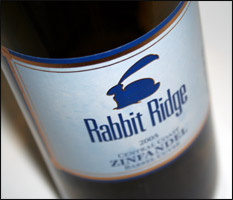 Rabbit Ridge produces a couple different Zinfandels bit we only tried the most affordable one, the Central Coast Barrel Cuvee Zinfandel. Whew, that’s a mouthful!
This is a fairly typical jammy, cheap zinfandel. The nose has a powerful cedar aroma, plus some blackberry jam, tar, a hint of black pepper and some alcohol heat. The alcohol nature on the nose is not surprising with the alcohol level clocking in at 15%.
The palate is abundantly jammy. Seriously, if this were a little thicker I’d spread it on some toast. It’s like a really good boysenberry jam. Sometimes an overly jammy wine really turns me off, but the jam was good enough with this one (not overly sweet) that I could enjoy it. There’s also some pepper on the palate, but not much else. The tannins are decent, although it could be a bit more tannic. The acid level is good and the finish is medium long and slightly peppery.
I gave it an 85 and it could have done better with a little more complexity. But at $10.99 it’s a decent bottle of wine.
Wine: Rabbit Ridge Central Coast Barrel Cuvee Zinfandel
Varietal: Zinfandel
Vintage: 2005
Alcohol: 15%
Rating: 85
Price Paid: $10.99
Find Rabbit Ridge Zinfandel with Snooth
Creating a wine blog – or a blog of any topic for that matter – is a lonely venture at first. You often feel like you’re blogging into the ether, and for the most part you are. It takes a while for people to discover your blog. And it takes even longer for readers to trust you and become a regular audience.
Another thing that makes it lonely when you start a new blog is the fairly cold reception you typically get from other bloggers. Blog communities are generally distrustful of newbies — at least that’s my perception. I’d like to change that in the wine blogging community to make it more inclusive and welcoming toward new bloggers. And to do so, I plan to highlight new wine blogs that I find which I think hold promise. I can’t write about every new blog, as it seems like there’s a new one every day, but I will pick out those that really grab my attention and focus particularly on blogs that feature value wines.
The first blog I want to spotlight is Everyday Wine by Gretchen Roberts. This blog is only just over one month old, but it is already on my regular reading list. One thing I like about this wine blog is the fact that it’s focused on affordable, everyday wines. Obviously, that is the sweet spot to which I relate.
Another thing about Everyday Wine that stands out is the great writing. Gretchen is an experienced writer who has written for magazines like Wine Enthusiast, Cooking Light, Better Homes & Gardens and several others and her experience shows. (Note: I realize that if I were writing in a serious journalistic style I would have written “Roberts is and experienced writer…” but I prefer to be more conversational with my writing. If you don’t like that, too bad.)
Everyday Wine features some reviews, but also includes a number of posts that are more topical and interesting than simple reviews. (I know I need to do more of this too, but reviews are my priority.) She writes about What to do with bad wine, How to save a sparkling wine and How to open champagne. Gretchen also shares my perspective on shopping at local wine shops and making friends with the staff. She discusses this in her Twin Palates post.
Among her affordable wine recommendations there are a few that I haven’t had, but I’ll need to try. And there are others that I have had and wholeheartedly agree with, such as Cousino Macul Cabernet Sauvignon, Brancott Sauvignon Blanc, and Rosenblum Cellars Zinfandel. (Note: While I agree that Rosenblum is a good Zinfandel, I think you can do better and my summary on Zinfandels will be posted within the next few weeks where you can see my top picks.)
Be sure to check out Everyday Wine and add it to your everyday reading list. Cheers!
When I tell people that I review inexpensive wines a common response I get is, “Oh, you must love Trader Joe’s.” And every time I hear that, I have to reply with, “No, I don’t.”
It’s not that I have anything personally against Trader Joe’s, but I have yet to find a bargain in their wine department to get excited about. I’ve reviewed a few TJ wines in the past and none of them were exceptional.
When most people think of cheap wine at Trader Joe’s they are thinking of Charles Shaw, the famous 2 Buck Chuck. But there are numerous other Trader Joe’s exclusive wines besides Charles Shaw. They also carry some good wines that aren’t TJ-exclusives, but their prices are the same or more than I find at other shops.
All of the TJ comments I hear leave me torn. With all of the raving I hear about TJ’s I think there must be something to it. If so many people rave about their wines, they must be good… right? Have I just been trying the wrong ones? After all, I haven’t tried every wine they sell. And so, I keep going back from time to time to give them another chance. It seems like every time I do, I find myself wishing that I hadn’t. This is one of those times.
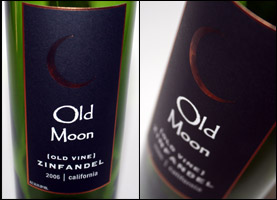 This time I tried the 2006 Old Moon Zinfandel from the Trader Moon Wine Company. It sells for $7.99 — a few bucks more than Chuck.
My assessment is that this is a fairly predictible low-priced zinfandel. Black cherry and oak on the nose with a little bit of spice heat. The intensity is moderate. The palate has more black cherry and some plum. The fruit is rather artificial tasting. There’s a touch of vanilla on the finish. It’s a drinkable wine, but it’s not a great wine.
In all honesty, my description probably made it sound more interesting than it really is.
Wine: Old Moon Old Vine Zinfandel
Varietal: Zinfandel
Vintage: 2006
Alcohol: 14%
Rating: 79
Price Paid: $7.99
It’s time for another double-header review. Today it’s from Cline Cellars located in the Los Carneros AVA in Sonoma, California. The Cline Cellars winery was founded by Fred Cline in 1982 with an inheritance from his grandfather Valeriano Jacuzzi (one of five brothers who created Jacuzzi Spas). The winery was originally in Oakley, California and relocated to its current 350 acre estate in 1991.
Earlier this year Cline Cellars was recognized for sustainable business practices. They were given the Sustainable 6 Award for generating 100% of the winery’s electricity with solar power and for following organic and sustainable farming practices.
Cline Cellars is best known for creating Rhône-style wines and Zinfandel. They produce several different labels of Zinfandel ranging in price from $9 to $34. We checked out the two Zinfandels offered by Cline for under $20.
Cline 2006 Zinfandel (red label)
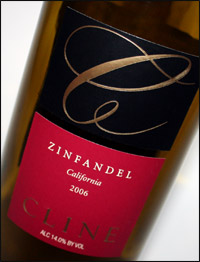 “Oh my, this is too jammy,” was the thought that kept echoing through my head as I tasted this wine.
Blackberry jam, fruitcake, vanilla and a wisp of leather make up the nose. And as I said, the palate is REALLY jammy. This would be good if it were slightly thicker so that I could spread it on some toast. It seriously tastes like blackberry jam. Good blackberry jam, but it’s too much in a glass of wine.
There’s a bit of plum and cherry on the palate too. There’s not enough earth or spice to give it much character. It’s very syrupy—in fact, the legs in the glass are thick and run like honey. There are mild tannins and tart fruit on the finish.
This wine has characteristics that resemble a Zinfandel, but it’s not a great Zin and I can’t recommend it. In fact, it was too sweet for me to finish it.
Wine: Cline 2006 Zinfandel
Varietal: Zinfandel
Vintage: 2006
Alcohol: 14%
Rating: 78
Price Paid: $8.99
Find Cline 2006 Zinfandel with Snooth
Cline 2006 Ancient Vines Zinfandel
 This is a much better wine than the red label. It has a hot leather characteristic to it. The nose is mostly cedar and black pepper. But there is also leather and cherry. While there is some cherry aroma, the fruit on the nose is fairly subtle.
On the contrary, the palate is full of fruit (but it’s not overly jammy like the entry-level Cline Zin). Cherry, blackberry and plum are all in there with a nice peppery high note. There is some vanilla, blackberry and cedar on the finish.
Overall, I enjoyed this one.
Wine: Cline 2006 Ancient Vines Zinfandel
Varietal: Zinfandel
Vintage: 2006
Alcohol: 14.5%
Rating: 85
Price Paid: $14.99
Find Cline 2006 Ancient Vines Zinfandel with Snooth
Today we’re reviewing two Zinfandels that you’re likely to see on the shelf at your local grocery store. While I often encourage readers to shop at their local wine shops versus grocery stores I realize that you may not have a convenient wine shop and sometimes you’re just in a hurry.
In addition to being two grocery store wines another thing these have in common is that they are both cheap… under $7. There’s something I like about these already.
Fetzer Valley Oaks Zinfandel 2004
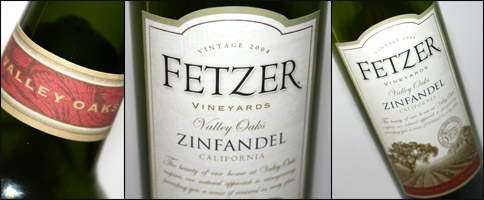
The first wine is from Fetzer, a name you’re sure to see on most grocery store wine shelves. At a high level, I would describe this wine as a muted Zinfandel. It has the characteristics you would expect from a Zinfandel, but those characteristics are lacking intensity and are just kind of dull.
There is a bit of jamminess with cherry and raspberry aromas. The mouth-feel is smooth from the tannins with a spicy kick on the finish. There is a bit of earthiness, a good amount of fruit and peppery spice. Again, it’s everything you would expect only with a very sterile / safe composition. There are no specific faults but there’s also nothing to get excited about. There is a general lack of intensity.
The score came out to an 80 (drinkable, but nothing to be excited about). There’s not one area in which this wine was incredibly off balance, rather the 80 was a result of not scoring excessively well in any of the 16 criteria I use to rate wine.
Wine: Fetzer Valley Oaks
Varietal: Zinfandel
Vintage: 2004
Alcohol: 13.5%
Rating: 80
Price Paid: $6.99
Find Fetzer Valley Oaks Zinfandel on Snooth
Pepperwood Grove Old Vine Zinfandel 2005
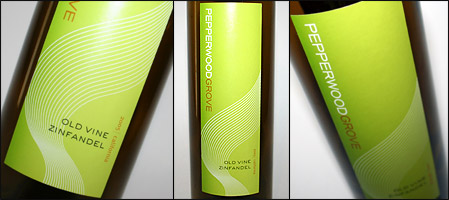
The second wine is the Pepperwood Grove Zinfandel, which is part of the 3 Loose Screws family of wine brands from Don Sebastiani & Sons.
The 2005 Pepperwood Grove Old Vine Zinfandel is a great wine for the price. It’s well balanced and quite enjoyable. If you want to pay more you can easily find a better Zin, but this is a great deal. The bouquet features a strop of leather with blackberry and cola aromas. On the palate it’s nicely acidic and has lots of blackberry and spice. Plus I picked up a little sour apple flavor that I don’t usually find in reds, but it was an interesting twist. The medium-length finish is spicy and crisp.
The bad news is that it looks like they are going non-vintage after 2005 which is a move I strongly oppose. Vintage is highly important in selecting wines and without one on the label, I can’t recommend a wine. If you find the 2005, it’s a good deal. If there is no year on the label, good luck.
Wine: Pepperwood Grove Old Vine Zinfandel
Varietal: Zinfandel
Vintage: 2005
Alcohol: 13.5%
Rating: 85
Price Paid: $6.49
Find Pepperwood Grove Old Vine Zinfandel on Snooth
Simply put, Picpoul is my favorite white varietal; specifically, Picpoul de Pinet from Coteaux du Languedoc in France. Since discovering it I almost don’t want to try any other white wine for I have found the one that I love. This is an absolutely delightful varietal. It’s light, dry, minerally, acidic… it’s everything I want from a white wine.
I’ve been wanting to highlight Picpoul de Pinet and when DrDebs at Good Wine Under $20 announced the theme for Wine Blogging Wednesday #46 I knew this was the right time. And the theme is White Rhone Varietals from Anywhere.
For those who stumble across this article and don’t know what Wine Blogging Wednesday is, it’s an event that occurs once every month when wine bloggers from around the world all write about a common theme. It’s a lot of fun and an opportunity to discover some great wines that you might not otherwise try. I hope to share just that with you today.
Picpoul is a varietal that originated in southern France and is often used as a component in blends versus bottled as a single varietal. It is known for its high acidity which makes it an excellent wine to pair with shellfish — oysters are a popular choice with Picpoul. It is also an excellent choice with rich, soft cheeses.
The Picpoul de Pinet terroir is the largest white wine producing region in Coteaux du Languedoc. Rather than spending my time rehashing the details, I’ll direct you to the Picpoul de Pinet site to read all about the terroir. They’ve done a great job.
In addition to being consistently a great white wine, another consistency I’ve noticed is that the producers all seem to use the same bottle design. See the designs on the neck of the bottles pictured below. So you can quickly identify this varietal on the shelf when you see the bottle.
It is sick how much I enjoy this wine. It is the most crisp and refreshing white varietal I have ever tasted. I tried Picpoul de Pinet from two different producers for this Wine Blogging Wednesday and they were both excellent.
Le Jade Picpoul de Pinet
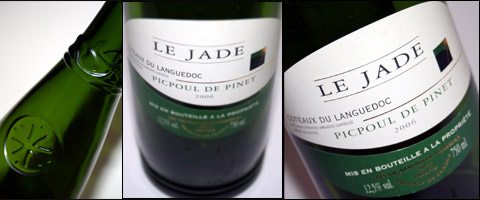
At times Picpoul can be a bit too acidic, but this one is just right. And it has surprising complexity for a $9 bottle of wine.
The nose is a full bouquet of tropical delights. There’s a bit of grapefruit, some pineapple, and lime. Yes, those are all acidic fruits, but trust me… it’s not too acidic. The palate on this has a gentle pineapple and lime flavor with really nice mineral undertones. The finish is rather long and is very minerally.
I enjoyed this with some garlic butter drenched escargot and some pan bigio bread with soft ripened fromage triple-crème. It was delightful, but I found myself wishing I had picked up the lobster I was eyeing in the market.
Wine: Le Jade
Varietal: Picpoul de Pinet
Vintage: 2006
Alcohol: 12.5%
Rating: 89
Price Paid: $8.99
Hugues Beaulieu
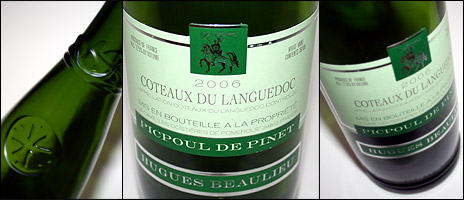
The nose on this one has a good bit of pear, pineapple, acidic lime, floral aromas and a rich mineral aroma that has a slightly petrol aspect to it. The flavor is delicate, crisp and refreshing. It has a good bit of acidic lime flavor, but by no means will it make you wince. The mineral flavors come through like a wet rock. The aftertaste is pear and mineral, and it lasts exceptionally long. It earned a solid 90 rating.
Simply put, this is an extraordinary value at $9.99. I enjoyed it with charcoal grilled garlic shrimp, flounder with spinach sauteed in olive oil with lemon & garlic, and grilled neo-Tuscan bread dipped in olive oil. Is your mouth watering yet?
Wine: Hugues Beaulieu
Varietal: Picpoul de Pinet
Vintage: 2006
Alcohol: 12.5%
Rating: 90
Price Paid: $9.99
It is unlikely that you’ll find these wines in your local grocery store. You’ll need to visit a wine shop, and even there they may only have one or two to pick from.
Learn more about Picpoul
One year ago today I published my first post on CheapWineRatings.com and I wanted to take a couple minutes to reflect on the past year and revisit some favorites.
As I look back at my first reviews (only a year ago) I feel that the quality has improved significantly. The tasting notes are better now, the photography is better and I now employ a more analytical approach to ratings than when I first started. I hope it continues to improve and I’m saying the same thing a year from now about today.
I had a lot of fun over the past year and I especially enjoyed the Wine Blogging Wednesday events. I’m looking forward to more fun and more wine over the next year.
Some of my favorite wines of the past year include (in no specific order):
There is one other wine that stands out as a favorite of mine and it was from my first review, Yasa Garnacha 2003. I enjoyed this wine so much that it is locked in my memory as “the best value wine of all time.” And it was a wine that inspired and motivated me to create this website. To celebrate my fond memories of that wine I decided to revisit the more current vintages of Yasa.
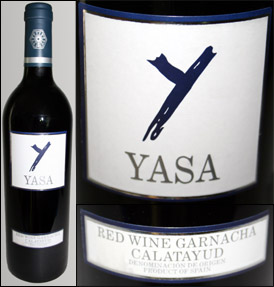 I picked up both the 2005 and 2006 vintages of Yasa Garnacha and what I found was disappointing. It was a validation of how important vintage is when identifying great wines. 2003 was an extraordinary year for Spanish wine and it’s not surprising that the Yasa was much better that year.
They updated the label since 2003, raised the price a couple bucks and lowered the quality. That’s not how it’s supposed to work!
Here’s what I found from the ’05 and ’06.
Yasa Garnacha 2005
Butterscotch, black pepper, cedar and cherry make up the nose. The palate is quite acidic is shows mostly a sour cherry flavor. There is also some walnut, plum and some spicy black pepper. There is a slight metallic aftertaste. This is not what I expect (or want) from a Grenache.
Wine: Yasa
Varietal: Grenache
Vintage: 2005
Alcohol: 14%
Rating: 78
Price Paid: $9.99
Yasa Garnacha 2006
The nose is fairly tight. It opened up to show some blackberry, cedar, black pepper and a touch of bubblegum. It has a slightly dirty/barnyard aroma too. The palate brings loads of blackberry and plum. It’s a little jammy. There’s a very floral black pepper spice on the finish. There are also some black tea tannins on the finish. It’s a step up from the 2005, but not nearly as good as 2003.
Wine: Yasa
Varietal: Grenache
Vintage: 2006
Alcohol: 14%
Rating: 83
Price Paid: $9.99
Oh well… not every bottle of cheap wine will be a winner. Here’s to another year of searching for the gems. Cheers!

 Prev
Prev