You may have noticed that I haven’t updated this site in a couple weeks. A cold had me down—and not tasting wine—for a while, then with the holiday I just took a couple extra days to recuperate. I’m back, but I’m a little behind on my planned tasting schedule. I have a couple more bottles of Sauvignon Blanc that I plan to taste and post reviews for in the next few days. Until I can get to those, I have a random tasting to share with you, and it’s another French red blend—something I just can’t seem to get enough of lately.
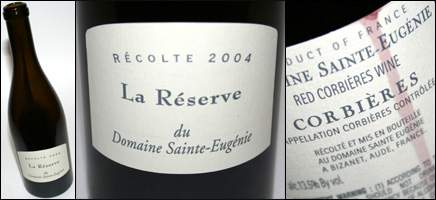
I’ve tasted a lot of wines recently from the Rhone Valley, but this wine is from a region further south in Languedoc Roussillon, and more specifically Corbières. Domaine Sainte Eugénie is located in the foothills of the Pyrénées along the Mediterranean coast. As you might expect along the southern coast of France, the weather is sunny, warm and dry here, creating a good grape growing environment—especially for Syrah, the dominant variety in this blend. The make up of the blend is 40% Syrah, 30% Carnigan and 30% Grenache.
The wine comes together well and with characteristics typical of a wine from the region. Cedar, cherry, blackberry and earthy straw aromas make up the nose. The palate is bursting with berry flavors. Big blackberry flavors, but not at all jammy. It’s very good. There is a very soft aspect, well-rounded nature to the fruit. Oak flavors come through on the finish, along with a subtle apple flavor—something I’ve not found in red wine that I can recall. This is a very enjoyable and interesting wine.
Wine: Domaine Sainte-Eugénie – La Réserve
Variety: Red Blend
Vintage: 2004
Alcohol: 13.5%
Rating: 87
Price: $14.99
I’m just doing a quick post for this review. Kendall-Jackson is a fairly big wine brand that you’ll find in just about any wine shop or grocery store that sells wine. Although it’s a fairly prevalent brand, it’s still a family run business. It seems to be one of the brands that people first “trade up” for when they are ready to spend more than $7 for a bottle. Their entry-level “Vintner’s Reserve” line of wines isn’t terribly expensive and is fairly reliable for decent quality.
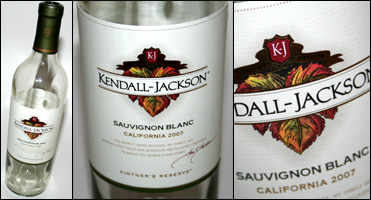
I’ve been trying a few different Sauvignon Blanc wines lately, so I thought I’d give the Kendall-Jackson a try. The nose lacks the intensity I’ve found on some other Sauvignon Blancs. It also lacks the complexity. It’s mostly grass, nettle and mineral. There is a touch of grapefruit, but not much fruit at all on the nose. The palate continues the theme of minimal fruit, but does bring some melon and some pear flavor. Otherwise, I would call it cut grass and mineral. There’s some citrus on the finish, which is relatively short.
It’s a good, enjoyable wine. But it’s not going to knock your socks off.
Wine: Kendall-Jackson Vitner’s Reserve
Varietal: Sauvignon Blanc
Vintage: 2007
Alcohol: 13.5%
Rating: 86
Price: $10.99
I am happy to announce and proud to be the host of the 52nd installment of Wine Blogging Wednesday. If you are new to Wine Blogging Wednesday and don’t know what it’s about, it’s one day each month when wine bloggers from around the world all write about a common theme. Lenn Thompson at Lenndevours started it all back in 2004 and it’s still going strong.
 And our theme for December 2008 is Value Reds from Chile! The rules are any red wine from Chile for $20 or less. If you can find a really good one for closer to $10, better yet.
As anyone who has visited this site knows, I love a great deal. Don’t we all? Well… Chile is a region that I’ve become more and more interested in for great wines at reasonable prices.
Back in the early 1990’s I had my first experience with Chilean wine and it was a horrible experience. I swore off all Chilean wine for years. But late last year I started trying Chilean wine again and I was amazed with what I found.
Since the early 90’s Chile has been undergoing a wine revival. Improvements in winemaking practices and knowledge have both grown significantly in the past 15 years and it’s showing in the quality of their wines. This first drew wide public attention in 2004 at a now famous blind tasting in Berlin where 36 highly regarded European wine journalists, writers and buyers gave top honors to two Chilean wines: Viñedo Chadwick 2000 and Seña 2001. Now while you won’t find these two wines on the bargain shelf, they do represent the improvements in quality coming from Chile in general.
Chile is sometimes referred to as a viticultural paradise. I’ve heard some people refer to Colchagua Valley as the next Napa Valley due to the geography. In reality, there is quite a bit of diversity in Chile’s wine making regions. The Pacific coastline runs the length of the country. Coastal hills lead into the Central Valley and the Andes boarder the east side of the valley, creating a variety of conditions.
The various climates, geography and governmental distinctions result in several regional designations. Most wines that you’re likely to find will be from Aconcagua, Cachapoal, Casablanca, Colchagua, Curicó, Maipo and Maule. But you’ll get extra points if you bring a wine to this event from one of the lesser known regions such as Bío Bío, Elqui, Itata, Limarí, Malleco or San Antonio.
Many of the red wines from Chile are big and bold! Some argue that they are too big, but that is changing and we’re seeing more variety and experimentation with wine styles in recent years. Most of what you’ll find in the value wine category will be Cabernet Sauvignon, Merlot, Carmenere and Syrah. You may also find some Pinot Noir and Malbec. Other red varieties are being produced, but mostly on an experimental basis.
The Details
If you want to participate, just pick your Chilean red wine to review and write it up on Wednesday, December 10. Then send an e-mail with a link to your review to wbw@cheapwineratings.com. If you don’t have a blog but want to participate why not start a blog? It’s free and easy to get started at http://wordpress.com or http://www.blogger.com.
More Info
If you want to do your homework on Chilean wine, here are a few resources.
Hooray, hooray… it’s Wine Blogging Wednesday. It’s been a few months since I’ve taken part in this event due to the fact that the last few themes were “off equity” for me, as we say in the marketing business. Actually, I considered sitting this one out too as “dessert wine” is an area I don’t know as well as other wines. But I was ultimately compelled to challenge myself with something new, plus a personal connection to the theme sealed the deal. More on that in a minute, but first…
“What the heck is Wine Blogging Wednesday?” you ask. It’s a monthly event when dozens of wine bloggers, like me, from around the world all write about the same theme. There is a host each month who picks the theme and summarizes all the contributions. The host today is Joe Roberts at 1WineDude and the theme he’s picked is “Baked Goods.” By that he means wines that are deliberately heated, or Madeirized. The resulting wines are sweet and caramelized. Since these wines can be hard to come by, he’s also allowing fortified wines such as Port.
The wine I picked for this occasion is a Madeira—the style of wine from which the term Madeirized was coined. I wanted to do a Madeira specifically because of the personal connection I mentioned… I have Madeira in my blood! Not because I’ve consumed too much of it or participated in strange intravenous things. According to some research my father found, part of my ancestral lineage tracks back to a guy named Domingo Madeiras, who supposedly was born in Portugal in the early 17th century and immigrated to the US. Based on the name, I have a hunch that the lineage leads back to the island of Madeira in some way. I don’t know if it’s 100% accurate, but I like the idea of having a bit of Portuguese in me so I’m running with it.
Madeira wines can be quite pricey, especially as you get into the well aged Madeiras which are the most prized. For this reason my options as a “cheap wine” guy were limited and the brand I selected, Broadbent, is a fairly common option on the Madeira shelf. As such, I’m probably not the only wine blogger writing about this wine today.
I didn’t just go for the absolute cheapest price I could find and instead opted for a $20 bottle that has spent at least 5 years in oak in hopes to find a moderate upgrade in quality. While I advocate finding great deals on inexpensive wines, I haven’t had much luck on finding good, cheap dessert wines. Thus, my rationale for spending my upper limit here. Of course I should note that although the bottle price is at the upper end of my preferred price range, this is a type of wine that you don’t drink much of in one sitting and the bottle lasts longer than a typical, everyday wine.
As I previously mentioned, Madeira is intentionally heated in what’s referred to as an “estufagem” aging process, meant to replicate the effect a long sea voyage through tropical climates would have on aging the wine. In inexpensive wines this can be done in a concrete cask surrounded with heating coils for a minimum of 3 months. It can also be done in large wooden casks in a room heated much like a sauna for 6 months to a year. But the highest quality Madeiras are aged in barrels in sun-heated rooms, where they are left to age for years. That’s the case with this Broadbent Madeira.
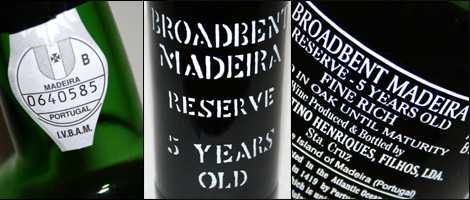
The Broadbent Madeira Reserve has been aged for 5 years. The grapes in this wine include Negra Mole, Complexa, Tinta da Madeira and Triunfo. While not as refined as some vintage Madeiras aged for 20 years or more, this is still a very good and interesting treat.
The color is a rusty caramel hue. The nose presents a smoky, molasses bouquet with a hint of orange peel. The orange came out a lot stronger on the palate, along with toffee, figs and nutmeg. The toffee flavor lingers on the finish, which also brings a touch of heat.
You can definitely smell and taste the oxidation, but it isn’t a turn off like it would be in a dry wine. There is a lot of character to this wine. The toffee characteristic is dominant and enjoyable. It’s been a while since I’ve really enjoyed a dessert wine and this is a nice welcome back.
Wine: Broadbent Reserve – 5 Years
Varietal: Madeira
Alcohol: 19%
Rating: 89
Price: $20.00
When one thinks of Chilean wine it’s often the big, bold and affordable red wines that come to mind. I’m certainly one who has become a big fan of the outstanding value reds that can be found from Chile. But there is a lot more diversity coming from Chile than you may realize and some outstanding white wines are to be found as well.
One reliably good white that I’ve found is the Veramonte Sauvignon Blanc from the Casablanca Valley. This wine has been highly acclaimed for the past few years and they’ve just released their 2008 which is proving to be another excellent vintage.
While the region is referred to as Casablanca Valley, it isn’t really a “valley” in geological terms. Rather than a valley, it’s more of a depression. The region covers the western side of the coastal hills between Santiago and Valparaiso. The main part of the region lies about 12 miles inland from the Pacific coast and the low-lying area surrounded by hills creates a basin where cool ocean air creates a maritime influence that results in a moderate climate. But throughout the region, microclimates create a lot of variety and opportunities for viticulturists.
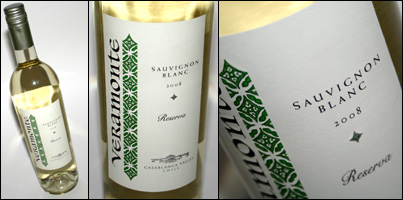
The Veramonte vineyards are in the far eastern end of the Casablanca Valley, where they established in 1990. The terrain of the vineyard varies, creating numerous microclimates that Veramonte takes advantage of—along with soil variations—blending grapes from different blocks to add complexity to the final wine.
The majority of vineyards in the Casablanca Valley, including Veramonte’s, are planted with Chardonnay and Sauvignon Blanc. But there is experimentation with other varieties throughout the region.
In the past, I’ve noted the Veramonte Chardonnay as one of my favorite great value whites to be found. And now, I’ve found another favorite with the Sauvignon Blanc. The nose has both outstanding intesity and complexity. I’m first struck by a combination of vegetal/cut grass aroma—much like you’d expect from a New Zealand Sauvignon Blanc—along with mango, melon and peach. There is also a flinty minerality as well as a touch of citrus.
The palate has perfect acidity. The flavors are primarily melon, mango and peach, followed by a mid-palate mineral and peach that lingers into a long finish. Some past vintages have been dinged for having a short finish, but I didn’t find that to be the case with this one.
Simply put, at $10.99 this is an outstanding value.
Wine: Veramonte – Reserva
Varietal: Sauvignon Blanc
Vintage: 2008
Alcohol: 13.5%
Rating: 91
Price: $10.99
At the recent Wine Bloggers Conference there was quite a bit of dialogue about wine blogger credibility. John Witherspoon at Anything Wine shared some post-conference thoughts about the topic, and I wanted to share some of my own. In my opinion, the debate about credibility is really not just about credibility—or at least it shouldn’t be.
When someone asks me, “are wine bloggers credible?” I don’t know how to answer that question. Credible against what measures? If a wine blogger is claiming to be a certified sommelier and they are not, then clearly they aren’t credible. But if you’re asking if someone is credible to give their opinion about wine, well that’s just a silly question.
Certainly some wine bloggers are more knowledgeable than others about wine and some have more experienced palates than others. But part of the beauty of blogs is that you get opinions from individuals with different tastes, different backgrounds, different experiences and different niches. You don’t get a homogenized perspective of what wine is supposed to be. I certainly try to serve a niche here by focusing on finding good value wines, while some others may tell you that only expensive wines are good.
Considering the fact that there is no entrance exam and no licensing board for wine blogging, the measures of credibility are difficult to set. It seems to me that credibility is a less relevant topic than integrity. Be honest and transparent about your background. Don’t pretend to know more than you really do. If you’re new to wine that’s OK as long as you’re up front about it. Your level of competence will show in your writing and you’ll attract readers who are at your level, while others looking for more advanced wine writing will look elsewhere.
In many cases, attracting readers will have less to do with credibility than style. Which brings me to my next point. What seems more interesting to me than either credibility or integrity is influence. This is a topic I find worthy of further discussion. Regardless of credibility, competence, integrity or other measures of elitism that old-world media luddites and highbrow wine bloggers alike will spew about venomously to discourage new wine bloggers, you can still have influence.
If you create good content that readers find interesting, you will have influence. If you cater to a niche that is under served, you’ll have influence.
But how do we measure influence? Is it by web traffic? Visitor loyalty? Commenting and social participation on blogs? Or is it measuring purchase decisions motivated by blogs? I think all of these are contribute to measuring influence, but the latter is what the wine industry wants to know about. Do wine blogs influence purchase behavior? And I think it’s an important measure to establish the relevancy of wine blogs.
Jeff Lefevere at Good Grape recently tried to conduct an experiment which could have revealed some of the influence of wine blogs. But that experiment became clouded by a manufactured controversy about the experiment itself. The idea was that a select number of wine bloggers recieved a sample of a wine before it was released and before the traditional media recieved samples. The bloggers all agreed to write their reviews of this wine within a defined window of time. The controversy swirled around the idea that the bloggers had been used as PR agents for the wine company and had been manipulated. Controversy aside, I like the idea of this experiment as if the only publicity in market about a wine is found on blogs, then the influence of those blogs can be revealed. It’s an elusive thing to measure and this is one way to find get a glimpse of influence.
Tracy Rickman, PhD student and one of the moderators of the credibility session at the Wine Blogger Conference is planning to do a study which may shed some light on the true influence of wine blogs. I look forward to seeing the results.
I know from feedback I’ve gotten from visitors to this site that they have been influenced in a way that impacted purchase behavior, but I don’t know the extent of it. I also know that I personally have purchased wines because I learned about them on wine blogs. What are your thoughts? Do you find wine blogs influential?
I say let’s drop the debate on credibility as it’s really going to vary from one individual to the next. And it’s a debate that’s mired in elitism. Let’s explore influence more, as it’s a better measure of the value of what we do. That’s my opinion. Cheers!
Prelude: I know most visitors to this site come here for wine reviews. Pardon me for a moment while I write an article addressed at the wine blogging and wine producer communities.
I observed some interesting dynamics at the Wine Bloggers Conference a couple weeks ago. There were some bloggers who were interested in monetizing their sites, while there were others who were adamant about not having ads. Those who expressed an interest in monetizing questioned how profitable their blogs could really be, and were (for the most part) unsure of how to go about monetizing. Those against it claimed that they only create their blogs because they are passionate about wine. And there was yet another group of bloggers who would accept advertising, but would not let wineries buy that advertising because they didn’t want to create the impression of a conflict of interest.
I personally don’t understand why some bloggers are uptight about earning an income from their blogs. Steve Heimoff stirred up some controversy when he suggested that attendees at the conference were interested in monetization. I know that not everyone wants to monetize, but I think that many do.
As you can see by looking around this site, I have no problem with advertising. I have ads on this site and I will continue to do so. While I am also passionate about wine, there are expenses to building and hosting a website. And as they say, “time is money.” It’s great to do something because you love it, but it’s even better to do something because you love it and get paid.
Don’t get me wrong, I’m not getting rich from the ads that run here and I won’t be leaving my day job any time soon. I agree with Alder Yarrow when he says that even the most successful wine blogs don’t make much money. But at the same time, I think most wine blogs could be more profitable than they currently are (mine included).
Conflict of Interest?
As I mentioned, some blogs will include advertising as long as it’s not from wine producers. Personally, I’m not concerned about creating the illusion of a conflict of interest by having winery ads. My reviews reflect my opinions of the wines I try, and the quantity of wines reviewed here—from different producers—should negate any perception of a conflict of interest.
Some folks may point fingers at me and say it’s a conflict of interest or call me a shill. I really don’t care. If I were going to be a shill, I would do so in a much more lucrative space than wine blogs. And I just don’t consider ads to inherently create a conflict of interest.
There are plenty of ads for wines in traditional wine publications and their reviews seem to be influential—even if some people suspect a conflict of interest. There are also plenty of blogs in other genres with ads for the products they review and nobody is complaining about a conflict of interest there. Why should I be held to a different standard?
Untapped Opportunities
Another twist to the dynamics at the conference was that I got the sense that some wine producers are interested in advertising on wine blogs, but they’re not sure how to go about doing it. Perhaps that’s because of the few vocal bloggers who won’t accept ads from wine producers.
Couple the interest from wineries to place ads with the number of bloggers interested in monetizing and I smell a huge opportunity. Not a huge opportunity for me, but for the wine industry to get dirt cheap advertising on wine blogs—at least in the short term.
The reality is that many wine bloggers earn little to no money on their blogs. Most of those interested in monetizing have no idea what their sites are worth and will sell out at bargain-basement prices. The first of those in the wine industry to move on this will get the best deals on highly-targeted, highly affordable ad placements. But the bargains won’t last forever. As more producers realize the influence and opportunities in advertising on wine blogs, bloggers will start to understand the value of their web properties. The result will be a rise in ad prices, but I still think it will be some of the most cost-effective advertising available.
In my opinion, there are untapped opportunities galore out there. Wine bloggers should drop the pretense that winery ads imply a conflict of interest. And wine producers should take advantage of the opportunities on wine blogs. Do you know who reads wine blogs? Wine consumers!
Wine bloggers should also get creative if they want to monetize. Don’t just think of banner ads as the only thing you have to sell… sell the background of your site, sell video, sell text ads, sell your services offline, be creative and work with advertisers to come up with new ideas. The most successful publishers are getting more and more creative with how to create innovative sponsorships.
I’ll put myself out there too. My door is open to any reputable advertiser who wants to come up with a new way to advertise. Here’s a creative idea… I’m available for sponsorship at the next Wine Blogger Conference. If the price is right, I’ll wear your schwag and publicize your brand. OK… so I’m getting into shameless self-promotion territory here, but I’m trying to show an example and make a point. There are innovative opportunities out there that are passing us up every day. Let’s embrace them and find more success for all of us. Cheers!
In my last post, I highlighted my walk through Rodney Strong’s vineyards along with a review of their Charlotte’s Home Sauvignon Blanc. In this post, I’m sharing a review of another Rodney Strong wine from that trip, the Knotty Vines Zinfandel.
Before I get into the review, I want to touch on sustainability. When I was in California, I heard a lot of producers talk about organic farming, and even beyond that I heard a lot about bio-dyamic farming. One person described bio-dynamic farming to me as organic farming plus Wicca. Anyway, I’m all for environmentally friendly farming practices, and I’ll often buy organically produced products—but at the same time, I’m not very paranoid about chemicals in my food (or wine). I eat plenty of food that’s not organic, but I still think it’s safe. Personally, I’m not apposed to the use of chemicals in farming techniques as long as it’s done in a smart way.
Rodney Strong was one of the few producers I met on this trip that didn’t claim to employ organic farming practices. And I’m OK with that. Although they don’t produce their wine organically, they do employ sustainable farming practices. In fact, they are certified as fish friendly, which is important as vineyards can create a lot of runoff into streams and rivers if not properly managed. I have some confidence that while they are not organic, their use of non-organic techniques is reasonable.
2006 Rodney Strong Knotty Vines Zinfandel
Similar to my last review, I need to add a disclaimer that I did not taste this wine in my typical environment and this may have some impact on the results. And to be honest, I hope that I enjoy this wine as much in the future as I did at this tasting.
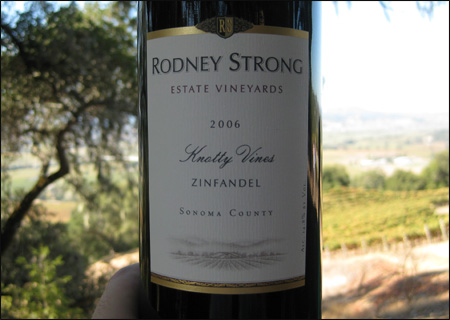
The wine is made up of 99% Zinfandel, with 1% Petite Syrah. It was aged for 10 months in a combination of American and French oak.
This wine has everything that a Zinfandel should have. On the nose I found raspberry and blackberry aromas softly carried by an undercurrent of cedar. The palate is bursting with berry flavors. It doesn’t come across jammy, but fruity. In addition to the blackberry and raspberry flavors, there is a bit of cocoa. Of course as any good Zinfandel, there is plenty of spice in this one. The finish is very long, and very enjoyable.
This is a great Zinfandel.
Wine: Rodney Strong Knotty Vines Zinfandel
Varietal: Zinfandel
Vintage: 2006
Alcohol: 14.8%
Rating: 91
Price: $20.00
On my recent trip to Sonoma County, California for the Wine Bloggers Conference I had the opportunity to visit some of Rodney Strong’s vineyards in northern Alexander Valley. The hike through the vineyard was led by Rodney Strong viticulturist Doug McIlroy and I was joined by some fabulous other wine bloggers like Lenn Thompsom from Lenndevours, Russ Beebe the Winehiker, Hardy Wallace from Dirty South Wine, Erika Strum from Strumerika, Doug Cook from AbleGrape and numerous others. Thanks to Zephyr Wine Adventures for coordinating the walk.
Doug McIlroy explained to us that the Alexander Valley was created by faults pulling apart from each other, revealing soils composed of sandstones from the ocean floor millions of years ago. The soils tend to be well drained. Erosion carries deposits into the valley, creating a geology where the hillsides tend to have soils of lower fertility and high acidity while lower in the valley you find newer alluvium deposits. The hillside soils are ideal for creating big, flavorful, high alcohol wines.
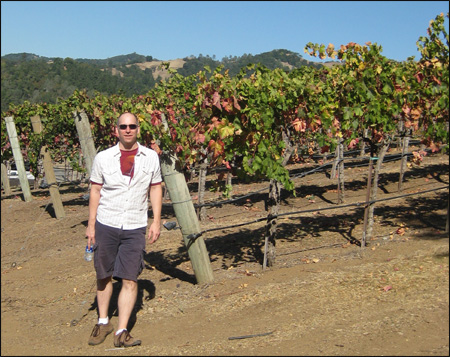
Our hike culminated with a somewhat strenuous hike up Rodney Strong’s Rockaway vineyard, where they are growing grapes for their highly acclaimed Rockaway wine. The picture above is yours truly at Rockaway. At the top of that vineyard we relaxed for a few minutes, tried some wines and enjoyed lunch. One of the wines we tried was the Rockaway wine—which was excellent—but it is also expensive, and only available by allocation, which means you probably won’t be able to get it, and even if you could it is above the price range for most readers of this site. But we also tried a couple other wines that are worth noting here, and so I shall. Starting with…
Rodney Strong Charlotte’s Home Sauvignon Blanc 2007
The core of the Charlotte’s Home vineyard is located in southern Alexander Valley. Although they also used grapes from other areas in the Alexander Valley, including blocks near the Rockaway vineyard that I visited.
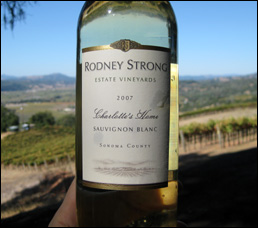 I should note that I tasted this wine in a picnic setting and not the typical environment in which I do most tasting and that may have some impact on results. Nonetheless, here are my thoughts.
The nose on this wine has outstanding intensity and a beautiful bouquet of peach, pear and a slightly nutty characteristic. Based on the aromas, I could easily imagine enjoying this with pears, walnuts and bleu cheese. The palate brings a very bright and refreshing acidity along with the flavors of slightly unripe peach, pear, mango and a hint of mineral. The finish is very long and adds a subtle apple flavor to the mix.
All told, this is an excellent wine at a reasonable price. I gave it a 90.
Wine: Rodney Strong Charlotte’s Home
Varietal: Sauvignon Blanc
Vintage: 2007
Alcohol: 13.5%
Rating: 90
Price: $15.00
This past weekend I attended the 1st Wine Bloggers Conference in Santa Rosa, CA. There were over 100 wine bloggers in attendance and I had the opportunity to develop new friendships, strengthen existing friendships and get lots of inspiration.
When I returned, my joy turned to sorrow as I learned that my cat, Mantra, had fallen ill over the weekend. I immediately took her to the vet and found that she had developed a tumor in her lung. This morning I said goodbye to her as she was put to sleep.

Mantra was my best friend for 16 years. She followed me everywhere and I sometimes called her my shadow. She had her own chair next to my computer chair and another next to my TV chair. Without fail, she would always be curled up next to me, whereever I would go. She would even sleep curled up next to me on my pillow.
She was the most gentle and sweet cat I’ve ever known and she will be missed.

 Prev
Prev