The Limarí Valley is one of the northernmost winemaking regions in Chile, about 75 miles south of the Elqui Valley. Remember, Chile is in the southern hemisphere which means that north is closer to the equator and therefore a warmer region than those further south. And although north generally means warmer in this part of the world, these vineyards reside in a cool maritime stretch of land that offers a good balance between the cool ocean air and the dry heat from the interior.
Casa Tamaya is still a relatively young winery. It began as a fruit farm and evolved into wine production. At first they grew grapes for sale to other wine makers and eventually decided to create their own winery. The first vintage from the Casa Tamaya winery was 2002, so this bottle is only the fourth vintage from this producer.
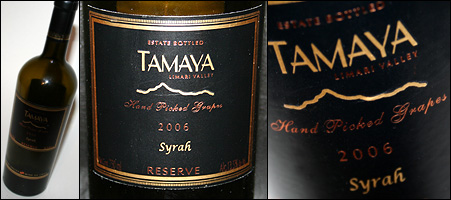
This isn’t as big as most Syrah I’ve had. The nose has jammy blackberry and plum aromas, along with some salami and leather aromas. The palate is both quite tannic and quite acidic. In fact for me it’s too tannic for serving right now, I’d lay it down in the cellar for a couple more years and it will probably be a much better wine. Plum, blackberry and sour cherry flavors dominate the palate, along with a little black pepper.
All told, it’s not a bad wine, but it is lacking some complexity. It’s a little more approachable and food friendly than a lot of Syrah I’ve had recently. It will be interesting to see how this wine improves over time.
Wine: Tamaya
Variety: Syrah
Vintage: 2006
Alcohol: 14%
Rating: 85
Price: $14.99
Find Casa Tamaya Syrah with Snooth
Critters on wine labels is often something that will steer me in another direction because it is often indicative of not-so-good wine. I’m not the first person to bring this up, others wine aficionados also avoid the critter. But many shoppers are attracted to wine with cute little animals on the label and some winemakers know that critters sell wine. And I would guess that no wine-producing region puts more animals on labels than Australia.
However, the “avoid wine with critters” rule does not apply when that critter is a Roogle. What is a Roogle, you ask? It’s half kangaroo and half bald eagle, and it’s found on labels of wine from Marquis Philips. This unique icon, which kind of looks like a mythical creature, represents the collaboration between Australian and American winemakers which results in Marquis Philips wine.
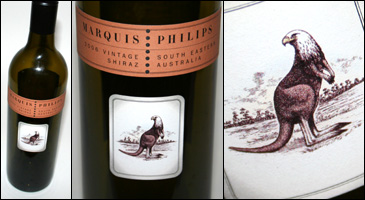
Marquis Philips started as a joint venture between American Dan Philips and Australian winemakers Sarah and Sparky Marquis, however Sarah and Sparky Marquis have since moved on to produce Mollydooker Wines. Dan Philips is still involved with Marquis Philips and is currently partnering with other Australian winemakers to create this wine.
And why is it that the Roogle gets an exception as an acceptable critter on a wine label? Because this wine is good!
In a way, this Shiraz reminded me of a Zinfandel with a little less spice. The nose is full and rich with blackberry jam, leather, dark chocolate and oak. The palate has very jammy blackberry with loads of dark chocolate. There’s also a bit of cherry on the palate and a hint of spice. And at 15.5% alcohol it is a big wine. The finish is long lasting and is like creamy dark chocolate melting on your tongue.
Wine: Marquis Philips
Variety: Shiraz
Vintage: 2006
Alcohol: 15.5%
Rating: 88
Price: $12.98
Find Marquis Philips Shiraz with Snooth
One of the challenges with picking wines to review on this site is finding a balance between mass-produced wines that are easy for readers to find and hidden gems that may be a little harder to track down but often offer unique and interesting nuances.
Another challenge is putting aside personal bias when doing reviews. To be candid, my preference for personal consumption tends to be smaller producers. Why? Because I tend to find those wines more interesting. My stereotype of big producers is that they tailor the wine to “focus groups” and sterilize the character out of the wine. I don’t know that they really do focus groups on the taste of the wine, but that’s the perception that I’ve concocted in my head. I also grew up on an apple orchard and have a soft spot for giving my business to independent producers.
Despite my personal preference, I know many readers come here just looking for a deal. You want to find a good wine that won’t cost you an arm and a leg… and you don’t want to hunt all over for it. You don’t need a 90-pointer, just something that is cheap and decent. Well this may be a pick for you.
The technology for wine has come so far that there is no reason a wine producer shouldn’t be able to create a decent wine, yet some of the wine from big producers that I’ve had has been undrinkable. That wasn’t the case with this one. I was apprehensive before I tasted this wine, but I was pleasantly surprised.
Now the last time I reviewed a Barefoot wine and had some positive things to say I found some passionate haters out there anxious to slam it. Feel free to disagree with me, but I did not find this wine at all objectionable. It’s lacking a bit of viscosity and complexity, but there are no real flaws. I wouldn’t call this an exceptional wine, but quality is very good for the price.
My biggest gripe is that there is no vintage on Barefoot wines. In a way it’s understandable, because when you’re creating wine in the quantity that they do I don’t know how you can have consistency. So, I worry about bottle consistency. Nonetheless, the one I had I liked.
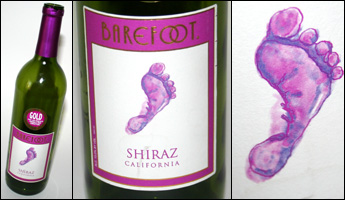
The nose is a little bit one dimensional: black cherry. If you work at it you can pick up some perfumey / black pepper aromas and a hint of leather, but those are subtle. The palate is a little thin on mouth feel, but big on juicy fruit flavors. This wine is brimming with ripe black cherry, plum and blackberry flavors. And it’s approachable—not overly jammy. There is a little spice on the finish, which is fairly short. It’s not an elegant or refined wine, but it’s quite tasty.
Wine: Barefoot
Variety: Shiraz
Vintage: N/A
Alcohol: 13%
Rating: 83
Price: $7.99
Continuing the exploration of Syrah, we’re reviewing a wine that you typically wouldn’t see on this site because it sells for over $20. While the general rule of thumb here is to only highlight wines that are $20 or less, I think it’s good to occasionally bring in a more expensive wine into the mix to see how it compares. And at about $24 this isn’t significantly over our limit.
This wine comes from Hahn Estates in California. You may recall the recent review we did of their
Pinot Noir, which was quite good. While Hahn has a number of wines in the under $20 price range, this one is from their SLH line of wines. The SLH comes from the region where the wine is produced, Santa Lucia Highlands. You may notice that they refer to it as “estate bottled.” This is a term that means that 100% of the grapes in the wine were grown in that estate’s vineyard, in a specific appellation, and the wine was vinified and bottled on the same property. Most wine is not estate bottled, so this is a unique aspect to this wine.
The Santa Lucia Highlands is a very highly regarded appellation in Californian wine, known for producing wines with pronounced fruit characteristics. It’s best know for its Chardonnay and more recently for its Pinot Noir, but there is also some very good Syrah coming from this appellation.
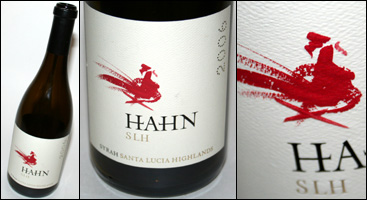
Everything about Hahn SLH Syrah is big. It’s dark and inky in the glass. Aromas of white pepper, toasted oak, vanilla, blackberry, cherry and blueberry make for a very big nose on this wine. The palate is huge with massive amounts of cherry, blackberry, and blueberry. It has a long finish with lots of toasted oak and a touch of peppery spice. This is everything I would expect from a good Syrah. It’s a good wine, but only one you’ll appreciate if you’re a fan of big wines.
Wine: Hahn SLH
Variety: Syrah
Vintage: 2006
Alcohol: 14.5%
Rating: 89
Price: $23.99
Find Hahn SLH Syrah with Snooth
Over the next few posts I’m going to take a look at a few Shiraz/Syrah wines. In general, if it comes from Australia it’s called Shiraz and if it comes from elsewhere it’s called Syrah—although I’ve seen a few non-Australian ones with Shiraz on the label. This is an example of just that, it says Shiraz but it comes from France.
Syrah is generally a big wine… big, jammy, juicy, spicy are all terms commonly used to describe it. Most people I’ve met either love it or hate it. If you’re into really big wines, you may be a fan of Syrah.
The first one I’m profiling is due to a recommendation from a friend. I get recommendations for wines all the time and I love getting them. When I get a recommendation for a wine I haven’t tried I’ll often hunt it down and give it a shot. The guy who suggested this wine to me said something like, “It’s mighty delicious.” That sounded like a good endorsement to me, and so I gave it a shot.
Now, the friend who suggested this wine is going to have a complex after reading my review and seeing me say, “Me no likey.” Actually, it’s quite drinkable but not quite what I expect from a Syrah.
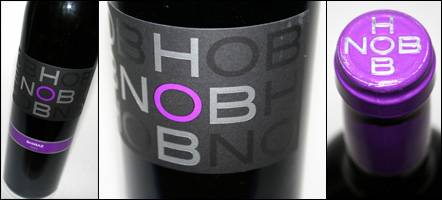
The Hob Nob Shiraz has a deep, inky purple appearance and creates massive legs in the glass. Commenting on the legs of a wine is kind of a wine-noobie thing to do and I usually wouldn’t do so, but they were really massive and I couldn’t help but comment.
Aroma-wise, you’ll find a bouquet of blackberry jam, leather, plum, black olive and black pepper. It smells great. But the palate is a let down after the dynamic nose. It’s rather flabby. There is some acid to it, but you don’t notice it until the finish. Flavor-wise the palate is mostly blackberry jam, cherry and chocolate. There is some spice, but it is subtle. Despite the massive legs in the glass, the viscosity is lacking. I.E. the mouth feel is a little thin.
It’s an OK wine for $10, but I’ll continue my quest for something better.
Wine: Hob Nob
Variety: Shiraz
Vintage: 2006
Alcohol: 13%
Rating: 82
Price: $9.99
Yesterday I had the honor to be one of the 45 judges for the upcoming Cincinnati International Wine Festival. There were 350+ wines entered in the competition, of which I only evaluated about 40. I thought you may be curious to get a little behind-the-scenes peek at how judging is done for these competitions—as well as a sneak peek at my personal picks.
This wine festival is one of only two in the country that train their judges to ensure consistency—the other is the American Wine Society competition. All judges in Cincinnati are required to attend a training session about a month prior to the actual judging.
The wines in the Cincinnati competition are judged on a 20 point system, using a modified version of the American Wine Society evaluation chart. It’s modified by changing “appearance” to only 1 point and “overall impression” to 4 points. This is a much different system than I use on Cheap Wine Ratings where, as you know, I provide a score based on a 100 point scale. The evaluation is a lot faster than I typically spend with a wine also. I usually spend 20-30 minutes exploring a wine while I take my notes, but at the competition we had about three minutes with each wine.
The judging is done by panels of five judges. All wines are tasted blind. We each rate all the wines in a flight of 4-8 wines and then compare our scores. The goal is to have all judges within a three point range. If one of the judges on the panel has a divergent opinion on the wine, then we all revisit it and debate why we gave the scores that we did until we can come to a consensus. It’s a good way to ensure that one person’s personal preferences aren’t the deciding factor on a score.
Typically there is a progression from white wines to red wines in these events, but the organizers mixed it up this year and I was surprised at how well that worked. The panel I was on started with a flight of Malbec, followed by Pinot Noir, red blends, then two white flights before we went back to reds.
The day started with a warm up. Everyone in the room tasted two high-end wines, a white and a red. We tasted them blind and the results reinforced my position that expensive wines are not that much better than affordable wines. They were both good wines, but definitely not a life changing experience. And the scores around the room did not give them perfect scores either.
My Favorites
Disclaimer: I don’t know the medal winners for this competition yet, and I won’t know until it’s announced to the public. I also didn’t taste all of the wines entered into the competition—I didn’t even taste 20% of them. I’ll share with you my favorites from those that I tasted, but to avoid being a spoiler I won’t give you my scores.
I will tell you that I’m not listing everything I tasted, I’m only listing wines that I thought were very good to exceptional. But these are listed in the order I tasted them, rather than how they scored. You’ll have to check out the official results to get the scores. I should also note that although I typically focus on wines that are $20 and less on this website, the wines I tasted ranged in price and a few of my favorites were over $20. But there are a number of great deals in the mix. The prices listed are approximate and based on prices I found in online searches.
Tamari Malbec, 2006 – $14
Septima Malbec, 2006 – $11
Mac Murray Pinot Noir, 2006 (They have a couple different Pinot Noirs and I didn’t note which one. I’ll update when I find out)
Sebastiani Sonoma Coast Pinot Noir, 2006 – $18
Robert Mondavi Private Select Meritage, 2006 – $10
Helix Pomatia Red Blend, 2005 – $22
Blackstone Sonoma Reserve Rubric Red Blend, 2005 – $19
Dry Creek Valley Vineyards Fume Blanc, 2007 – $14.50
McNab Ridge French Colombard, 2008 – $14
Michel-Schlumberger Pinot Blanc, 2007 – $21
Maryhill Winemaker’s White White Blend, 2007 – $14
Menage a Trois California White White Blend, 2007 – $12
Michael David Petite Sirah, 2006 – $18
Two Angels Petite Sirah, 2006 – $25
Annabella Cabernet Sauvignon, 2006 – $12
Sebastiani Sonoma County Cabernet Sauvignon, 2005 – $18
Broadside Cabernet Sauvignon, 2007 – $16
Attend the Cincinnati International Wine Festival
If you want to try these and hundreds of other great wines, consider attending the Cincinnati International Wine Festival. The event runs March 12-14, 2009 and offers a number of different tasting events. Tickets run from $55-100, depending on which events you want to attend. For the bargain hunters, the Saturday afternoon tasting is the way to go at $55. It also tends to be less crowded than the other times. The proceeds from the event go to charity and your ticket is partially tax deductible. It’s a fun event and a great way to discover some new wines and make some new friends.
Once each month, wine bloggers around the world all write about a common theme. It happens on a Wednesday and is called Wine Blogging Wednesday. Today is the 54th installment of this event and the theme is “A Passion for Piedmont” (i.e. wines from the Piedmont region in Italy). Dozens of bloggers will write up their thoughts on wines from Piedmont today, and then in a few days the host of this month’s event, McDuff’s Food & Wine Trail, will post a summary of it all with links out to everyone’s contribution so that you can find—and read—them all.
The first thing that comes to mind when I think of wine from Piedmont is Barolo, an outstanding wine made from the Nebbiolo grape. To me, Barolo is the most majestic and enjoyable red wine around. It also tends to be quite pricey… much more pricey than we can afford with our $20 per bottle limit on Cheap Wine Ratings. And so, I had to choose some wines other than Barolo in order to stay true to the principles of affordability this website is all about. I ended up choosing three wines to try, a Barbera, a Dolcetto and a Gattinara.
This month I did something a little different. I picked up three different bottles of Piedmont wines and in addition to taking my own notes, I shared them with some colleagues from my day job after work one day and got thier impressions as well. They were shy about describing the wines (or perhaps just not as geeky as me) but I did find their preferences to be interesting.
Beni di Batasiolo – Barbera d’Alba
Barbera is considered one of the “lesser” red wine varieties in Piedmont—along with Dolcetto. But don’t let that label steer you away because you can find some very nice wines made from Barbera at much more affordable prices than other wines from this region. In fact this bottle was only $10.
Barbera is known for having a high level of acidity, which can be particularly pronounced when the wine is fermented in stainless steel rather than oak. This particular Barbera was oaked, which softened the acidity but the aromas and flavors don’t indicate that it was heavily oaked.
By the way, the “d’Alba” part of the name is a regional designation. Alba is a town in the Piedmont region and that’s all that means.
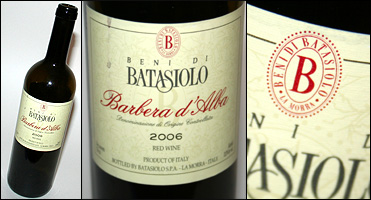
The nose on this wine is fairly tight at first, but give it a few minutes to open up. It’s not very fruit forward—which is typical for a Barbera. Cedar, loads of mushroom and light cherry aromas make up the bouquet. There is moderate fruit on the palate, with mostly cherry flavors. It has soft tannins and near perfect acidity. The length and aftertaste are both great. In general it’s fairly simple and soft wine that will easily pair with foods.
For the most part this is a varietally correct wine. It lacks a little bit of intensity and complexity, which is why my score came in at an 85. But it’s a very enjoyable wine. In fact, this was the crowd favorite with most of those who tried it with me. And at only $10, it’s a budget favorite too.
Wine: Beni di Batasiolo
Variety: Barbera
Vintage: 2006
Alcohol: 13.5%
Rating: 85
Price: $9.99
Find Beni di Batasiolo Barbera with Snooth
Elio Altare – Dolcetto d’Alba
Similar to Barbera, Dolcetto is considered one of the “lesser” grape varieties from this region… lesser to Nebbiolo is really what that means. Dolcetto is a grape that ripens early and produces a wine that is best consumed young, and for these reasons it is often a second variety grown by Nebbiolo producers. Growers are able to harvest these grapes before the Nebbiolo is ripe and winemakers are able to sell these wines without the aging required by Nebbiolo-based wines.
The name, Dolcetto, means “little sweet one” and although I wouldn’t classify this as a sweet wine it is a lot more fruit forward than the Barbera. Dolcetto also tends to be less acidic and more tannic than Barbera.
The Elio Altare winery started as a family farm and winery when Giuseppe Altare purchased it in 1948. In the mid-1970’s and at the age of 26, Elio Altare began to change the winemaking techniques based on knowledge he gained in other winemaking regions, such as Burgundy. Today the winery is still a family run operation and is producing some outstanding wines—this being one of them.
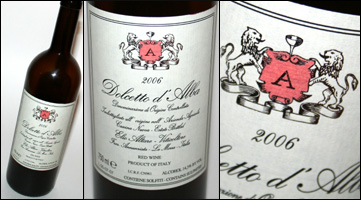
The first thing you’ll notice about this wine is a dark, inky purple color. There’s loads of intensity on the nose, which is a bit smoky and complex with tar, blueberry, prune, vanilla and licorice. The palate is filled with abundant ripe fruit. Lots of blueberry, plum, black cherry and pepper. Silky tannins and an outstanding finish make this a very enjoyable wine.
Although I thought this was very much varietally correct and an outstanding wine, it wasn’t the crowd favorite. Many of those I shared this wine with found it to be too big for their palates, but if you like big wines this is a good one.
Wine: Elio Altare
Variety: Dolcetto
Vintage: 2006
Alcohol: 14.5%
Rating: 90
Price: $17.69
Find Elio Altare Dolcetto with Snooth
Travaglini Giancarlo – Gattinara
Like Barolo and Barbaresco, this wine is produced from the Nebbiolo grape, but it is classified as Gattinara based on the region where it is produced. One of the things I like about this wine is that you can enjoy the characteristics of a Nebbiolo-based wine at a more affordable price than most Barolo and Barbaresco—although you can find some rather pricey Gattinara too.
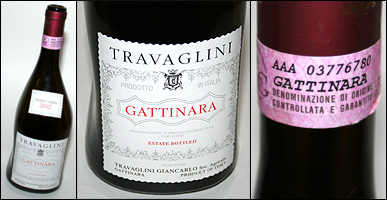
Travaglini is probably the best known producer of Gattinara and they produce a few different labels of it, this one being the most affordable. The bottle for this wine was a crowd pleaser and a couple folks commented that they would buy this just for the bottle. Travaglini claims that the bottle shape serves a purpose too, to hold the sediment in the bottle when you pour the wine.
The nose of this wine is spicy and interesting. It’s very smoky, with cinammon, raisin and pencil shavings. The palate is rich and well balanced, with dried cherry, raisin, black pepper. Velvety tannins lead into a long finish.
To me, this is a great wine and I could drink it any day.
Wine: Travaglini Giancarlo
Variety: Gattinara
Vintage: 2002
Alcohol: 13.5%
Rating: 89
Price: $19.91
Lately I’ve been doing a lot of odds and ends with my wine reviews and neglecting the “themed series” approach. I have a couple themes in the works in the tasting room (i.e. my office in front of the computer). But before I get into those series I have a couple more odds and ends. Today it’s a Chardonnay.
A couple weeks ago I did a review about the X Winery Zinfandel, which I enjoyed. I’ve also heard some buzz about their Carneros Chardonnay, so I thought it would be good to give that one a shot and get a review posted here.
In my writeup about the Zinfandel I was speculating about the origins of the X Winery name. A rep from the company contacted me to share the story of the origin. Apparently when they were trying to come up with names for the winery they had a list of possible names and started to put X’s next to the names that they liked. When they went back to the list, they realized that they liked the X’s more than any of the names so they went with it.
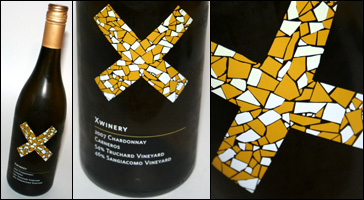
The grapes for this Chardonnay are sourced from two highly acclaimed Carneros vineyards: Sangiocomo Vineyards in Sonoma County (which has been the grape origin for a number of award winning wines) and Truchard Vineyards in Napa Valley (whose wines have also won their share of awards).
In a nutshell, the X Winery Chardonnay is very good—one of the best I’ve had in quite a while. The nose has a nice blend of pear, floral/honeysuckle, straw and pineapple. The palate is rich, filled with pear and vanilla, followed by lemon on the finish. It’s perfectly balanced and the finish pleasantly lingers.
It’s not going to work for the $10 and under crowd, but if you’re willing to spend a few dollars more, this is a very nice wine.
Wine: X Winery
Variety: Chardonnay
Vintage: 2007
Alcohol: 14.5%
Rating: 91
Price: $18.99
Find X Winery Chardonnay with Snooth
If you want to share something sweet this Valentine’s Day there are a number of fantastic dessert wines you can try. I don’t drink a lot of dessert wine, but when I do I like to be adventurous and try new things.
Monbazillac is something that you probably haven’t had before, but you may want to give it a shot. It’s a wine produced from grapes effected by noble rot. When I first heard of noble rot, I didn’t know what to think. “Noble” sounds like a good thing, but “rot” does not sound so appealing. And grapes effected with this benign fungus look much more rotten than they look noble. In fact, if I came across grapes looking like this on my grape vines I’d be inclined to put on a pair of latex gloves that go up to my elbow to remove this contaminated-looking mess. Making wine from the grapes would not even cross my mind.
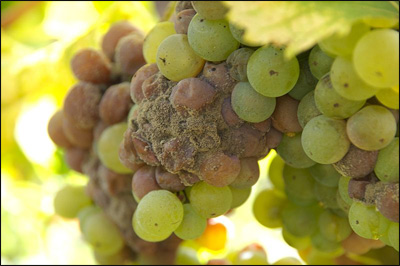
Image Source: WikiMedia Commons
Luckily, someone at some point in time decided to try making wine with these grapes and the results are spectacular. Noble rot removes much of the moisture from the grapes, this results in a high natural sugar level in the grapes which can be used to make concentrated sweet wines. These are also referred to as botrytized wines, named after botrytis (the fungus that causes noble rot.)
The most renowned botrytized wine is Sauternes, which is made from Semillon, Sauvignon Blanc and Muscadelle grapes in the Sauternes region of France. Sauternes is often an exceptional wine, but it also tends to be rather pricey. Better deals can be found with wines from neighboring regions, such as Monbazillac. In a way, you can think of Monbazillac as a “poor man’s Sauternes.”
Monbazillac, like Sauternes, can be produced with different blends of Semillon, Sauvignon Blanc and/or Muscadelle. The blend in this Monbazillac from Grande Maison includes 35% Muscadelle, 50 % Semillon and 15% Sauvignon Blanc.
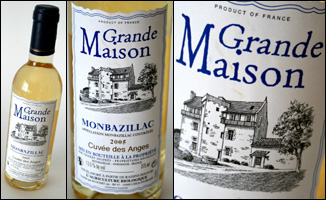
The first thing I notice about this wine is a somewhat grassy aroma. There is also a nutty quality along with some pear, lemon and mineral in the bouquet. The palate is apple, pear and soft peach with honey on the long and lingering finish.
This is a very nice dessert wine and only $10.59 for a 375ml bottle. I should note that many dessert wines come in smaller bottles and the prices are what you would expect to pay for a full size bottle of non-dessert wine. But you will typically consume a lot less of a dessert wine at one sitting than you would a table wine.
Wine: Grande Maison – Cuvee des Anges
Variety: Monbazillac
Vintage: 2005
Alcohol: 13.5%
Rating: 89
Price: $10.59 (375ml)
Find Grande Maison Monbazillac with Snooth
Welcome to WordPress. This is your first post. Edit or delete it, then start blogging!

 Prev
Prev