There’s a thing that wine bloggers do called “Wine Blogging Wednesday.” It’s an event that happens once every month… usually on a Wednesday. The idea is that several wine bloggers all write about the same topic that day. Then there’s a host, who summarizes the collective thoughts and points you to all the writers for that theme. I used to participate in it every month, but I haven’t done so for the past six months or so. It’s good to get back in it today.
The host this month is Michelle, the author of My Wine Education. And her theme is “Snow Day Wine,” which I interpret as meaning we should write about a wine we would want to drink on a day when we’re snowed in at home.
To me, being snowed in is a time when I want some comfort foods, which for me means Italian. Yep, if it’s cold and ugly outside I crave baked mostaccioli or gnocchi with homemade marinara sauce. And I want a good Chianti or Sangiovese to go with it. In order to give this another twist, I decided to pick a Californian Sangiovese rather than an Italian.
To be honest, I generally would prefer an Italian Sangiovese over a Californian one due to the acidity and aromatics I expect from the Italian ones. They go great with food and I just find them interesting. Those I’ve had from California tend to be much more fruit-forward and less aromatic.
So, I pour a glass of 2007 Luna Vineyards, Napa Valley Sangiovese and I’m pleasantly surprised. While it’s definitely a “new world” style of wine and very different from an old-world, Italian Sangiovese , it’s still really good.
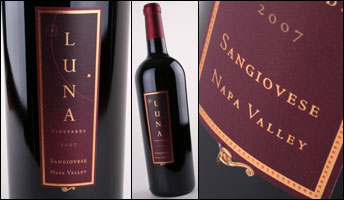
It’s spicy on the nose, with cloves, white pepper, red raspberry, black cherry and an ever-so-slight barnyard. The palate is big and full of ripe fruit, like juicy raspberry, black cherry, currant and plum. A little bit of dark chocolate shows up mid-palate and it finishes with a black cherry flavor that lasts and lasts. It doesn’t have the acidity you would find in most Italian Sangiovese and is more fruit-forward, making it clearly a “new world” wine. The tannins are perfect for drinking now. While it’s not what I would typically look for in a Sangiovese (i.e. old world style) it’s still a very enjoyable wine.
The suggested retail price is $25.00, which is slightly higher than we typically go here, but I expect you could find it for less if you shop around. When I work the rating numbers on it, I get an 89-point-something. But hey, it’s a snow day… let’s round up and give this one a 90.
Wine: Luna Vineyards Sangiovese
Variety: Sangiovese
Vintage: 2007
Alcohol: 14.1%
Rating: 90
Price: $25.00
Find Luna Vineyards Sangiovese with Snooth
Disclosure: This wine was received as a sample.
Espiritu de Chile is a joint venture between A. Racke from Germany and Aresti Vineyards in Chile. And while they have a long list of awards, accolades and good reviews from well-respected reviewers I don’t expect they’ll be adding the 2007 Classic Carménère to that list. I guess not all the wines I review can be stellar.
Espiritu de Chile produces two tiers of wine: Classic and Gran Reserva. Classic being the lower priced tier, and the only one I’ve tasted.
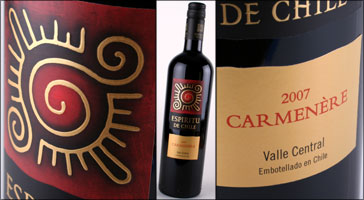
This Carménère has an intense green pepper aroma on the nose, which is indicative of under-ripe grapes. I don’t mind a little of this aroma—in fact I think a little bit makes a wine interesting—but it’s too intense on this one. There’s also quite a bit of smoky oak and dark berries on the nose. The flavors are mostly blackberry, plum and a touch of coffee. The finish tastes like green pepper. It’s still a drinkable wine, but not ideal.
Wine: Espiritu de Chile Classic Carménère
Variety: Carménère
Vintage: 2007
Alcohol: 13.5%
Rating: 81
Price: $10.00
Disclosure: This wine was received as a sample.
We’ve previously reviewed a number of good wines from Cono Sur, and I’d even go so far as to say I’m a fan. The breadth of the wines they produce is phenomenal and the quality of what we’ve tasted has been consistently good.
I think of them as an innovative and experimental producer from Chile, willing to try new techniques in order to improve the quality and character of their wines. They even produce some really unique styles of wine, like a Carmenere Rosé—which I haven’t tasted, but piques my curiosity.
The 2007 Cono Sur Visión Carménère continues the trend of good wine coming from Cono Sur. But this is one that I’d say is just “good” and not as good as some other wines I’ve tried from them.
Something that is interesting about this wine is the fact that they not only list the region on the label, Colchagua Valley, but they also list the block within their vineyard, Peumo. Not that this is an unheard of practice, but I don’t see this on many wines in this price range. Why does it matter? If you really like this wine, there’s a good chance that you’ll find some consistency with wine from this block and can look for it in future vintages.
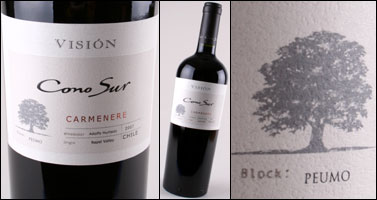
Licorice, blackberry, black cherry and pine aromas give it good complexity and make it interesting. The palate is rich and fruit-filled with big blackberry and black cherry flavors. There’s also a bit of a coffee flavor. The tannins are heavy, making it slightly astringent, but overall it has a nice mouth feel. The dark berries and tannins coat your tongue and cling to it for a long finish.
Wine: Cono Sur Visión Carménère
Variety: Carménère
Vintage: 2007
Alcohol: 13.5%
Rating: 85
Price: $15.00
Disclosure: This wine was received as a sample.
Viña La Rosa is one of the oldest wineries in Chile, established in 1824 by don Francisco Ignacio Ossa y Mercado. That’s a name and a half, if you ask me.
I’m not going to get into a lot of background on this wine, but instead jump ahead to, “90 alert, 90 alert!!!” As a website focused on relatively inexpensive wine, we don’t come across a lot of wine that we score in the 90’s. There’s a lot of good wine, some very good wine, but the exceptional wine is limited in this price range. And at $18, this is edging toward the upper end of our price range. I realize that it’s just a number, and some folks detest the 100 point system, but what I’m really saying here is “this is an awesome wine!”
And while the 2008 was exceptional, we also tasted a bottle of the 2006 that was flawed and undrinkable. So, if you seek this wine out, be sure to check the vintage.
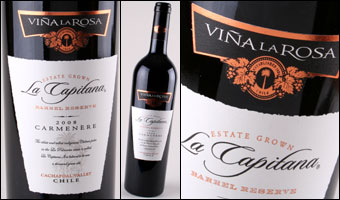
Chocolate is all over the nose of this wine, along with plum and nutmeg. The palate is filled with rich fruit, particularly luscious blackberry and blueberry, and that fruit lasts for a long, long, long finish. There’s a little smokiness to this wine, which is most noticeable on the finish. This is a very elegant wine and is exceptional for the price.
Wine: Viña La Rosa La Capitana
Variety: Carménère
Vintage: 2008
Alcohol: 14.5%
Rating: 90
Price: $13.00
Disclosure: This wine was received as a sample.
The story of Odjfell Vineyards began about 25 years ago when Norwegian ship owner Dan Odfjell acquired property in the Maipo Valley of Chile. However, the planting of vineyards didn’t begin until about 15 years ago. They now have vineyards in a few different Chilean appellations.
In addition to wine production, they also breed Norwegian Fjord Ponies on the Odfjell property. Hence the pony image on the label.
This Carménère is labeled as being from “Central Valley” but if you look at the wine regions in Chile you’ll find that there is no Central Valley. In fact, this wine is 50% from Maipo and 50% from Colchagua. The term “Central Valley” is a generalization, rather than a specific wine region. Because the grapes in this wine come from two different regions it must be categorized as Central Valley.
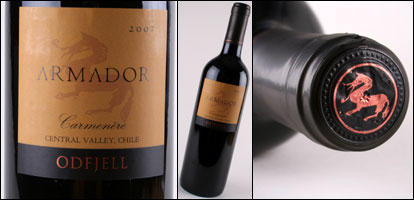
Dark fruits, blackberry and currant are prevalent on the nose of this wine and a little musty mushroom aroma makes it interesting. There’s a touch of green pepper too, which is common in Carménère and indicative that the fruit wasn’t fully ripe at harvest. Carménère is a late-ripening variety, which can be problematic for producers. Personally, I don’t mind a little bit of the green pepper aroma. I think it can add interest and character to a wine, but too much of it can be a problem. In this wine, I don’t think it’s too strong. On the palate, the fruit is dark and rich. Smooth tannins give a nice mouth feel. The finish brings a touch of black pepper, which I always like.
Wine: Odfjell Armador
Variety: Carménère
Vintage: 2007
Alcohol: 13.5%
Rating: 86
Price: $13.00
Find Odfjell Armador Carménère with Snooth
Disclosure: This wine was received as a sample.
Let’s check out another ten dollar Carménère today, this one from Santa Carolina.
Although the popularity of Chilean wines has only recently exploded in the US, Santa Carolina has been around since 1875. Founded by Luis Pereyra Cotapos, it was named after his wife, Carolina Iñiguez Vicuña. The roots of wine production at Santa Carolina come from French winemakers, led by enologist Germain Bachelet, recruited to establish the vineyards and production. Their original cellar is still in use today and was declared a national monument in 1973.
One thing you may notice on a lot of Chilean wine is the word “reserva.” It should be noted that while in some regions, “reserve” has a specific meaning (e.g. number of years in oak), in Chile it is just a marketing term with no consistent definition.
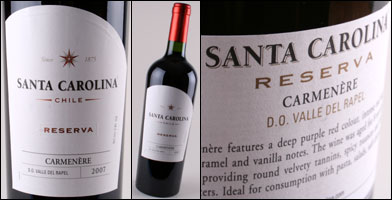
This Carménère has a powerful nose, with big, luscious red and black fruit, toasted oak and vanilla. Oak is all over this wine. The palate shows red raspberry and cherry, but not a whole lot of complexity. Firm tannins and good acidity give the wine nice structure—particularly for a wine of this price. For $10 it’s a decent Carménère.
Wine: Santa Carolina Reserva
Variety: Carménère
Vintage: 2007
Alcohol: 14%
Rating: 85
Price: $10.00
Find Santa Carolina Reserva Carménère with Snooth
You may also want to check out our review of the 2007 Santa Carolina “Reserva de Familia” Carménère.
Disclosure: This wine was received as a sample.
As I’ve mentioned in previous posts, Carménère is a variety once used in Bordeaux wines that has recently made a resurgence. It was always a difficult grape in Bordeaux, due mostly to late ripening. And then it was wiped in France, in part by a phylloxera infestation in the 1880’s. For years it was considered a lost grape, but was actually still growing in Chile, misidentified as Merlot for years. It was actually in the vineyards of Viña Carmen that Carménère was rediscovered and they just celebrated the 15th anniversary of that rediscovery this past fall.
This particular Carménère is also a wine that you can read about in my recent column about bargain-priced Chilean red wines in the January/February issue of Mutineer Magazine.
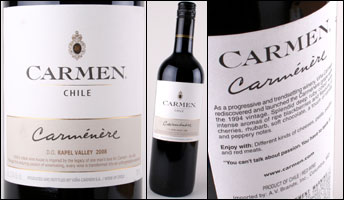
Cinnamon, cedar and cherry give this wine a pleasant nose. The palate has plenty of fresh cherry and raspberry flavors, and black pepper and coffee come in on the finish to make it interesting. It’s not going to blow you away, but for ten bucks it’s a decent Carmenére.
Wine: Viña Carmen
Variety: Carménère
Vintage: 2008
Alcohol: 13.5%
Rating: 85
Price: $10.00
Find Viña Carmen Carménère with Snooth
Disclosure: This wine was received as a sample.
As I think back on the wines we’ve tasted over the past year, one stands out in my mind as being really interesting… and I’m just now getting it posted to the site. Perhaps it stands out, in part, because we tasted it near the end of the year, but it is also just a cool wine. And you’ll see with this review that it’s not all about the numbers. I really, really dig this wine and yet it didn’t get a 90+ rating. Why not? Because it could have had a bit more concentration in the flavors and finish was good but not extraordinary. Still, I love this wine!
Terra Andina is a winery, not a vineyard, meaning that they source their grapes from other growers rather than managing their own vineyards. This gives them the ability to select grapes from different regions of Chile without managing their own vineyards in those regions. They are headquartered in Santiago and owned by Claro Group, the same company that owns Santa Rita winery, Carmen, Doña Paula and other Chilean wine properties.
The blend in the 2007 Terra Andina Altos Carménère Carignan is 60% Carménère, a traditional Bordeaux grape variety that was once thought lost until it was rediscovered in Chile. The other 40% is obviously Carignan, another old world grape variety most prevalent in France, and in particular the Languedoc-Roussillon region. Terra Andina is the first Chilean producer to release a Carménère Carignan blend, and I’m glad they did.
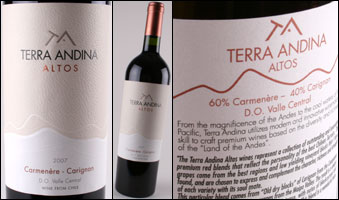
This is a really interesting wine. There’s a ton of complexity and unique, yet pleasing characteristics to the nose, with aromas of stewed tomatoes, cherry, cola and pencil shavings. There’s also plenty of fruit flavors on the palate, primarily plum and blueberry. White pepper and oak come in on the finish. One of the things I love about this wine is that it has an old world, rustic quality as well as a new world fruit quality.
The stewed tomato characteristic makes me want to enjoy this wine with a tomato-based pasta dish. I think it would pair beautifully. This is a cool wine.
Wine: Terra Andina Altos
Variety: Carménère Carignan blend
Vintage: 2007
Alcohol: 14%
Rating: 88
Price: $19.00
Find Terra Andina Altos Carménère Carignan with Snooth
Disclosure: This wine was received as a sample.
I have one more Silvaner from Castell to share with you, but this one isn’t 100% Silvaner. It’s a blend of 80% Silvaner and 20% Traminer, which is technically a family of grape varieties—the most well known of which is Gewürztraminer—but in Germany they tend to refer to all grapes from this family as just “Traminer.” And it may in fact be Gewürztraminer that they used.
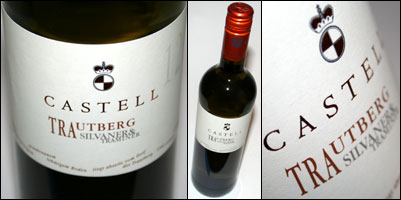
This wine is extremely floral on the nose. It also shows some white peach and lychee aromas. This is one of those wines that I could sit and smell for hours, as I just find it that fascinating. I know, I’m a geek. It not only smells great, but it tastes nice too, with lychee, apple, honeydew and citrus on the palate with amazing acidity. The acidity gives the fruit an exceptionally fresh characteristic, which I think is a big plus in this wine. The finish is quite long and enjoyable too.
Although it’s at the upper end of our “cheap” wine price range, it’s an interesting and enjoyable wine.
Wine: Castell Trautberg
Variety: Silvaner Traminer blend
Vintage: 2008
Alcohol: 13.5%
Rating: 88
Price: $20.00
Disclosure: This wine was received as a sample.
Continuing the theme from yesterday, today’s review is another Silvaner from Castell.
I mentioned in the review of Castell Trocken Silvaner that it is from Germany, but I didn’t mention which part of Germany. Both the Trocken and the Kugelspiel come from the Franken wine region in the state of Bavaria. This is one of the best regions for Silvaner, due to the pronounced acidity from the grapes grown in this region.
I mentioned yesterday that some Silvaner can be downright interesting, and this is a great example of that. And to make it even better, it’s really fun to say, “Koo-gull-shpeel.”
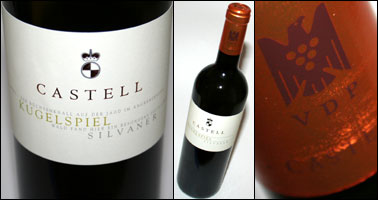
One of the things that can distinguish a good wine from a great wine is the intensity, and there is a ton of intensity on the nose of the Castell Kugelspiel. Intensity and complexity, with aromas such as honeysuckle, apple, banana, subtle lime and a touch of mineral. There’s plenty going on on the palate too, mostly tropical fruit like pineapple, caramelized pears (I know that sounds very specific, but it’s the perfect description) and banana. The tropical fruit and mineral linger on the finish. To put it simply, this is an exceptional wine.
Wine: Castell Kugelspiel
Variety: Silvaner
Vintage: 2006
Alcohol: 13%
Rating: 90
Price: $20.00
Disclosure: This wine was received as a sample.

 Prev
Prev