Cono Sur is a Chilean wine brand that I’ve grown to trust for good to very good wines, but I have yet to taste one of their wines that blows me away as exceptional. Yet, I’ll take that good consistency as an attribute for which they deserve credit. And while I don’t recall ever looking at a Cono Sur wine and saying, “Yes! That’s my favorite!” I do know that when I’m offered one of their wines my expectation is that it will be good.
If there is a particular Cono Sur wine that you want to check out, you do need to pay attention to the name as they have several different lines of wine. This one is from their “Organic” line, which you can identify at a glance by the bicycle on the label.

It’s a little bit restrained on the nose, but very nice nonetheless. There’s a wet stone aroma that is cool and calming, and it just makes me smile. There’s also soft citrus and a little bit of vegetal aroma, but not much. The acidity and mouth feel are spot on. This one has a lot of green apple flavor and a little bit of lemon. The apple lasts well into the finish. Consistent with my general take on Cono Sur wine, I like this one a lot but it doesn’t totally blow me away.
Wine: Cono Sur Organic
Variety: Sauvignon Blanc
Vintage: 2009
Alcohol: 13.5%
Rating: 86
Price: $13.00
Find Cono Sur Organic Sauvignon Blanc with Snooth
Here’s what others thought of the this wine:
Disclosure: This wine was received as a sample.
Although I often say that Chilean sauvignon blanc is my favorite, New Zealand is right up there too. And, to cut to the chase, this Brancott sauvignon blanc from Marlborough, New Zealand totally kicks ass.
Those who know me, know that I’m always critical of myself. I constantly question my performance at work, play, or whatever I do, which motivates me to study more, practice more and employ rigorous processes around everything that I do. Some might consider this to be neurotic, but knowing about the Dunning-Kruger effect, I consider self doubt to be a good thing.
I mention all that to say that my self doubt also comes into play when I’m reviewing wines. I spend a good 15-20 minutes per wine when I’m taking tasting notes to be sure that I’m doing justice to the wines. And when I taste a really good or really bad one, I come back to try it again later to make sure that I wasn’t just having a fluke moment with my palate. Yet, with all this self doubt I do have some validating moments that reassure me that I’m doing things right — or at least consistent with others — and reviewing this wine was one of those moments.
I first tasted this wine as a part of a blind tasting and it instantly stood out to me as an outstanding wine. I ended up giving it 91 points. I shared it with some colleagues the next day, along with a few other wines, and I told them that this one was exceptional. I didn’t even realize until a few moments ago, when I sat down to write up this post, that this wine was #28 on Wine Spectator’s top 100 list from last year. They gave it a 92. I’m glad to see that we’re aligned on this one and it does give me some validation to see that my rating is pretty consistent with one of the established “authorities” on wine.
The price of this wine might be toward the top end of the price range for bargain hunters, but it might be worth a few extra bucks if you’re into sauvignon blanc.
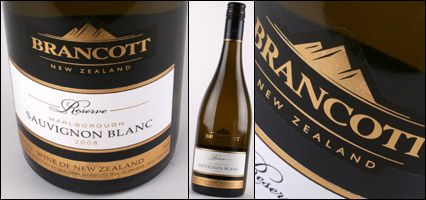
This wine screams “New Zealand Sauvignon Blanc” with intense grassy and tropical fruit aromas. The acidity is outstanding, giving this wine a brightness on the tongue. I know that may sound weird, but it’s the best way to describe it. Pineapple, grapefruit, mango and melon flavors explode in your mouth and last for minutes on the finish. The intensity and concentration from this wine is incredible. This is an exceptional sauvignon blanc.
Wine: Brancott Reserve
Variety: Sauvignon Blanc
Vintage: 2008
Alcohol: 13.5%
Rating: 91
Price: $19.00
Find Brancott Reserve Sauvignon Blanc with Snooth
Here’s what others thought of the this wine:
Disclosure: This wine was received as a sample.
This morning I was watching the news and this video came on of a bull in Spain jumping up into the stands and chasing spectators. When I saw the bull leap into the stands, I immediately thought of the Dancing Bull logo. So, tonight we review a sauvignon blanc from Dancing Bull.
But first, here’s the video of that bull “dancing” all over some spectators.
[youtube=http://www.youtube.com/watch?v=4W2T5swEH3s]
The Dancing Bull Sauvignon Blanc is a California SB, and that’s as specific as the appellation gets. That means that grapes for this wine were sourced from various regions in California, but most came from the Central Coast and Sonoma County. Now, California isn’t typically my top pick for sauvignon blanc. I’ve had a few from California that I’ve liked, but I’ve found that I generally have better luck with those from Chile or New Zealand. So given that California isn’t my top pick for this variety and this is not an appellation specific wine, I wasn’t really expecting much from this wine, but I was pleasantly surprised.

Grapefruit, artichoke, green apple and tropical fruit aromas give this wine good character and complexity on the nose. It has great acidity on the palate with refreshing citrus flavors like grapefruit and lime. The finish is crisply acidic too, and there’s kind of a salty citrus aftertaste, like a margarita from a salted rim glass. All told, this is a nice, tropical sauvignon blanc.
Wine: Dancing Bull
Variety: Sauvignon Blanc
Vintage: 2008
Alcohol: 13.5%
Rating: 86
Price: $12.00
Find Dancing Bull Sauvignon Blanc with Snooth
Here’s what others thought of the this wine:
Disclosure: This wine was received as a sample.
This isn’t the first time we’ve reviewed the Veramonte Reserva Sauvignon Blanc. The 2008 vintage was exceptional. It’s one of those wines that was memorable and thus became a “go t0” wine. If we needed a good Sauvignon Blanc and didn’t want to put much thought to it, Veramonte was our choice. And with this affinity for Veramonte Sauvignon Blanc, we was thrilled to taste the 2009 vintage.
But this is where I get to make a point that it is important to note the vintage, because while the 2009 vintage of this wine is good, it’s not quite the mind-blowing experience that the 2008 was… OK, I might be going overboard with the “mind-blowing” language, but I’m a geek, I get excited about good wines.
Veramonte is a Chilean wine, and from the Casablanca Valley — where most of our favorite Chilean Sauvignon Blanc comes from.
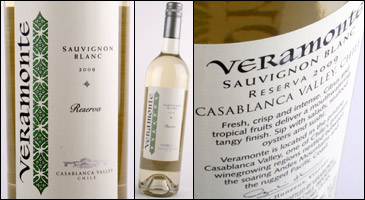
Grapefruit, wet stones, melon and a touch of fresh cut grass give this Sauvignon Blanc refreshing aromas. It’s super-citrusy on the palate with fresh squeezed grapefruit and lemon flavors that give you a slight pucker, but some melon flavors mellow it out. The mid-palate brings Granny Smith apple flavors that last into the finish where you’ll also get a reprise of lemon. This is a mega-citrus example of Sauvignon Blanc and with that I’d recommend enjoying this with Tuna Tartare. Yum.
Wine: Veramonte
Variety: Sauvignon Blanc
Vintage: 2009
Alcohol: 13.5%
Rating: 86
Price: $11.00
Find Veramonte Reserva Sauvignon Blanc with Snooth
Here’s what others thought of the this wine:
Disclosure: This wine was received as a sample.
It should come as no surprise to anyone whose been reading this site for some time that Chile is one of our favorite regions for Sauvignon Blanc. But what you might not have noticed is that our favorite Chilean SB (shorthand for Sauvignon Blanc) usually come from the Casablanca Valley region. But with this wine from Haras, we found an SB from Maipo Valley to get excited about.
Haras de Pirque made its first wines in the 2000 vintage, but the history of the property goes back a little further. The owner, Eduardo A. Matte, purchased the estate in 1991, when it was just a thoroughbred horse farm. He has since improved the horse farm and, obviously, launched the winery. You may notice the horse images on their packaging, a reflection of the dual-mission of the estate — to breed exceptional horses and produce distinctive wines.
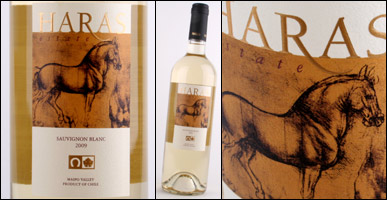
“Tangy, tangy, tangy” was the first thing I said when I smelled this wine. But as I explore it further, I find that there’s quite a bit going on with this wine… quite a bit that I like. Cool melon, flint and citrus aromas are most prevalent. It has a touch of green to it, which smells somewhat like tomato leaf. The palate is filled with lemon, melon and apple flavors. The acidity is nice and crisp, nearly perfect. This is a very good SB.
Wine: Haras de Pirque
Variety: Sauvignon Blanc
Vintage: 2009
Alcohol: 13%
Rating: 88
Price: $12.00
Find Haras Sauvignon Blanc with Snooth
Here’s what others thought of the this wine:
Disclosure: This wine was received as a sample.
OK, so here’s a review that’s a little different than most that we do here, due to the fact that this is really a “wine drink” rather than just a wine. In other words, flavors were added— citrus flavors, to be exact. Given that fact, I’m not going to give it a score, because my scoring methods require measures like “varietal correctness” and I have no way to gauge that. Instead, I’ll just give you the scoop on my thoughts about sangria and about this Reál Sangria.
First of all, I love sangria. Red sangria is actually the first wine drink I remember tasting when I was just 13 years old on a visit to Spain. But I like both red sangria and white sangria. I’ve made them both numerous times. When I make sangria, I just use some inexpensive Spanish wine (usually grenache), fresh fruit, some brandy, triple sec, sugar and Sprite or just a club soda. Here’s my sangria recipe, for the red version anyway. So, I’m accustomed to mixing my own sangria rather than using a pre-made version, but I was curious how Reál Sangria would compare.
Reál Sangria White is labeled as being made with Spanish white wine and natural citrus flavors. I’m not really sure what that means. I would expect it to have natural citrus juices, but that’s not what it says. The label also states that the alcohol level is 7 – 10%, which struck me as odd as I would expect a consistent production process to yield a consistent alcohol level. I inquired with the PR rep about that, but didn’t get a reply. It retails for $6.99 – $8.99 (depending on region) for a 750 ml bottle.
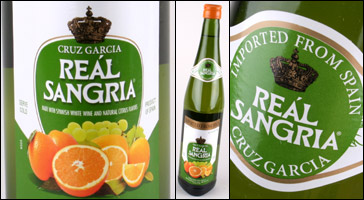
The aromas smell much more orange-like than wine-like, and it’s kind of an artificial orange too. It reminds me a bit of Sunkist soda. On the palate, it’s very sweet — which is to be expected from a wine in the 7 – 10% abv range. And I don’t have a problem with sweet wines as long as that sweetness is well balanced with acidity. But this drink is somewhat off-balance to me with a sugary sweetness that overpowers any other flavors. The aftertaste is that of sugar-coated orange slices — you know, the candy ones.
It’s best served on ice, and/or used as a mixer (i.e. add a bunch of fresh fruit or fruit juice to it). On its own, this isn’t really my cup of tea, due to the fact that I can’t really taste anything wine-like in it. I prefer my sangria to have more wine flavors along with fresh citrus and other fruits.
Given that this didn’t strike my fancy, I asked my wife, Robyn, to give it a shot. She loves sangria — even more than I do — although we both generally prefer red versus white. Her review: “It’s pretty good on ice, with a salty snack… if you’re desperate.” She then finished the bottle.
I guess she was desperate.
Disclosure: This product was received as a sample.
A few months back I decided to fill out an application for the Wine Century Club, a group that you can become a member of after you’ve tasted 100 different grape varieties. I sat down with the application and picked my brain for which varieties I’ve tasted. It was easy to come up with about 60, but then I was stuck. Just past half way I found myself left with more tasting to do. Since then I’ve worked my way up to about 80, but it’s tough for someone focused on everyday wines to come across 100 different varieties. But I’ll get there soon.
Given this Wine Century challenge, I’m always excited when I come across a wine with unique grape varieties in it and thanks to Big House Red I was able to check off two more: tannat and sagrantino. And if you’re just starting your Wine Century adventure you could be 13% done with one sip of Big House Red. That’s right, there are a whopping 13 different grape varieties in this wine and the Wine Century Club does allow wines in blends to be counted. Well, that’s true in most cases but there is one exception, the 2005 Giribaldi Cento Uve Lange DOC which has a staggering 152 grape varieties in one bottle and has been ruled as a non-qualifying wine for initial membership. So, my quest continues.
The 2008 Big House Red is a blend of 23% syrah, 14% petite sirah, 9% grenache, 9% montepulciano, 6% mourvedre, 6% sangiovese, 6% aglianico, 6% tannat, 5% nero d’avola, 4% sagrantino, 3% touriga, 3% barbera and 3% petite verdot. The wine was barrel aged in mostly French and American neutral oak.
This wine is available as either a bottled wine or a bag-in-box, but we only tasted the boxed version. And it’s no ordinary box, rather it’s an “Octavin Home Wine Bar” which is branded name for an octagon-shaped box. It looks a little nicer than a regular square box, but to my eyes it functions the same as any other bag-in-box packaging.
The artwork on the label is a little campy / cartoony, which doesn’t set the mood I usually want with a wine, but the juice inside is what really counts.

The complexity on the nose of this wine is outstanding, but not surprising with all the different grapes that go into it. It has mostly raspberry and cherry aromas, but also some cola, leather and black pepper. The palate is bursting with plum, cranberry, red raspberry and black cherry flavors with some spicy pepper kicking in on the finish. The acidity is nearly perfect and smooth tannins give it a nice mouth feel.
It’s not what I would call an elegant wine, but more of a fruit bomb. But it’s still enjoyable as a fruit bomb. This would be a good wine to enjoy with burgers off the grill.
Wine: Big House Red
Variety: Red Blend
Vintage: 2008
Alcohol: 13.5%
Rating: 85
Price: $21.99 for 3L (equivalent to $5.50 per bottle)
Here’s what others thought of the this wine:
Disclosure: This wine was received as a sample.
As the story goes, in 2006 a veteran winemaker worked alongside his protégé Boyd Morrison to explore old world winemaking traditions and in so doing realized a wine with a new world style. Morrison used that inspiration to create Apothic Red. The wine is a blend of zinfandel, Syrah and Merlot.
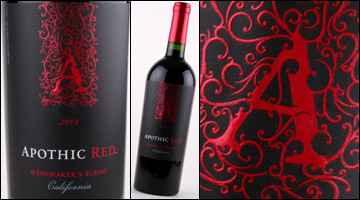
This is a dark colored wine with aromas that also smell… well… dark—like chocolate, black pepper and salami. Underneath those earthy aromas there are some sweet cola and berry aromas too. It has a full mouth feel that’s bursting with ripe cherry and cola flavors. It takes on a vanilla characteristic on the finish, and that sticks with you for some time. This is not your run-of-the-mill, average cheap wine. It’s different. It’s interesting. But be warned, it is a little bit on the sweet side for a red. It’s not a sweet wine, just sweeter (if that makes sense). Still, if you like to explore different wines, this one is worth a shot.
Wine: Apothic Red Winemaker’s Blend
Variety: Red Blend
Vintage: 2008
Alcohol: 13.1%
Rating: 85
Price: $14.00
Here’s what others thought of the this wine:
Update: Check out our review of the 2009 Apothic Red.
Disclosure: This wine was received as a sample.
Earlier this week I was invited to take part in a Twitter tasting with several other wine writers to taste two types of Beaujolais wine. We were sent the wines in advance and were given a date and time to collectively taste them. But I messed up. Yikes!! I put it down on my calendar for Thursday, but it was actually on Tuesday. Whoops. It’s very much unlike me to miss something like this, but I guess it proves that I’m human. I feel bad for missing the event too — it was one I was looking forward to.
But just because I missed the Twitter tasting, doesn’t mean I’m not going to try the wines. And writing my thoughts here will ultimately get a lot more visibility than anything I put on Twitter, which is about as impacting as a fart in the wind.
A Brief Background on Beaujolais
Beaujolais is a French wine from a particular part of Burgundy and is made from a specific grape – gamay, which by many is not considered to be one of the better grapes for wine making. But it can produce some interesting wines. That said, there are certainly plenty of critics when it comes to gamay.
You may have heard of Beaujolais Nouveau, which comes out in the fall as the first release of the year’s wine. It’s very young and fruity, and usually not very good in my opinion. But there is lot’s of marketing behind it so people drink it up and pretend that it’s good. The wines in this review is much better than Beaujolais Nouveau, but they are also made from gamay.
There are different appellations of Beaujolais — as there are with all French wines.
- Beaujolais AOC is the lowest grade and much of the Beaujolais Nouveau comes from this appellation.
- Beaujolais-Villages AOC is a step up and is a designation given to Beaujolais from specific villages considered to produce better quality grapes.
- Cru Beaujolais is the cream of the crop when it comes to Beaujolais and these wines are named for the specific appellations from which they are produced. Moulin-a-Vent is one of those Cru appellations, and is considered by many to be the best.
While most Beaujolais is consumed young, that from Moulin-a-Vent is oaked and aged for a couple years before being released. And it can be aged for 20+ years. Well-aged Moulin-a-Vent is said to take on characteristics similar to aged Pinot Noir.
About The Ratings
This is actually an interesting type of wine to rate as it raises a philosophical dilemma — aside from the whole debate about numbered ratings, which I’m not even going to debate today. The dilemma is, should the rating of a wine suffer from weaknesses inherent in the grape variety?
One of the lenses I use when rating any wine is “varietal correctness.” For example, is the color of the wine correct for the variety? Are the aromas correct for the variety? Etc. Using that lens, any variety could theoretically be a 100 point wine if it is overwhelmingly exceptional for that variety. While at the same time, that 100 point wine may not be nearly as enjoyable to most consumers as an 85 point wine of another variety.
However, consumers don’t necessarily look at wine ratings with the lens of varietal correctness. Many consumers would expect that a 100 point wine must be “better” – or more enjoyable to them – than an 85 point wine regardless of the fact that they are different varieties.
Ultimately, any wine review is subjective at some level. It’s hard to taste a wine with weaknesses inherent to the variety and see through it well enough to score it without some bias.
If, as a reviewer, you’re going to use numbers, I think the answer is somewhere in the middle. While I cannot see “punishing” a wine for characteristics inherent to the variety, I also can’t see ignoring those characteristics if they diminish the enjoyability of a wine. So, while varietal correctness is used as a lens for part of the score, the “overall impression” of the wine is an important factor and it must be impressive to garner a solid rating.
This also highlights the importance of looking beyond the numbers and getting more context. This is why I try to not just provide a rating, but give you a description of the wines we review. The numbers may be OK as a general guide, but don’t let them be the sole basis for your wine buying decisions.
I should also note that although we taste most wines blind, these ones were not. I didn’t really see a reason to taste them blind as I didn’t have any bias for the brands. I do have some bias when it comes to gamay as a grape variety, but there was no way to taste these without knowing they are gamay. And although I have a bias against gamay, you may be surprised when you see the ratings. I really did enjoy these wines.
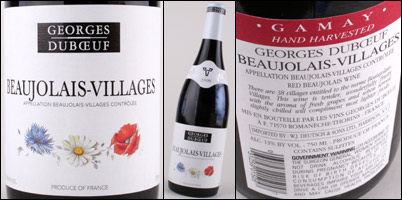
Georges Duboeuf
Beaujolais-Villages
This wine is a beautiful, purple color and while it is on the light side the color is deeper than I expected it would be. On the nose the aromas are mostly strawberry and banana, kind of like strawberry-banana jello. It also shows some cherry. The intensity is pretty good and it’s enjoyable to smell this wine.
On the palate it’s strawberry flavors galore. There are some other red fruit notes too, like red plum. The acidity is adequate, but not over the top. And while Gamay is generally not a very tannic wine, I’m getting some tannins on the palate. The finish is relatively quick and fruity. It’s nice, light wine with a fresh quality to it.
Wine: Georges Duboeuf
Variety: Beaujolais-Villages
Vintage: 2009
Alcohol: 13%
Rating: 84
Price: $12.00
Find Georges Duboeuf Beaujolais-Villages with Snooth
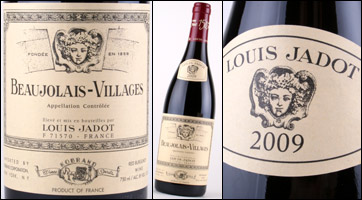
Louis Jadot
Beaujolais-Villages
This is a light, purple-red colored wine. The aromas are raspberry, cherry and some floral notes, but the intensity on the nose is a little soft. The flavors are consistent with the aromas, with raspberry and cherry being the story to tell. It has nice, crisp acidity. The finish is fairly long with lingering raspberry flavors. It’s pleasant wine but the lack of depth on the palate leaves me wanting something with more concentration.
Wine: Louis Jadot
Variety: Beaujolais-Villages
Vintage: 2009
Alcohol: 12.5%
Rating: 82
Price: $13.00
Find Louis Jadot Beaujolais-Villages with Snooth
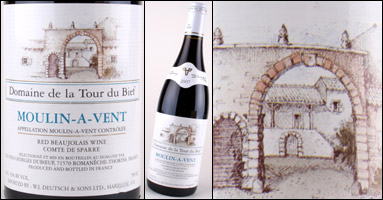
Georges Duboeuf
Domaine de la Tour de Bief, Moulin-a-Vent
The color is much lighter and more red than the Beaujolais-Villages. The nose has some really interesting spice notes, like orange peel and black pepper. It’s a bit herbal/earthy too, and wild cherry aromas fill it out. I’d even say the aromas are a bit Nebbiolo-esque, which means I dig it. And when I say that I don’t mean like a Barolo, but like a young, non-DOC Nebbiolo. I know to some of you I’m really going out on a limb with that description, but that’s how it’s striking me.
The flavors are nice, but a bit thin — not that surprising from a Beaujolais. It’s cherry flavors up front with a pop of raspberry on the finish, which is quite long. The acidity and tannins are great. It’s a good wine.
Wine: Georges Duboeuf, Domaine de la Tour de Bief
Variety: Moulin-a-Vent
Vintage: 2007
Alcohol: 13%
Rating: 87
Price: $17.00
Find Domaine de la Tour de Bief, Moulin-a-Vent with Snooth
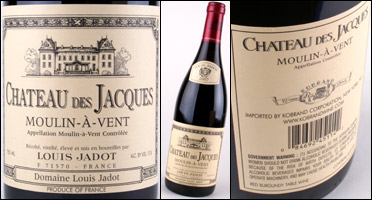
Louis Jadot
Chateau des Jacques, Moulin-a-Vent
This wine is brick red in color with medium opacity. I’m finding some really fun and exciting spices on the nose of this wine, like cedar, cola and mint. The palate is pure cherry with good tannins and acidity. The finish is medium in length with cherry and spice flavors. It’s a nice wine and I expect it would be better with a couple more years in the bottle.
Wine: Louis Jadot, Chateau des Jacques
Variety: Moulin-a-Vent
Vintage: 2007
Alcohol: 13%
Rating: 85
Price: $19.00
Find Chateau des Jacques, Moulin-a-Vent with Snooth
Disclosure: These wines were received as a sample.
You’ve probably seen this wine on the shelves of your local grocery store — that is, if they sell wine at grocery stores in your area. Regardless, my point is that this is a mass-produced and widely distributed wine. It’s made by the Bronco Wine Company, the same folks who are famous for producing Two-Buck Chuck.
A number of years ago there was actually some controversy surrounding this wine. At one point in time Napa Valley vintners accused Bronco Wine Company of exploiting the Napa name by calling their wine Napa Ridge when it wasn’t from Napa Valley. But that has since changed and Napa Ridge is actually from Napa Valley these days.
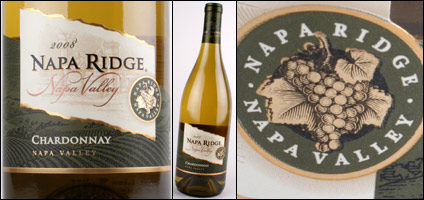
There’s a bit of an earthy, hay-like aroma on the nose of this wine. It also shows vanilla and apple characteristics. The flavor is like lemon-drenched apples and honeydew melon. It’s slightly harsh and off balance when it hits your tongue. There’s a little bit of heat on the finish too. It’s a drinkable chardonnay, but not a top pick.
Wine: Napa Ridge
Variety: Chardonnay
Vintage: 2008
Alcohol: 12.5%
Rating: 82
Price: $12.00
Disclosure: This wine was received as a sample.

 Prev
Prev