With terms like spatlese, kabinett, auslese, trocken, halbtrocken, combinations of those terms and more, there is a definite learning curve to understanding German riesling — or German wines in general. And those terms all represent different styles of riesling. Being “into riesling” isn’t as easy as being “into cabernet sauvignon” where you can pretty much leave it at that (although some wine nerds will push you for a style there too). If you like riesling you have a plethora of styles to choose from. You may like all of them, or you may have a preference for a specific style. All regions that grow riesling can do different styles, but with Germany you get a consistent taxonomy to the names. Therefore, while there is a learning curve at first, it can help you consistently pick the wines you’re more likely to enjoy.
This riesling from G.H von Mumm is a trocken, which means it’s a dry style. And this one is bone dry!
The 50° reference in the name comes from the location of the vineyards where the grapes for this wine are grown. It’s from the Rheingau region and the 50th degree of latitude runs through the center of the region.
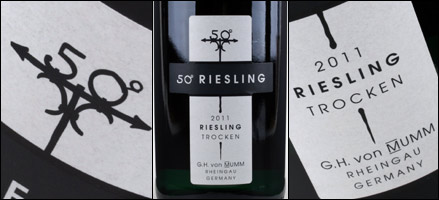
Orange blossom, lime and mineral aromas give this wine a pleasant nose. The palate is bone dry with mostly mineral and lime flavors, but there is a hint of peach tucked underneath those. The acidity is stellar and the mouth feel is good. It finishes with mostly mineral flavors, but a touch of green apple gives it some depth. This is a fairly simple riesling, but quite enjoyable.
Wine: G.H. von Mumm 50° Riesling Trocken
Variety: Riesling
Vintage: 2011
Alcohol: 12%
Rating: 86
Price: $13.00
Find G.H. von Mumm 50° Riesling Trocken with Snooth
Disclosure: This wine was received as a media sample.
Hello again. It’s been over a week since we’ve had a chance to update, thanks to a little bit of travel. But we’re still focused on riesling. And yes, that is a reason to celebrate.
While we’ve reviewed a number of different rieslings in the past few weeks, and a number of German rieslings in particular, one German region we haven’t highlighted yet is Pfalz. This is actually the second largest wine region in Germany. Rheinhessen, directly to the north of Pfalz, is the largest. You may also see Pfalz referred to as Palatinate, the English name for the region.
Like many German vintners, Reichsrat von Buhl has a long history going back to 1849. Since 2008 the estate has been working towards obtaining organic certification.
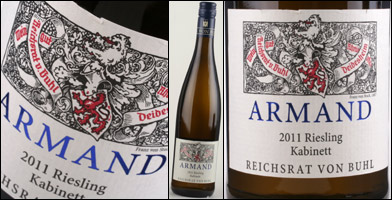
Honeysuckle, lime and pear aromas give this wine a pleasant nose, although the intensity is just moderate. The palate is semi-sweet with flavors like lime, apple, pineapple and peach. The acidity is good. It has an ever-so-slight effervensence, giving a like prickle to the mouth feel, which is fun and livens the wine up a bit. It finishes with a lingering sweetened-lime flavor, sort of margarita-like.
Wine: Reichsrat von Buhl Armand Riesling
Variety: Riesling
Vintage: 2011
Alcohol: 8.5%
Rating: 88
Price: $20.00
Find Reichsrat von Buhl Armand Riesling with Snooth
Disclosure: This wine was received as a media sample.
I have an idea. How about another riesling review?
This one from the impossible-for-any-American-to-spell-correctly Schloss Reinhartshausen winery in Rheingau, Germany. Those who’ve been reading our other recent riesling reviews will know that Rheingau is the region along the River Rhine.
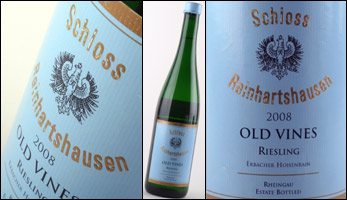
The nose is pretty nice, with rose petal, peach and pear aromas. The palate is off-dry (i.e. slightly sweet) with really nice apple and peach flavors. The acidity is good and adds some lemon notes to the palate. It finishes with a little bit of peach flavor, more apple and a touch of mineral. It’s a nice wine. The sweetness makes it pair well with spicy Thai food.
Wine: Schloss Reinhartshausen Old Vines Riesling
Variety: Riesling
Vintage: 2008
Alcohol: 12%
Rating: 87
Price: $20.00
Find Schloss Reinhartshausen Old Vines Riesling with Snooth
Disclosure: This wine was received as a media sample.
Every now and then we receive samples of wine that sell for more than our typical $20 maximum limit and while we like to stay true to our mission (i.e. cheap wine ratings) we’re not foolish. We’re still going to taste those wines. After all, if we never taste a $50 wine how can we legitimately ever say that a $10 bottle tastes like a $50 bottle? Not that I’ve ever used that analogy. Regardless, if we tasted it, we might as well review it. I know a few of you spring for the more expensive bottles now and then anyway. So here goes…
Hans Lang is a relatively small producer, with just 18 hectares of vineyards in the Hattenheim and Assmannshausen regions of the Rheingau (Rhine river region). The grapes for this particular wine come from Hattenheim.
This wine is labeled as a Erstes Gewächs, which is the German equivalent of a Grand Cru. As such, the appellation where this wine was produced has been recognized for producing top quality wines and the production methods adhere to strict guidelines for the classification.
So, how does this premium riesling deliver?
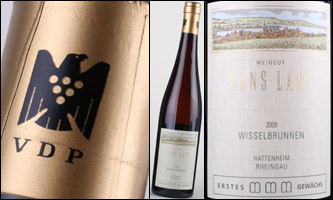
The nose is soft, but I wouldn’t call it tight. It’s nicely balanced, elegant and shows delicious aromas like orange peel, pear, mineral and a slight touch of floral. The palate is dry and tasty, offering green apple, pear and lime flavors. The orange peel aromatics reemerge on the finish and give a light, orange aftertaste which is very enjoyable. The acidity is good. All told, this is a lovely, dry riesling.
Is it worth $50? It’s hard for me to ever pay $50 for a bottle that I’ll consume in short order. But if you occasionally splurge on a bottle, you won’t be disappointed with this wine.
Wine: Hans Lang Wisselbrunnen Erstes Gewächs Riesling
Variety: Riesling
Vintage: 2009
Alcohol: 13%
Rating: 90
Price: $50.00
Find Hans Lang Wisselbrunnen Erstes Gewächs Riesling with Snooth
Disclosure: This wine was received as a media sample.
Do you know Nahe? Nahe is a wine region in Germany along the… you guessed it, River Nahe. If you don’t know this river, it’s a relatively small river that is a tributary to the Rhine (a relatively big river). The Nahe is east of Luxembourg, if that helps give you a sense of location. While the history of wine in Nahe doesn’t go back as far as other regions, like Mosel, it has established itself as a top quality region. It’s a region most known for its white wines and riesling is the most common grape here.
While I know that Hooked riesling is from the Nahe region, they don’t say exactly where within the Nahe it originates. There are actually a few different sub-regions within Nahe. But I think it’s fair to say that a bargain wine like this is unlikely to be from a specific, singular appellation.
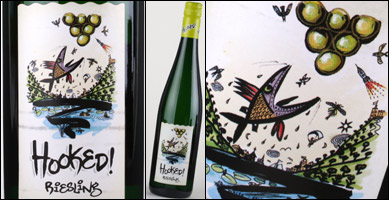
This is a fairly predictable, but still quite enjoyable riesling. The aromas are citrus, apple, mineral and a touch of perfume. The palate is off dry with delicious flavors of apple, peach and pear. The acidity is sufficient, but not out of this world. It finishes with lingering apple and citrus flavors.
Overall, I’d say it’s good. It doesn’t totally knock my socks off. But then again, it’s only $12 and at that price it’s great.
Wine: Hooked Riesling
Variety: Riesling
Vintage: 2008
Alcohol: 9.5%
Rating: 86
Price: $12.00
Find Hooked Riesling with Snooth
Disclosure: This wine was received as a media sample.
Compared to other European wine brands Dr. Hermann is relatively young, with the estate being established in 1967. Although similar to the stories of many European winemakers, the history of winemaking in the Hermann family goes back hundreds of years.
The Dr. Hermann estate is run by Rudi Hermann and his son Christian. The vineyards are in Mosel, along the banks of the Saar river. They produce a number of different rieslings and consider the H to be their “basic riesling.”
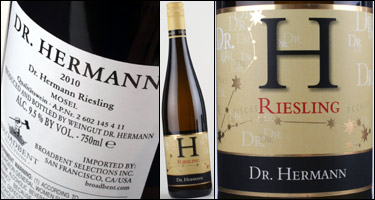
The nose is really nice, with honeysuckle, pear and citrus aromas. There’s a faint touch of kerosene aroma underneath all that. The palate brings a sweet apple and pear flavor with sufficient acidity. It evolves into a peach & apple flavor on the mid palate and into the finish. It has a slight effervesence to the mouth feel. If you’re into sweet riesling, this is definitely one to check out.
Wine: Dr. Hermann, H Riesling
Variety: Riesling
Vintage: 2010
Alcohol: 9.5%
Rating: 87
Price: $17.00
Find Dr. Hermann, H Riesling with Snooth
Disclosure: This wine was received as a media sample.
We’ve been checking out a lot of riesling lately, so let’s continue that trend with another one from the Mosel region in Germany.
This wine is part of the Bronco Wine Company portfolio, which is probably best known as the producer or “Two Buck Chuck” but is also the company behind 50+ other bargain wine brands. If there’s an ultra-cheap wine that you really like, there’s a good chance that wine comes from Bronco.
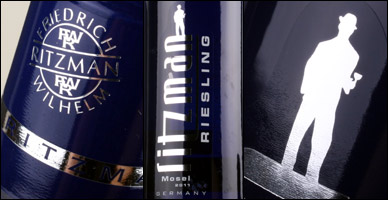
There are a lot of tropical fruit aromas coming from this riesling, so much that I might guess it was a sauvignon blanc if I didn’t know differently. It shows plenty of citrus, melon and some green pepper. The palate is much more riesling-like, with apple, citrus and tart peach flavors. Although it’s labeled as “semi-sweet” it comes across on the drier side. It finishes with lime-drenched apple flavors. It’s decent, but not nothing spectacular.
Wine: Ritzman Riesling
Variety: Riesling
Vintage: 2011
Alcohol: 9.5%
Rating: 84
Price: $14.99
Find Ritzman Riesling with Snooth
Disclosure: This wine was received as a media sample.
It’s another hot summer day, so it’s perfect weather for another riesling review. Like the Geil riesling we reviewed yesterday, this one from Selbach is also a Kabinett style. However, this one comes from the Mosel region.
Riesling accounts for about 60% of the grapes grown in the Mosel region. It’s an area that I haven’t visited yet, but it’s high on the list of places I’d like to see. The slopes are steep in this region, along the Moselle river, requiring most vineyard work to be done by hand rather than by machine. And when you realize all the manual labor that goes into a wine like this, the $17 price seems like a steal.
This wine is made by renowned winemaker Johannes Selbach as a “second label” wine, not to be confused with Selbach-Oster wines. In other words, this is the budget line while Selbach-Oster is the premium line.
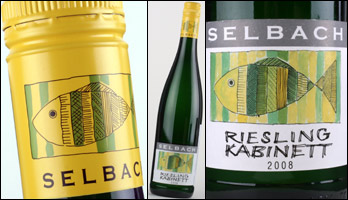
The nose on this riesling is a little tight, and leans toward the mineral (salts and petrol) versus the fruit side of the spectrum. That’s not to say it’s void of fruit, there is a touch of apple, but it’s subtle. The palate is a different story. This wine is off dry, offering a touch of sweetness, and it’s brimming with lemon/lime flavors. As such, it almost has a 7UP-like quality. It also offers some apple flavors. The acidity is good, giving the wine a bright expression on the palate. The finish is also bright and citrusy.
Wine: Selbach Kabinett Riesling
Variety: Riesling
Vintage: 2008
Alcohol: 9%
Rating: 85
Price: $17.00
Find Selbach Kabinett Riesling with Snooth
Disclosure: This wine was received as a media sample.
This is one of those moments in life when I find myself rather busy and I’m at risk of neglecting this website. But, of course, I don’t want to do that. So tonight I’m just going to give you a quickie review of another riesling.
This one is a Kabinett riesling from Geil in the Rheinhessen region along the left bank of the Rhine river in Germany. The Kabinett designation translates to “cabinet” which means this is a wine to tuck away in the cabinet for a few years before drinking it. Kabinett wines are typically semi-sweet, as is the case with this one, unless they are labeled as “trocken” (dry) or “halbtrocken” (off-dry).
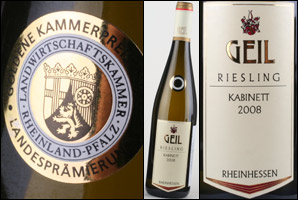
The nose is fairly muted on this wine, but not unpleasant. It offers subtle mineral, honeysuckle and lemon aromas. The palate is semi-sweet and has a predominantly apple flavor, although there is also a tropical nuance to it that is rather mango-like. The acidity is sufficient. It finishes with lingering apple and peach flavors. It’s definitely a nice, tasty riesling.
Wine: Geil Kabinett Riesling
Variety: Riesling
Vintage: 2008
Alcohol: 9%
Rating: 87
Price: $15.00
Find Geil Kabinett Riesling with Snooth
Disclosure: This wine was received as a media sample.
Recently, I’ve lauded Germany as a great region for riesling. I’m sure I’ve also sung praises for Austria, Alsace and Washington state in the past. But I don’t ever think I’ve brought up Australia as a region for riesling. I don’t have anything against Australia. It’s just not the first region that comes to mind for me when I think of riesling. But after tasting this one from Frisk, I’ll be thinking more about Australian riesling.
This wine comes from the Alpine Valley region in the Australian state of Victoria. This is a mountainous region with slopes going up to 2,000 feet. And by the taste of this wine, I’d say it’s a great region for riesling.
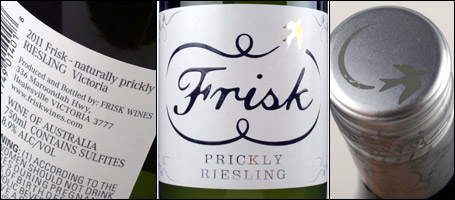
Well-balanced citrus, floral and melon aromas give this wine a pleasant nose. The palate has a slight effervescence, hence the “prickling” name. It’s not a full-on sparkling wine, it’s just ever-so-slightly bubbly, but that characteristic gives the wine a really nice mouth feel. The flavors are on the off-dry side and primarily citrus. It tastes a little bit like 7Up, but not quite that sweet. It’s tangy and delicious.
It’s an easy quaffer, at under 9% alcohol, and a great wine for a hot summer day. It would also be a superb choice to go with spicy Thai food.
Wine: Frisk Prickly Riesling
Variety: Riesling
Vintage: 2011
Alcohol: 8.9%
Rating: 89
Price: $7.99
Find Frisk Prickly Riesling with Snooth
Disclosure: This wine was received as a media sample.

 Prev
Prev