The best way to gain an understanding of a wine is to go where it’s made. Meet the people who produce it. Explore the vineyards. Experience the overall landscape. Smell the air of the region. And taste the wines along with the winemakers. Some may say that’s the only way to understand a wine.
I recently had a chance to do just that on a trip to visit the Mt. Etna DOC in Sicily. The trip was only a few days, so I can’t say that I truly, thoroughly know the wines. But I, along with about fifteen other wine writers, got a great introduction to the region of Mt. Etna, its people and the wines they create.
A couple weeks ago I published an overview of one of the wines we discovered there, Etna Bianco. And now I want to introduce you to another gem from the region, Etna Rosso.
Etna Rosso is a complex and exciting wine, filled with spice and character. At times, it can be edgy and daring… and that’s one of the things I love about it. It typically offers an interesting and harmonious blend of spice, bright fruit, herbs and earthiness. At its best, it’s magical. Etna Rosso has the character and personality that gets me excited about wine.
The Terroir of Mt. Etna
You might say that Etna Rosso is a reflection of the landscape, the people and the culture of Mt. Etna. After all, isn’t that what terroir is really about? Some might think that terroir is just a fancy, romantic concept that wine producers use to sell their wine, but I think there’s a legitimacy to it. It’s a combination of all the influences on a grape besides the vine itself. The climate, the soil, the exposure and the elevation, but also the people are all part of what makes a terroir. If you change any of those factors you’ll have a different wine. So then, what makes the terroir of Mt. Etna?
One of the first things I noticed in Mt. Etna was the aromatics. Walking through the vineyards of Etna, one can’t help but be overcome by the intense and delightful fragrances from the herbs and flowers scattered across the landscape. Oregano, citronella and other herbs and flowers are found everywhere. And after tasting the wines, one can’t help but think that the fragrances from these plants somehow make their way into the wines as Etna Rosso offers some of the same herbal aromatics.
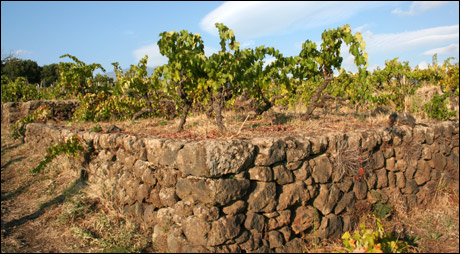
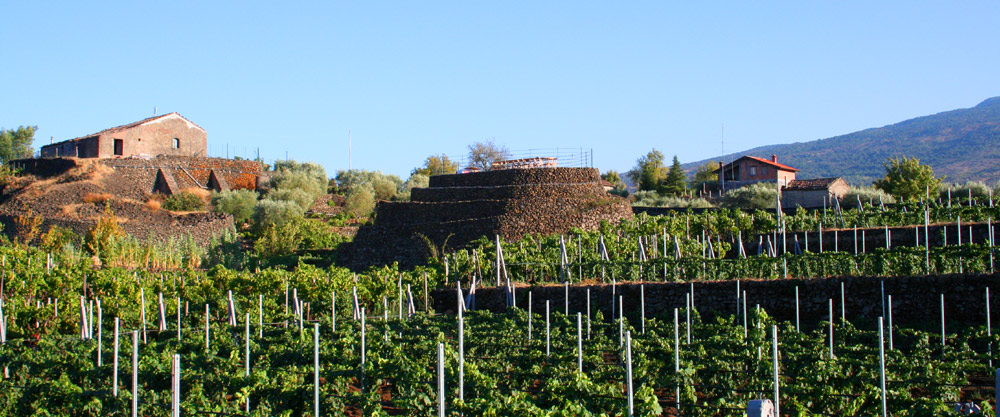
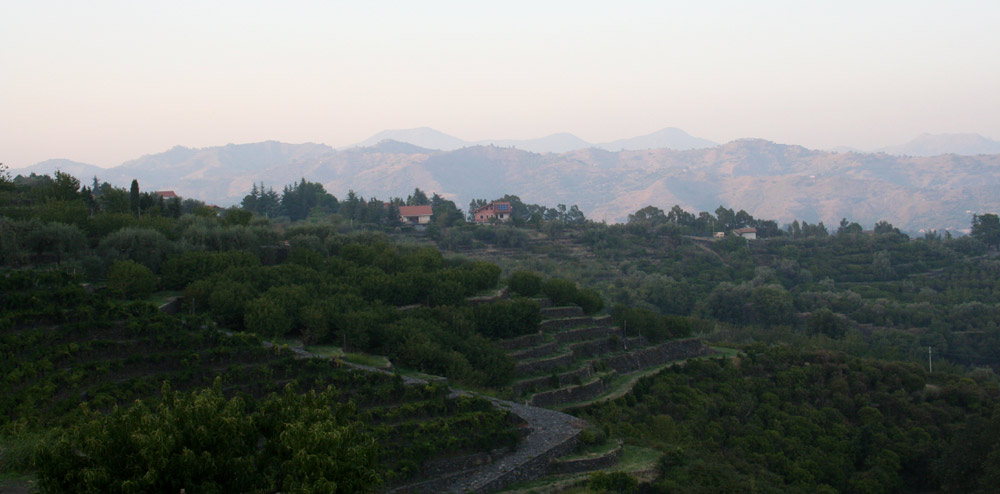
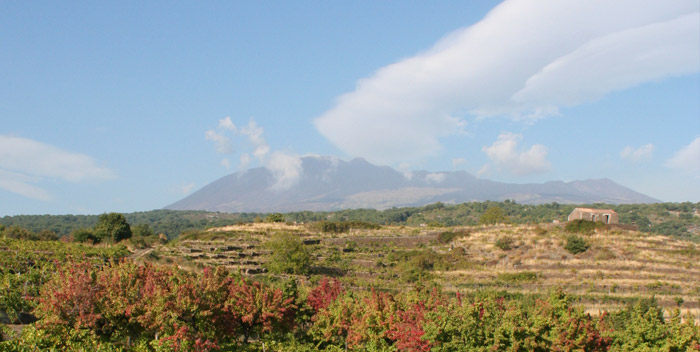
The vineyards themselves are beautiful, wild, rugged, romantic and tough all at once. Many of the vineyards are too steep for mechanical harvesting, meaning that all work must be done by hand. Some vineyards that we visited required driving up steep, pit-filled lava roads in 4-wheel drive jeeps and others required us to climb steep trails by foot.
Although many vineyards are now using more contemporary trellising, it’s also common to find vines grown with the traditional “albarello” (goblet) style training.
There’s a wildness to some of the vineyards, where albarello style vines are mixed in with herbs, bushes, nut trees and flowers in a chaotic but beautiful manner.
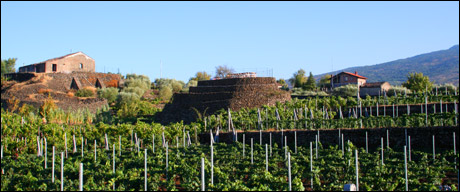
Many of the vineyards are terraced, using lava stones pulled from the soil. In one vineyard we visited they had removed so many stones from the soil that they used them to build a “torretta” ( a stone platform) where we stopped for a wine tasting.
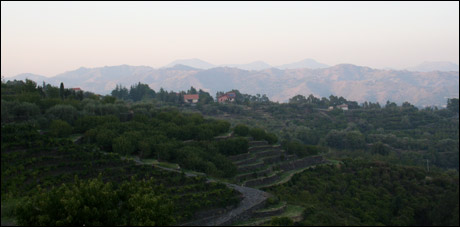
Wine producers here credit the minerals in the volcanic soil for much of the characteristics found in the wine.
Lava stones of all sizes are scattered throughout the vineyards and we were told that they fall from the sky whenever the volcano burps—which happens fairly often. Although Mt. Etna is a very active volcano, there isn’t a sense of impending doom from it in the vineyards, despite its intimidatingly massive size. Eruptions are common, but destructive pyroclastic and lava flows are not.
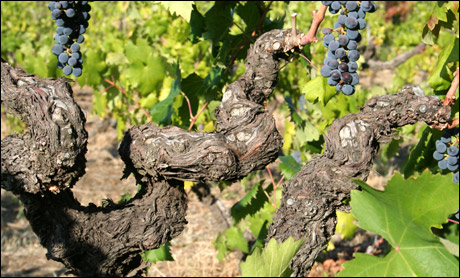
The vines are hearty. Most vineyards we visited, if not all, had vines that were 80-100 years old or more. We were shown one vine in one of Salvo Foti’s vineyards that we were told is over 200 years old.
The people of Mt. Etna are equally hearty, although not quite as old. It’s backbreaking work to maintain any vineyard, but add the steep grades in Etna along with the manual labor and I don’t know how they do it. But winemakers we met, such as Alberto Graci, Salvo Foti, Ciro Biondi, Marc de Grazia, Giuseppe Benanti and others seem to thrive on it.
There’s a true excitement about the wine that exudes from the winemakers here. While Etna has a long history connected to wine, the region has been experiencing a rebirth of its vineyards over the past 30 years and the current generation of winemakers have a seemingly endless energy and enthusiasm to push these wines further. They strive to preserve history, while adopting contemporary winemaking techniques where it makes sense to improve the quality of their wines. It’s all about balance.
Creating Etna Rosso is an art and I met a number of vintners who saw a synergy between art and their wine. Most notable were the producers at Al-Cantàra, who name their wines after Sicilian poems and have collaborated with hundreds of artists to develop artwork that reflects the poetry and the wine.
The Deliciousness of Etna Rosso
Etna Rosso is made primarily from Nerello Mascalese. Wine must be at least 80% Nerello Mascalese in order to be labeled as Etna Rosso DOC. This grape gives the wine its structure with rich tannins and vibrant acidity, but it also adds plenty of spicy and aromatic fruit.
And when it comes to fun grape names to pronounce, it doesn’t get much better than this. In case you don’t know it, the pronunciation is, neh-REHL-oh MAHS-kah-LEH-zeh.
A study done in 2008 suggests that Nerello Mascalese is related to Sangiovese, but it definitely has developed it’s own unique character.
The other main grape found in Etna Rosso is Nerello Cappuccio, which is also fun to say. It’s primarily added to take the edge off the potentially aggressive tannins from the Nerello Mascalese and to brighten up the color.
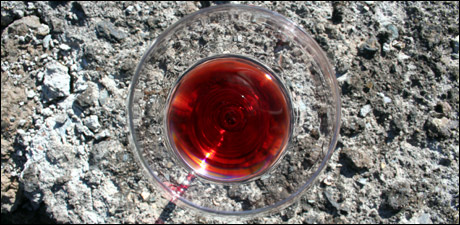
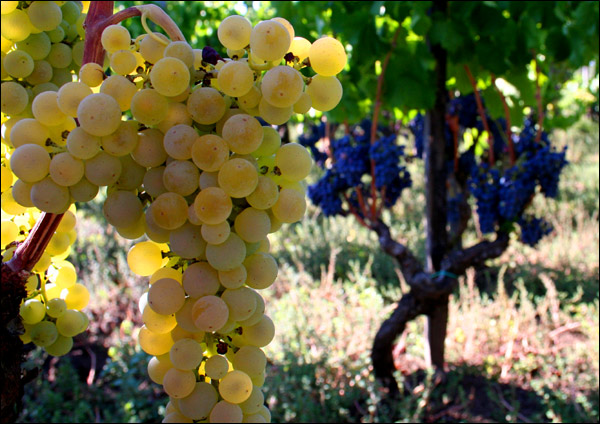
Nerello Mascalese tends to create a rather brownish wine while Nerello Cappuccio is more of a purplish-red. The brown hue from Nerello Mascalese is even visible in the ripe grapes themselves. And when looking at a glass of wine with a significant amount of Nerello Mascalese you might think it’s much older than it is, just due to the color.
My first impressions of Etna Rosso was that it reminded me of a Barolo, but a little more approachable. It offers similar spices, flavors, tannins and acidity, prompting me nickname the wine “nebbiolo junior.” But different from Barolo, Etna Rosso doesn’t need as much time in the bottle before it’s ready to consume. You might say Etna Rosso matures more quickly, but that’s not to say it can’t handle aging.
Going through my notes I found a lot of common themes, such as cherry, rasperry, powerful aromatics, bright acidity and tons of spice. It can be quite challenging to describe the nuances that distinguish one wine from the next and words like cherry, raspberry and spice just don’t do enough to explain what makes a wine stand out. It’s the balance, the harmony, the texture, the subtle surprises that make a wine special. And sometimes you can’t put that something special into words.
Regardless of the fact that my words can’t do enough to tell the full story of these wines, here are a few that stood out as something special, something to get excited about, something to remember.
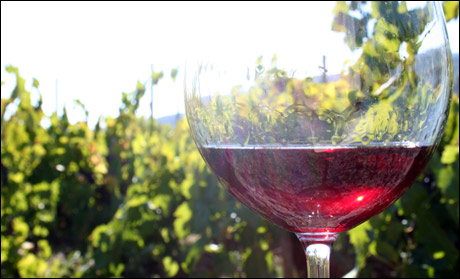
Benanti, Serra della Contessa, Etna Rosso DOC 2004
This wine exudes the character of Mt. Etna with deep, earthy aromatics like smoky mushrooms harmoniously counterbalanced by red plums and vanilla. The palate brings dense raspberry flavors with plenty of spice and firm tannins. The finish is seemingly never ending and delightful.
Tenuta Monte Ilice, Etna Rosso 2010
The complexity on the nose of this wine makes it interesting, offering cedar, leather, violet and plum aromatics. The palate is loaded with tasty raspberry flavors and spices. The tannins and acidity are perfect. It finishes long with a raspberry tea quality.
Al-Cantàra, O’Scuro O’Scuro, Etna Rosso DOC 2008
The artists at Al-Cantàra created a masterpiece with this wine, offering intense aromas of cherry and raspberry spiced with nutmeg and vanilla. It also shows some cured meat aromatics. The palate brings chewy red berry flavors balanced with a touch of earthiness. Enjoy this wine with charcuterie.
Girolamo Russo, A’Rina, Etna Rosso DOC 2010
Fresh and spicy red raspberry give this wine a bright and refreshing nose. Lively acidity makes the palate sing too, offering plenty of bright raspberry and cherry flavors. This one is all about the vibrant fruit flavors. The mouthfeel is nice too and the finish is relatively long.
Cottanera, Etna Rosso DOC 2008
Powerful floral fragrances give the wine a wow factor while red raspberry, cherry and nutmeg aromatics round it out. The acidity of this wine is superb, adding vibrancy to the cherry, raspberry and red plum flavors. And, of course, there’s plenty of spice on the palate too. Simply put, this is a lovely wine.
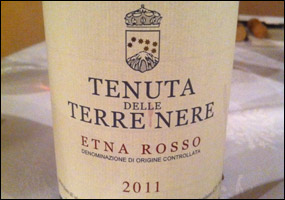
Tenuta della Terre Nere, Etna Rosso DOC 2011
This is the one that stood out above all the others for me. I had to keep going back to taste it again and again as it was simply amazing! The nose abounds with floral and red plum aromatics that have stratospheric intensity. It’s fascinating, harmonious and exciting. The palate brings what’s best described as “deliciousness.” The complex medley of raspberry, strawberry, plum and spice flavors are lively, dense and evocative. It finishes with a long raspberry tea flavor.
Although I geeked out over this wine and found it to be delightful, I actually found it a little challenging with food. The powerful aromatics and spices make it compete with some foods. Therefore, I’d recommend either enjoying this wine by itself or with simple cheeses.
Crasale, Etna Rosso DOC 2008
The nose of this wine is sexy and aggressive, offering a complex medley of intense nutmeg, cherry and raspberry offset with soft mushroom and a floral twist. Dense tannins and vibrant acidity give the wine an incredible mouthfeel. Concentrated raspberry and cherry flavors are coupled with intriguing spices. The finish is long and spicy.
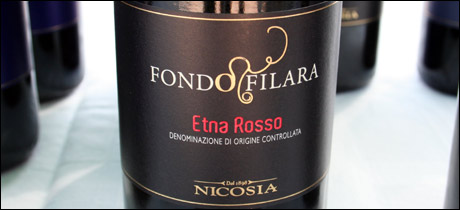
Nicosia, Fondo Filara, Etna Rosso DOC 2010
This is a beautiful wine, overflowing with violet, herb, raspberry and plum aromas. The palate is really well balanced, offering spicy raspberry and red plum flavors with herbal notes adding to the complexity. Chewy tannins give it a nice mouthfeel. Licorice, nutmeg and cherry flavors linger on the finish.
Disclosure: I tasted the wines of Etna as a part of a sponsored blogger tour of the region, organized by Consorzio Tutela Vini Etna D.O.C.. My travel and accommodations were provided by the sponsor.
When I got the email from the public relations representative asking if I wanted to try AC/DC wine, my reaction was instant. Yes! Absolutely! But that’s not because I expected it to be stellar wine, it just sounded like a fun thing to try. In fact, I didn’t have high expectations for the wine itself. I wanted it to rock. Seriously. I wanted to be able to come to this site and tell you that AC/DC wines kick ass. But, unfortunately, that’s not what happened.
The wine is OK. It’s not awesome. It’s not great. But it’s not horrible. It’s just OK. But, I guess, that’s OK. Because that’s not why you buy AC/DC wine. You don’t buy a bottle of AC/DC Back in Black shiraz to serve with your filet mignon, thinking it’s going to be the best red wine you’ve ever tasted. No… you buy it because it’s fun. You buy it because it’s cool. And that’s fine, because part of enjoying a bottle of wine is the total experience. Sure, you want the juice inside the bottle to be tasty, but if seeing Angus Young on a bottle of wine makes you happy and adds to the overall experience for you, then great!
There are actually a number of rock bands with their own wine brands now. Iron Maiden, Ratt, Motorhead and KISS all have wines bearing their band names. And celebrity association with wines is even more widespread. Some just license their name to a wine, some are investors in vineyards and some, like Maynard James Keenan from Tool, get really hands on with the winemaking process. As far as I can tell, the boys in AC/DC didn’t really get involved in the making of this wine as it was made by Warburn Estate.
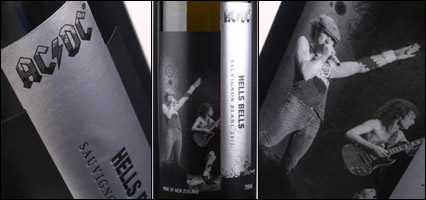
AC/DC Hells Bells Sauvignon Blanc
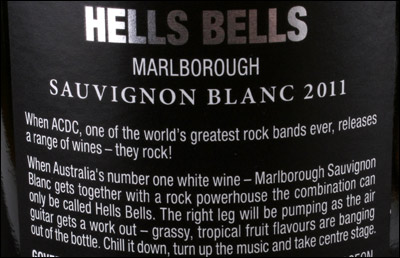
My favorite thing about this wine is the back label, which reads, “When Australia’s number one white wine — Marlborough Sauvignon Blanc, get’s together with a rock powerhouse…” OK, wait a minute. Marlborough Sauvignon Blanc is Australia’s number one white wine? But Marlborough is in New Zealand, a totally different country. Who did the fact checking for this label? Regardless of the poor world geography skills, I still wanted this wine to rock.
The nose of this wine is on the subtle side for a sauvignon blanc, although it does show some lime, celery, light tropical fruit and mineral aromatics. On the palate it tastes like a watered down sauvignon blanc, with the right flavors but a lack of concentration. It offers mostly green apple and citrus flavors. The aciditiy is good, giving it a nice pucker. The finish is rather quick. It’s not a bad wine, it’s just not a great one.
Wine: AC/DC Hells Bells
Variety: Sauvignon Blanc
Vintage: 2011
Alcohol: 12%
Rating: 84
Price: $17.99
Find AC/DC Hells Bells Sauvignon Blanc with Snooth
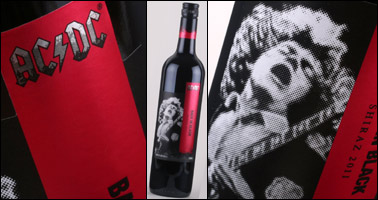
AC/DC Back in Black Shiraz
The first thing I noticed about this wine is that the color isn’t as dense as I would expect from a shiraz, it’s a little bit light. The nose is pleasant and offers plum, cherry and chocolate aromas. The palate is slightly tart and slightly sweet, with fresh, ripe fruit flavors like plum and cherry. It’s a little bitter on the finish. Overall, it’s a simple wine that’s drinkable, but nothing special.
Wine: AC/DC Back in Black
Variety: Shiraz
Vintage: 2011
Alcohol: 13%
Rating: 83
Price: $17.99
Find AC/DC Hells Bells Sauvignon Blanc with Snooth
Disclosure: This wine was received as a media sample.
I’ve highlighted a couple tasty Chilean, cool-climate chardonnays lately. So, today let’s round it out with a third. This one, from Concha y Toro, is another from the Limarí Valley.
Concha y Toro is the largest wine producer in Chile, and the largest in Latin America. Its roots go all the way back to 1883, when Don Melchor Concha y Toro brought vines from Bordeaux to the Maipo Valley region. Concha y Toro has a dozen or so different brands they produce, ranging from bargain brands to premium. The Marques de Casa Concha brand has been around since 1976 and is a low mid-price brand.
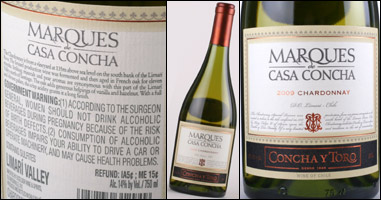
This chardonnay has a rather spicy and smoky nose. In terms of the fruit it’s mostly melon aromas. The palate offers green apple, melon and pineapple flavors, with outstanding acidity. The mid-palate and finish show a touch of spice too. It has a nice mouth feel and a long, tasty finish.
Wine: Concha y Toro Marques de Casa Concha Chardonnay
Variety: Chardonnay
Vintage: 2009
Alcohol: 14%
Rating: 88
Price: $19.00
Find Concha y Toro Marques de Casa Concha Chardonnay with Snooth
Disclosure: This wine was received as a media sample.
Last week, in my review of Santa Ema chardonnay, I had mentioned how cool climate regions tend to produce better chardonnay than other locations. And tonight I want to highlight another awesome chardonnay from another cool climate region.
De Martino Legado Reserva chardonnay is also from Chile, but this wine is from the Limarí Valley—a cool climate region in northern Chile. Now remember, Chile is south of the equator. Therefore, northern Chile is the closer end to the equator, which might intuitively make you think that this would be a hot region. But it’s all about the coastal influence. Cool air and fog from the Pacific has a strong impact on the climate of this valley, making it a great region for cool climate chardonnay.
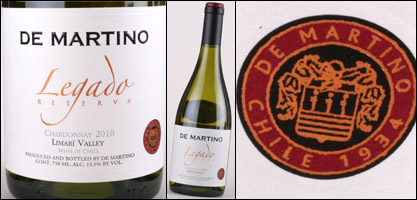
This wine has lovely, nutty and perfumey aromas along with some melon and peach fragrances. The palate has bright acidity with apple, citrus and caramelized peach flavors. The mouth feel is almost effervescent, making it refreshing and enjoyable. The finish is tangy and long lasting with melon flavors.
This is a beautiful wine and makes me want to drink more chardonnay… as long as it’s like this.
Wine: De Martino Legado Reserva Chardonnay
Variety: Chardonnay
Vintage: 2010
Alcohol: 13.5%
Rating: 89
Price: $16.00
Find De Martino Legado Reserva Chardonnay with Snooth
Disclosure: This wine was received as a media sample.
My quest to find the world’s most interesting and enjoyable wines recently brought me to the Mt. Etna DOC in eastern Sicily, where I discovered some serious awesomeness in their Etna Bianco. To be honest, I found awesomeness in many of the wines, food, culture, etc., but today I want to focus on Etna Bianco.
For those who want the short version of this story, the headline says it all. Etna Bianco is the perfect shellfish wine. Really, it’s perfect for pretty much any seafood but especially for shellfish. And I do mean perfect. It has stellar acidity, intense lemon flavors and saline mineral qualities. It’s lively, exciting and delicious. Boom! End of story. That’s all you need to know. But if you want more, read on.
The Mt. Etna wine region runs along the north, east and south of the Mt. Etna, which is the tallest active volcano in Europe and one of the most active volcanoes in the world. This produces mineral-rich, volcanic soils for the vineyards and plenty of micro-climates throughout the region with different exposures and elevations. These characteristics, along with native grape varieties, contribute to the unique wines of the region.
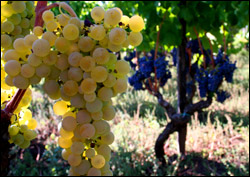 While the Etna region has centuries of history in winemaking, it’s really only within the past 30 years that contemporary Etna wines have become what they are today. Traditionally, Etna Bianco didn’t exist. The wine was a blend of everything in the vineyard. You can see that in how many of the old vineyards are planted, where white grape vines are intermingled with red grape vines—often in an “albarello” (goblet) style vine training. The traditional Etna wines were made from a field blend of everything in the vineyard, but today producers are much more selective with which grapes they put into their wine.
The winemakers of Etna have discovered how good an Etna Bianco can be, and the world is beginning to discover it creating a growing demand for this style of wine. While only a small percentage of the wines from Etna are currently white, a number of producers there are increasing their plantings of white grapes for Etna Bianco.
Carricante, a grape native to the region, is the main variety used in Etna Bianco. Wine labeled as Etna Bianco must have at least 60% carricante. Etna Bianco Superiore, which can only be produced from grapes grown in Milo, must contain a minimum of 80% carricante. Catarratto is the most common secondary grape allowed in Etna Bianco, however some other varieties are allowed. And while secondary grapes are allowed, the majority of the Etna Bianco that I tasted was 100% carricante.
Some of those who were traveling with me accused Etna Bianco of not having a consistent, defining style. As I reviewed all of my tasting notes, I can’t say that I agree with that. Yes, there is some variability but that could be said about most wines. Some were more austere and mineral-focused, some showed more intense citrus and some showed herbal or floral aromatics. But out-of-this-world acidity, tangy lemon and salty mineral were pretty much universal in all the Etna Bianco that I tasted.
The biggest difference I saw was in vinification style. The majority of the wines I tasted were vinified in stainless, but a few spent some time in barriques, which brought some creaminess to the texture and in some cases brought out stone fruit characteristics. I’m typically not a big fan of oak on white wines, but Etna Bianco I tasted that had been in barrique was amazing and I hope this is a style that more producers adopt.
While I’m fawning over Etna Bianco, I should note that not everyone thinks this is a wine for the masses. Marc de Grazia, the owner of Tenuta della Terre Nere, commented that “carricante isn’t for the uncultured palate.” I’m not sure what he means by that. I think it’s a very approachable wine. If you like good food and like good wine, I think you’ll like carricante. If that means you have a “cultured palate” then so be it.
This wine is also great for aging. With the intense acidity, it has the structure a wine needs to age with character. I had the opportunity to taste a 2001 Etna Bianco Superiore and it was outstanding, showing caramel flavors along with lemon and pear. The mouthfeel was creamy and smooth. The finish was long, tangy and very well balanced. In short, it was magical.
Now, the bad news about Etna Bianco is that I haven’t found many that are imported to the US at my ideal retail price of $20 or less. There are plenty that are reasonably-priced if you’re in Europe, but most of them making it to the US are a touch more expensive. However, I suspect that more will be imported as production volume increases and hopefully a couple bargains make it over here. Regardless, keep an eye out for Etna Bianco in your local wine shop.
If you’re dying to check this wine out, here are a few I would recommend seeking out.
Barone di Villagrande, Etna Bianco Superiore DOC 2011
This is one that I have found retailing for $20 in the US. The nose has a nice floral aspect to it, as well as plenty of lemon and mineral. On the palate the lemon and lime flavors sing with a lively acidity. And “lively” may be an understatement, it’s incredible! The finish is tangy with salty mineral notes. Barone di Villagrande is also the oldest winery in Etna that’s still producing wines, with a history going back to 1727.
Al-Cantàra, Luci Luci, Etna Bianco 2010
100% carricante, this Etna Bianco shows intense floral aromatics, such as orange blossom or “zagara” as it’s called in Sicily. It has exceptional balance and is loaded with lemon flavors along with the salty mineral that makes these wines stand out. The finish is exceptionally long and the floral aromatics make an appearance there too. Superb!
 Cottanera, Etna Bianco 2011
I think this wine from Cottanera is the reason some were accusing Etna Bianco of not having a defining style, because it was the most sauvignon-blanc-like Etna Bianco that we tasted. It’s mostly carricante with a small percentage of catarratto. The aromas on this one range from lemongrass to pineapple to green pepper. Flavor-wise it has the lemon and salty mineral that define an Etna Bianco, but it also has intense grapefruit flavors. While I don’t think it’s as representative of the region as some other wines, it’s still pretty tasty.
Pietradolce, Archinera Etna Bianco 2011
This is the first vintage of this Etna Bianco from Pietradolce and they’re off to a great start with it. The nose shows some pear notes along with the citrus and mineral you would expect. Likewise, there is some soft pear flavors and an intense minerality that makes this wine just awesome!
Cantine Russo, Rampante, Etna Bianco 2010
Wet stones, dried grass, pear and lemon give this wine a good bit of complexity on the nose. The palate has a creamy texture along with soft lemon and salty flavors. It’s tangy, lemony, salty and is a great example of Etna Bianco.
Benanti, Peitramarina, Etna Bianco Superiore 2008
The nose of this wine highlights the mineral qualities of Etna Bianco, think wet stones and a saltiness you can smell. It also shows some soft lime aromas. The palate offers intense lemon with equally intense acidity. And it finishes with a long salted lemon flavor. Benanti is one of the producers who helped lead the resurgence of Etna wines over the past few decades.
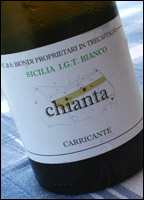 Biondi, Chianta 2011
OK. This wine is labeled as an IGT rather than an Etna Bianco DOC, but that was only due to a technicality of their paperwork when they bottled the wine. Since bottling they have gotten DOC certification and the next vintage will be labeled as such.
Regardless of the labeling issues, this was one of the most amazing wines I tasted in Etna. It was fermented in barrique and was kept in barriques until bottling. The result is a beautiful wine, with harmonious and comforting aromatics of butterscotch, peach and a touch of vanilla. On the palate it offers creamy lemon flavors that evolve from zesty up front to cool on the finish. It has great concentration to the flavors too. The finish is extraordinarily long. This is an exciting and incredible wine!
Crasale, Etna Bianco 2010
This is another wine that spent time in barrique and the result again is superb. It offers deep, powerful pear and lemon aromas on the nose. The palate has a rich, creamy texture with approachable lemon flavors. It finishes with salty citrus. This wine is yummy.
Disclosure: I tasted the wines of Etna as a part of a sponsored blogger tour of the region, organized by Consorzio Tutela Vini Etna D.O.C.. My travel and accommodations were provided by the sponsor.
The Biltmore in North Carolina has been on my list of places to visit for a number of years, but I just haven’t made it there yet—that list is a long one. But I do want to visit some day to see the architecture, the landscape and taste the wine. And so, I was glad to have an opportunity to taste a couple of their wines even though I didn’t travel there.
Despite the long history of the Biltmore, winemaking isn’t really a part of that history going back very far. The first vintage of Biltmore wine offered to the public was from 1979 and the Biltmore winery didn’t officially open until 1985.
I generally don’t think of North Carolina as a wine region, but then wine of some form or another is made in every state. And the wines that they produce at the Biltmore winery aren’t all from grapes grown in North Carolina. In fact, many of the wines originate from other regions, including the majority of the two that I tasted. The official appellation designation on these wines is “America” although most of the grapes come from California, aside from 2% of the white, which comes from North Carolina. Due to the American appellation designation these wines are not allowed to have a vintage date, however they are both from the 2010 vintage.
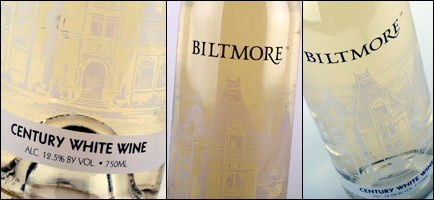
Biltmore Century White Wine
This wine is a blend of Gewürztraminer, Muscat Canelli, Riesling and Symphony. As I mentioned, 2% of the grapes are from North Carolina and the rest are from the Mendocino and Monterey regions of California.
I like the nose on this wine, it offers plenty of citrus, such as lemon an grapefruit, but it also shows melon, hay and mineral aromas—giving it a good bit of complexity. On the palate, this is a semi-sweet wine. I’m not opposed to sweeter wines, but it’s all about balance. If a wine is on the sweet side, it needs to have enough acidity to balance that sweetness or else it comes off as flabby. And this one is a little shy on the acidity. It’s not a trainwreck, but it’s just a little out of balance in my opinion. That said, the flavors are good with notes like lime, apple and tropical fruit. It finishes with apple & honeydew melon flavors that linger on for a good bit. The sweetness of this wine would make it a good wine for spicy Thai food.
Wine: Biltmore Century White Wine
Varieties: Gewürztraminer, Muscat Canelli, Riesling and Symphony
Vintage: Technically non-vintage, but really 2010
Alcohol: 13.1%
Rating: 84
Price: $15.99
Find Biltmore Century White Wine with Snooth
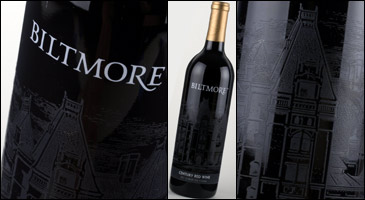
Biltmore Century Red Wine
The Biltmore Century Red is a blend of Sangiovese and Merlot from the Cienega Valley, Sonoma and Lake County regions of California.
The nose is pretty spicy, showine lots of nutmeg and cedar aromas alongside cherry, currants and chocolate. It’s also rather spicy in the mouth, with tangy wild cherry, plum, currant and spice flavors. It has nice tannins adding structure to the wine and good acidity too. The finish is medium-long and continues the theme of spiced berry flavors, plus a touch of black tea. It’s good.
Wine: Biltmore Century Red Wine
Varieties: Sangiovese and Merlot
Vintage: Technically non-vintage, but really 2010
Alcohol: 14.2%
Rating: 86
Price: $15.99
Find Biltmore Century Red Wine with Snooth
Disclosure: This wine was received as a media sample.
Not unlike a lot of wine geeks, I’m not a big fan of chardonnay. Although I try to be impartial with all reviews and judge a wine on how good it is for its style, I’m admittedly a little hard on chardonnay. I just often find it to be out of balance, clumsy and not enjoyable. And so, when I find a chardonnay that wows me that says something good about that wine. And this is one of those times.
Honestly, I think chardonnay gets a bad rap. It’s grown virtually everywhere that wine is produced and some of those places just aren’t good regions for chardonnay. OK… maybe many of those regions aren’t good for chardonnay.
The Santa Ema reserve chardonnay comes from the Casablanca Valley in Chile. This is a cool climate region that turns out some incredible wines. And cool climate chardonnay tends to be the chardonnay that rocks. Hence, this chardonnay rocks.
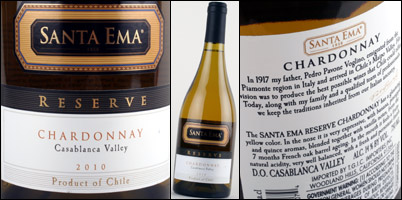
The nose is quite powerful, oozing with honey, banana, butterscotch and tropical fruit aromas. The palate has super bright acidity that makes the fruit flavors sing. It offers well-balanced pineapple, apple and citrus flavors. The finish is long and pleasant with citrus, honey and mineral flavors. Overall, this wine is delicious.
Wine: Santa Ema Reserve Chardonnay
Variety: Chardonnay
Vintage: 2010
Alcohol: 14%
Rating: 88
Price: $13.00
Find Santa Ema Reserve Chardonnay with Snooth
Disclosure: This wine was received as a media sample.
Some folks I know are biased against Robert Mondavi wines. I assume that’s due to the fact that many of their wines are produced in bulk and can be found anywhere, in other words they are “supermarket brands.” In some cases this is an unfair accusation. Robert Mondavi actually produces a wide range of wines in terms of both price and quality. But their lowest-priced, most-entry-level brand is Woodbridge. This stuff is produced in large quantities and it’s dirt cheap, but does that mean that it’s no good? I’d say, no… not necessarily. Don’t let your prejudice get in the way of enjoying a tasty cheap wine!
The Woodbridge Extra Dry sparkling wine is a great example of that. As an “extra dry” sparkling wine, this is just a touch sweeter than a brut, but it’s still very dry.
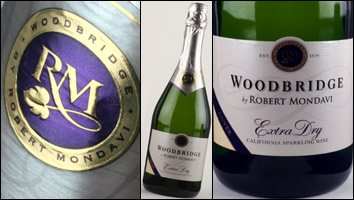
The nose is pleasant, with aromas like yeast, grapefruit and pear. Plus there’s a slight floral note. The palate offers crisp apple and citrus flavors, with superb acidity and a nice mouth feel. It finishes with lemon and mineral flavors. This is a great bubbly for the price.
Wine: Woodbridge by Robert Mondavi – Extra Dry Sparkling Wine
Variety: Sparkling white
Vintage: Non-vintage
Alcohol: 12%
Rating: 87
Price: $7.99
Find Woodbridge by Robert Mondavi – Extra Dry Sparkling Wine with Snooth
Disclosure: This wine was received as a media sample.
Five years ago, when I launched this site, I wasn’t sold on Chilean pinot noir. They had produced a couple decent ones, but for the most part it was lacking. But my how things have changed. In the last 10-15 years the quality of wines coming from Chile has increased significantly and while pinot noir was a bit of a laggard on the Chilean evolution, it’s come around in the last few years and they’re consistently producing some tasty pinot noir now.
This one comes from Santa Carolina, a pretty big producer in Chile with 2,000 hectares of vineyards. It comes from the Casablanca Valley, one of the best cool-climate regions in Chile and is part of the Santa Carolina “Reserva” line of wines—their entry-level priced series.
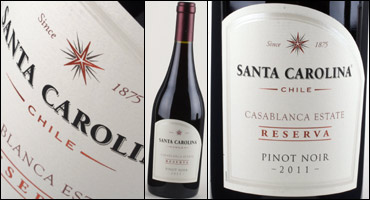
This wine has really nice aromas, such as raspberry and plum with intense spice, which I would describe as a combination of cola and black pepper. The intensity on the nose is also pretty good. The palate offers raspberry, tart cherry and plum flavors up front, with a touch of raspberry tea on the mid-palate. The acidity is perfect. The mouth feel is nice, but nothing exceptional. It finishes long with cherry and cranberry flavors. This is a really good pinot noir for the price.
Wine: Santa Carolina Casablanca Estate Reserva
Variety: Pinot Noir
Vintage: 2011
Alcohol: 14%
Rating: 87
Price: $12.00
Disclosure: This wine was received as a media sample.
A few weeks ago I reviewed the Reginato Sparkling Torrontés Chardonnay, which was just outstanding. So I was excited to check out another sparkler from them, the Reginato Sparkling Rosé of Malbec.
Like much of the malbec you see on the shelves these days, this one is from Mendoza, Argentina. But it’s a lot lighter in color than you might expect from a malbec… yep, it’s a rosé.
Similar to the Torrontés Chardonnay, the Rosé of Malbec is a relatively small production wine with only 1,500 cases produced. It didn’t blow me away the way the Torrontés Chardonnay did, but it is still a very nice sparkler and an exceptional bargain.
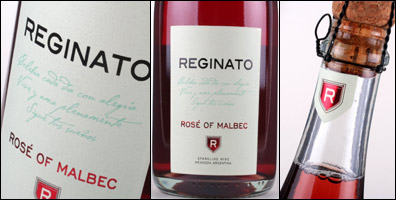
Yeast and cranberry aromas give this wine a pleasant nose. The palate is dry and offers lemon, rhubarb yeast and mineral flavors. The texture is moderately bubbly. The acidity is good. It finishes with salty mineral and citrus flavors.
Wine: Reginato Sparkling Rosé of Malbec
Variety: Malbec
Vintage: Non-vintage
Alcohol: 13.5%
Rating: 87
Price: $15.00
Find Reginato Sparkling Rosé of Malbec with Snooth
Disclosure: This wine was received as a media sample.


 Prev
Prev