I’ve mentioned before that one of the things I like about merlot is the different personalities it can have. This one from Jacob’s Creek reveals one of those unique personalities. Perhaps that’s the Australian terroir coming through. Although, this isn’t a single vineyard wine. And that brings up a philosophical question about terroir. Can there be a terroir expression in a wine that is designated from a broad region, like South East Australia, versus from a single vineyard? Can there be a macro-terroir and a micro-terroir? What do you think?
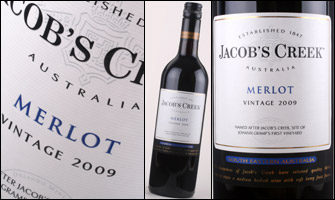
While I often think of merlot as having a “round” nose, the nose on this one is rather pointed with sharp cherry and spice aromas. It also shows some blueberry and plum aromas, all as though it’s sitting in a smoky cedar box. The palate is also somewhat angular, with tangy cherry and plum flavors that are zipping with acidity. This is a lively merlot and would be perfect with a big juicy burger.
Wine: Jacob’s Creek
Variety: Merlot
Vintage: 2010
Alcohol: 13.5%
Rating: 86
Price: $12.99
Find Jacob’s Creek Merlot with Snooth
Disclosure: This wine was received as a media sample.
Concha y Toro is Chile’s largest wine producer, with vineyards throughout Chile and a dozen or so different brands. One of those brands is Casillero del Diablo.
I admit, I’m a fan of the Casillero del Diablo brand. The story is that the name came from a winemaker who told others that the devil lived in his cellar in order to keep them away from his better wines.
The brand has a fun attitude in their marketing and they produce some good wines. While I did choose the word “good” to describe their wines versus “exceptional,” I’m not going to complain about good wines. I will, however, complain about the Casillero del Diablo website. It’s totally unusable. And while wineries are generally known for having bad websites, this one particularly annoyed me.
This merlot comes from the Rapel Valley in Chile, which is a broader region including the Colchagua Valley and Cachapoal Valley sub-regions.
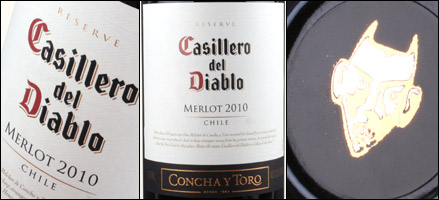
This wine is powerful and loaded with spice, offering intense strawberry, plum, vanilla and toast aromas. It’s a pretty big wine on the palate too, with jammy plum and cherry flavors, but it’s a bit clumsy. What I mean by that is while it’s big and bold it’s not harmonious and balanced. The acidity is sufficient and the finish is nice. It’s quite drinkable, but not exceptional.
Wine: Casillero del Diablo
Variety: Merlot
Vintage: 2010
Alcohol: 13.5%
Rating: 85
Price: $10.00
Find Casillero del Diablo Merlot with Snooth
Disclosure: This wine was received as a media sample.
Chilean wines are one of my “go to” choices when looking for exceptional value. And it’s not just for one type of wine. You can find really good reds and whites from Chile and given the broad range of wine regions within Chile, there are a number of different styles to be found too.
And within Chile, the Colchagua Valley region is one of my favorite regions for red wine—although most of what I’ve tasted has been carmenere, cabernet sauvignon and pinot noir. I haven’t had a lot of merlot from the region, so I was curious what this one would have to offer.
Within Colchagua Valley there are a few different zones. The grapes for Santa Carolina’s wines come from the Miraflores and Los Lingues estates at the foot of the Andes Mountains. The cool ocean breezes in this region result in a long ripening period, which some producers claim results in better wine.
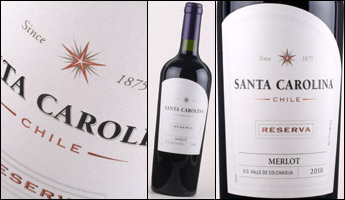
The nose on this merlot is a bit angular. It shows some smokiness, oak, salami and cherry. It’s interesting, although not totally balanced. The palate offers raspberry, cherry and plum flavors with moderate intensity. While it has plenty of fruit flavors, it’s not a fruit bomb. It finishes with soft fruit and black tea flavors. It’s a bit on the earthy side, which some folks really like.
This is a good wine with unique character. And it hints at the potential of merlot from this region, but doesn’t fully realize that potential. I will look forward to future vintages of this one.
Wine: Santa Carolina Reserva
Variety: Merlot
Vintage: 2010
Alcohol: 13.5%
Rating: 85
Price: $10.00
Find Santa Carolina Reserva Merlot with Snooth
Disclosure: This wine was received as a media sample.
You may have noticed that the last few reviews on this site have all been for merlot. That’s also the theme of my column in the latest issue (issue #26) of Mutineer Magazine.
This merlot from Estancia didn’t make that column, but it’s still a very tasty merlot worth checking out.
It comes from the Central Coast at a location called Keyes Canyon Ranches, which is a property with about 700 acres of vineyards in the Paso Robles region.
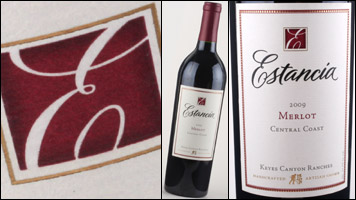
This merlot shows a nice balance between fruit and earth aromas, with cherry and black raspberry spiced with tobacco and leather aromatics. The leather is an interesting note and is almost like a new wallet smell… and yes, I consider that a good thing. The wine is well balanced and smooth in terms of texture, offering black plum and black raspberry flavors. Vibrant acidity makes those flavors pop. There’s a touch of spice on the mid-palate. The finish is long and delicious.
Wine: Estancia Keyes Canyon Ranches
Variety: Merlot
Vintage: 2009
Alcohol: 13.5%
Rating: 88
Price: $14.00
Find Estancia Keyes Canyon Ranches Merlot with Snooth
Disclosure: This wine was received as a media sample.
I commented a couple days ago about merlot-haters, but one thing I failed to mention is that these consumers may just misunderstand merlot. They may have just tasted the wrong merlot. One of the things I like about merlot is that it can have a number of different personalities. It’s grown all over the world, and when you have different merlot clones from different regions, made into wine using different techniques it can result in a wide range of styles.
Tonight I’m highlighting a merlot from the Umbria region in Italy. While some other Italian regions, like Chianti and Piedmont, get a lot of fanfare they also can come with some sticker shock. Lesser known regions, like Umbria, can offer some equally tasty wines at much more appealing prices.
Umbria is located just east of Tuscany and it’s the only Italian wine region that doesn’t border either the sea or another country. Falesco, the producer of this wine, is one of the largest in the Orvieto DOC. This particular wine, however is labeled as an IGT, being from this part of the Umbria region, but not meeting specifications of the Orvieto DOC. It is, however, a reasonably-priced and very tasty wine. And stylistically this wine screams “Italian” with it’s vibrant acidity and good tannin structure — clearly showing a unique expression of merlot from this region.
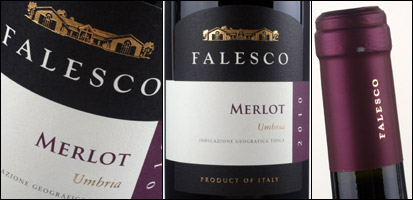
The nose is elegant and spicy, offering aromas like black currant, blackberry, black pepper and cedar. The palate is perfectly balanced with spiced blackberry, cherry and raspberry flavors. Crisp acidity makes it lively and moderate tannins give it a nice mouthfeel. It finishes with blackberry and black tea flavors that stay with you.
This is a fantastic wine.
Wine: Falesco
Variety: Merlot
Vintage: 2010
Alcohol: 13.5%
Rating: 90
Price: $16.00
Find Falesco Merlot with Snooth
Disclosure: This wine was received as a media sample.
How about another merlot review? I thought you’d like that idea.
181. You may have seen this wine or another one from the Noble Vines family in shops and wondered what it’s all about. The labels are simple. It’s just a number and a varietal name. But what does it mean?
The numbers represent vine clones. Clones of grape vines are given numbers to classify them so that the same clone can be reproduced with an expected set of characteristics. Each of the vine clones in the Noble Vines family come from France but are matched to vineyards in California that the producers feel are best suited to each clone.
The 181 Merlot clone was matched to a red clay soil in Lodi, California that supposedly is similar to soils in Pomerol, an appellation in Bordeaux. I’m not a soil scientist, so I cannot confirm or deny the validity of that assertion. And, unfortunately, I don’t have the disposable income to drink many Pomerol wines and therefore cannot speak to the comparison to those wines (FYI, in case you didn’t know, wines from Pomerol tend to be rather pricey.)
But what I can tell you is that this wine is really, really good. And it’s an exceptional bargain regardless of whether it tastes anything like wines from Pomerol.
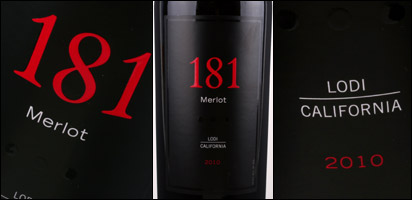
The fruit aromas from this merlot stand out. There is a distinct black cherry and plum characteristic that dominates the nose of this wine, but it also shows some spice with vanilla and nutmeg notes. The palate is also dominated by black cherry and plum, but it is nicely balanced with a hint of spice. The concentration of flavor is just right and the acidity and tannins are also well proportioned. It finishes slightly tart and with a silky feeling.
This is an elegant and enjoyable merlot. One I will gladly drink again.
Wine: 181 Merlot
Variety: Merlot
Vintage: 2010
Alcohol: 14%
Rating: 89
Price: $11.00
Find 181 Merlot with Snooth
Disclosure: This wine was received as a media sample.
If there’s one complaint we got on this site in 2012, it was the quantity of white wine reviews versus red wines. The red wine lovers have spoken and they felt under-served. So, let’s start off 2013 with a little balance and follow up my first white wine review with a red. And, let’s make it a 90+ scored wine!
While I’m putting this review out there to satisfy the demands of red wine drinkers, there are two things about the review that may make some scoff at it. 1) It’s a merlot. 2) It’s a Robert Mondavi.
Yep… there’s a segment of wine drinkers out there who have chosen to be merlot haters. And it’s an attitude driven by pop culture more than anything. All merlot isn’t bad, just because someone in a movie said it was bad. Sure, there are plenty of boring cheap ones out there, but you can also find some pretty tasty merlot that is worthy of your attention and your affection.
There’s also a segment of consumers who are anti-Mondavi. I’ve heard people make comments like, “it’s just Mondavi.” My hunch is that consumers who are anti-Mondavi believe that a “good” wine can only be one that you’ve never heard of. But the big producers can produce some good wines. I concede that Robert Mondavi wines include a broad range with varying levels of quality, some of which leave something to be desired. But they do have some wines that kick ass. And this is one of them.
So, if you have any prejudice against merlot or Robert Mondavi wines I challenge you to put those aside and just enjoy this delicious wine. The suggested retail price is $19.oo, but it can be found in some locations for as little as $10. Now that’s a bargain for a wine like this.
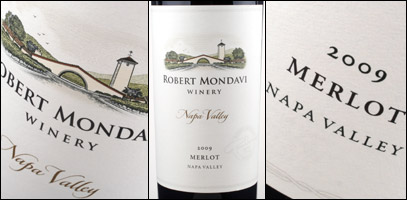
Powerful aromas of blueberry, tobacco, cherry and toasted oak grab your attention. One sniff will suggest that this is clearly a good wine, but on the palate this wine truly sings. The mouthfeel is silky and elegant and the flavors are perfectly balanced. It offers flavors like plum, blackberry and chocolate. The finish is long and luscious.
Wine: Robert Mondavi Napa Valley
Variety: Merlot
Vintage: 2009
Alcohol: 14.5%
Rating: 91
Price: $19.00
Find Robert Mondavi Napa Valley Merlot with Snooth
Disclosure: This wine was received as a media sample.
Happy New Year to everyone. And let’s start the new year with a killer, 90+ wine review.
When it comes to sauvignon blanc, I’m partial to two regions, 1) Casablanca Valley, Chile and 2) Marlborough, New Zealand. Both regions consistently produce sauvignon blanc that’s bursting with tropical fruit flavors and grassy aromatics. This one from Kim Crawford comes from Marlborough and is an excellent example of how good (yet incredibly affordable) the sauvignon blanc from this region can be.
The average price for this wine clocks in at about $15, but depending on where you live and where you shop you may find it for a couple bucks less.
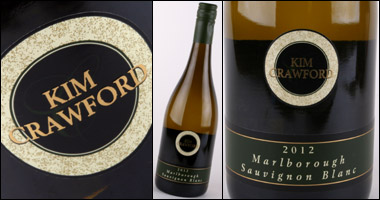
The nose on this wine strikes me as exactly what I expect from a Marlborough sauvignon blanc. It offers cut grass, lemon, grapefruit and other tropical fruit aromas, along with a touch of mineral. The palate is superb! It’s loaded with powerful, but well balanced tropical fruit flavors, like pineapple, mango, grapefruit and lemon. The acidity is spot on. The finish is relatively long, with citrus flavors and a touch of salinity. There’s nothing not to love about this wine!
Wine: Kim Crawford
Variety: Sauvignon blanc
Vintage: 2012
Alcohol: 12.5%
Rating: 91
Price: $15.00
Find Kim Crawford Sauvignon Blanc with Snooth
Disclosure: This wine was received as a media sample.
It’s that time of year when many are reaching for a bottle of bubbly. While Champagne is the first bubbly to come to mind for most consumers, there are many better bargains to be found in sparklers from other regions. If you want a French sparkler but don’t want to pony up the cash it will take to get a true Champagne, then Cremant is the wine for you, and Cremant D’Alsace is one of my favorites.
Certainly we could get into a cultural debate about whether Cremant D’Alsace is more French or more German. The Alsace region does have a lot of Germanic cultural influences, but technically it is French.
This Cremant D’Alsace from Albert Mann is made from a combination of Pinot Blanc and Auxerrois grapes. If you’ve had much bubbly in your life you’ve probably had Pinot Blanc before, but Auxerrois may be a new variety for you to add to your Wine Century Club list. It’s a white variety, closely related to Chardonnay, which is grown in Alsace and parts of Germany.
One of the things that surprised me about this wine is that it has a vintage, 2010. Most sparkling wines I come across in this price range are non-vintage.
This wine is a brut, which means it’s dry. For those new to sparkling wine, brut is the most common style you’ll come across and generally it’s what most consumers prefer.
Another thing you may like about this wine is the label, which is festive by design and perfect for holiday celebrations. Although, in my opinion, you don’t need a holiday to enjoy a bottle of bubbly.
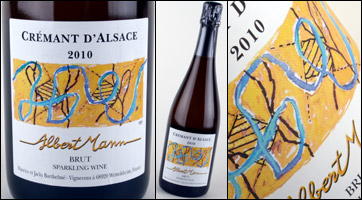
Of course what’s most important is how the wine tastes, and this one delivers in droves. Yeast dominates the aromatics, which isn’t a bad thing in my opinion. There are also some pear and straw notes. The palate is super bubbly with crisp apple flavors up front, evolving into pear and yeasty bread flavors. The acidity is great. The finish reveals plenty of aromatic notes from the yeast along with salty mineral. This is a tasty bottle of bubbly at a reasonable price.
Wine: Albert Mann
Variety: Cremant D’Alsace
Vintage: 2010
Alcohol: 12.5%
Rating: 88
Price: $22.00
Disclosure: This wine was received as a media sample.
In my previous post about Georgian wine I promised that my next post would highlight some Georgian wines that I know are available in the US — and available at very reasonable prices. I’m not only going to fulfill that promise, but I’m going to do so while sharing with you the wines that impressed me the most on my visit to Georgia.
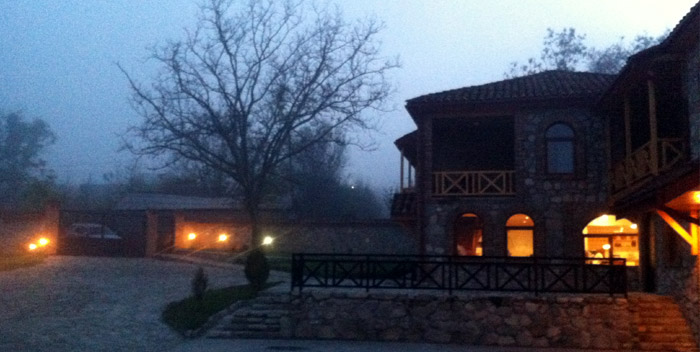
Schuchmann Wines is located in the village of Kisiskhevi, which is in the Telavi region of Kakheti province in Georgia. We arrived at the winery just before sunset, after a long bus ride on some bumpy roads. We were rather tired when we arrived, but glad to take a break from riding in the bus. The building looks almost like a hunting or skiing lodge and with a fog settling in at dusk, it was somewhat eerie.
The winery has only been around since 2002, although managing director Dr. Georgi Dakishvili is a third generation winemaker who has been around wine production all of his life. The winery gained an investor in 2008 and today has two main brands of wine, Schuchmann and Vinoterra. The main difference between those brands is that the wines under the Vinoterra label are all made in qvevris (underground clay vessels) while those with the Schuchmann name on the label are made using modern methods. We tasted wines from both labels during our visit and all the wines we tasted were good, although most of our focus was on the Vinoterra wines and those are the ones that most impressed me.
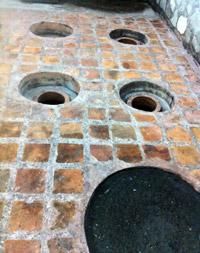 As you walk around the outside of the winery, you see qvevri holes on what you might think is a patio, as well as inside buildings. The qvevris are large clay pots, sized from 500 liters to over 3,000 liters. They are buried underground and show up as holes scattered across a brick floor. You must watch your step when you’re walking among the qvevris. The qvevris are covered with slate stones when the wines are aging, making it a little safer to walk around.
Dakishvili impressed me with his humble, yet experienced and knowledgeable presentation of their wines. He didn’t feed us lines of bullshit, but candidly shared that he sometimes finds faults in his wines. He said that he’s never produced a wine he thought was bad, but he’s found flaws in as much as 5% of the wines he’s produced.
I also think Dakishvili is the first winemaker I’ve ever heard talking about microbiology related to winemaking. It was a reassuring to hear him addressing the topic as there were questions in the back of my mind about how safe it was to create wine in a clay pot, buried underground. The insides of the qvevris are coated with beeswax, which would seal them. But Dakishvili suggested that bad organisms could still get into the wines, and for that reason they always put the wines through malolactic fermentation after their time in the qvevri. The malolactic fermentation would kill any bad things that might have gotten into the wine.
Schuchmann/Vinoterra currently have about 65 hectares of vineyards and the vast majority of their vines are Georgian varieties, like Rkatsiteli, Kisi, Mtsvane and Saperavi. They do have some Chardonnay and Cabernet Sauvignon in their vineyards too.
As I was tasting their wines, I was both delighted by how good they are but at the same time heartbroken thinking that I would never be able to find these wines in the United States. But I was thrilled to learn that my assumption about distribution to the US was wrong. While I haven’t come across them at any of my local wine shops in Cincinnati, I have found that they are available in the US—and at very reasonable prices. So, depending on where you live, you may be able to find these in your local wine shop—or you may be able to purchase them online.
While the wines really impressed me, I can see how they might be challenging to some consumers. Particularly the white wines, which I rather enjoyed, but present a different structure and flavor profile than the simple, fruity wines many consumers know. If you have an opportunity and a curious side to your palate, here are the wines I tasted that I can highly recommend.
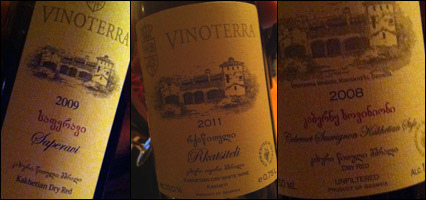
Vinoterra Rkatsiteli 2011
The nose of this white wine offered intense floral aromas, but a I couldn’t put my finger on the flower. It was a different floral than I’m used to finding in wines, but it was delightful. It also offers pear and peach aromatics. The palate has outstanding structure and mouthfeel, with lemon and pear flavors. The acidity is spot on. It finishes quite long and overall this is a beautiful wine. I have found it for sale in the US for the bargain price of $12.99.
Vinoterra Kisi 2011
Another white qvevri wine, this one offers light floral and peach aromatics. The palate is well balanced with a slight spice and a flavor I could only describe as “flower water.” It’s somewhat tannic and has sufficient acidity. The finish is long, with apple skin and tea flavors and a tea-like tannic quality. This was also a very good wine. This one sells for about $16.00.
Vinoterra Mtsvane 2008
Mstvane is another Georgian white wine varietal. This one was one of the most interesting wines we tasted, offering coriander,white pepper and apple aromatics. The flavors were reminiscent of tea with lemon, spice and a very nice tannic structure. The finish is quite long and again is rather tea-like. You can find this one in the US for about $12.00.
We also had the opportunity to taste a Schuchmann Mstvane made using modern techniques, which was an interesting comparison. The modern version had a chardonnay-like quality to it, showing apple and pear on the nose with good intensity The palate offered apple and peach flavors, with the peach lingering on the finish. This was a very good wine, but I did find the Vinoterra version of the wine to be much more interesting. Unfortunately I failed to note the vintage of the modern Schuchmann one in my tasting notes.
Vinoterra Saperavi 2009
Saperavi is the most prominent Georgian red wine varietal. This one has a spicy nose with intense raspberry, nutmeg and smoke aromas. It has a beautiful mouthfeel and structure, plus perfect acidity. The palate offers raspberry, cherry, and tea flavors that are perfectly balanced, harmonious and elegant. The finish is long and features cherry flavors with a slight spiciness. This is a superb wine, but the price is a touch higher than the whites. It goes for about $22.00.
Vinoterra Cabernet Sauvignon Kakhetian Style 2008
I would love to sit down with any Napa Valley Cabernet Sauvignon fan and have them taste their favorite Napa Valley cab alongside this wine to see if this one doesn’t blow their mind. On the nose it offers nutmeg, toast, cherry, currant and mint aromas. The palate has great structure and good acidity. It’s elegant and balanced, featuring cherry, black currant and blueberry flavors. The finish is super long with currant and tea flavors. This is an outstanding wine. Unfortunately, I haven’t found this one for sale in the US but I’ll keep my eye out for it. Let me know if you find it… and where!
Cheers! 😉
Disclosure: I tasted the wines of Georgia as a part of a sponsored blogger tour of the region, organized by Georgian Wine Association. My travel and accommodations were provided by the sponsor.

 Prev
Prev