I’ll keep this one short and to the point. I tried Concannon Central Coast Chardonnay 2004 tonight and it is good if you’re into a classic buttery chardonnay with a nice touch of oak. The fruit is nice too — pear and nectarine. It has a nice long finish. I think it’s a bit more complex than many inexpensive chards I’ve tasted. Although it is a bit predictable, that’s not necessarily a bad thing if this is what your into.
This is a smooth chardonnay. It gets a thumbs up from me, or maybe a “bottoms up.” At $7.99, I give it a 89 – yummy.
I’ll keep this one short and to the point. I tried Concannon Central Coast Chardonnay 2004 tonight and it is good if you’re into a classic buttery chardonnay with a nice touch of oak. The fruit is nice too — pear and nectarine. It has a nice long finish. I think it’s a bit more complex than many inexpensive chards I’ve tasted. Although it is a bit predictable, that’s not necessarily a bad thing if this is what your into.
This is a smooth chardonnay. It gets a thumbs up from me, or maybe a “bottoms up.” At $7.99, I give it a 89 – yummy.
Charles Shaw Chardonnay, often referred to as “Two Buck Chuck” recently won double gold honors at the California State Fair wine competition. It beat 350 other Chardonnays for the honors and was rated at a 98. It goes to show, cheap wine can be enjoyable.
Full Article
I’ve come across a number of casual wine drinkers who endorse Barefoot wines as a good cheap wine. I tried one of the reds a couple years ago (I can’t remember which one) and wasn’t that impressed, so I haven’t gone back to Barefoot until now.
The Barefoot Chardonnay is actually not that bad. And it seems I need to retract some of my lambasting of E&J Gallo in my last post. Why? Because Gallo owns Barefoot – they purchased the winery back in 2005.
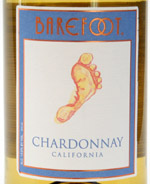 One of the things that did strike me as peculiar with Barefoot is that there is no vintage on the bottle. It’s just Barefoot Chardonnay. Apparently the year doesn’t matter. No vintage, but they do have a big sticker that says “98 Points!” This is from a 2002 California State Fair Wine Competition and while I’m sure this wasn’t the vintage that was entered in the competition, Barefoot is going to milk all the marketing they can out of that award.
I did not give it a 98. I gave it an 87. It features peach and apple flavors and a decent finish. Overall, it’s a nice enjoyable wine for $6.99. Not outstanding, but a decent value wine.
I have somewhat of an internal debate going on with this website. Should I focus on small wineries that offer those hidden gems in the wine world, or should I review wines that are massed produced and anyone can find? While I generally have an affinity for the independents, I also want this blog to be helpful to readers all over the states… not just to those who have access to the distributors & stores in my region. So I’m trying to strike a balance…. review some wines that are available anywhere and some that may have more limited distribution. But when I taste a wine like this one, I want to cast aside the mass producers altogether.
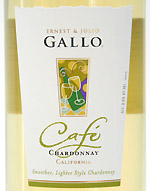 The culprit is Ernest & Julio Gallo Café Chardonnay. I can’t even remember the last time I tried a Gallo wine before this (if I’ve ever had one). Something about the brand makes me wary and this experience justified all my fears. This wine is the sweetest Chardonnay on earth. It tastes like apple juice sweetened by honey… a lot of honey… too much honey. Did I mention that this wine is too sweet? Ugh. I forced down a glas and a half and I had to dump it.
To my surprise my wife was upset when I dumped this wine. She called it “wasteful” and said that she kind of liked it. What!? So is this a gender-specific wine? Maybe women actually enjoy this, but I know that I didn’t. I gave it a 77. I know you may think that rating is high, but to be fair there weren’t any bad flavors in this… it is just too damn sweet. I could see some folks enjoying it, but I would venture to guess that the majority of them would be 21 year old women (because that’s the legal age, right?) who are “new to wine.”
If you like good, well balanced wine but are on a budget this is not the wine for you.
I’ve had a few bottles of twin fin wines recently and I’ve been pleased with all of them. twin fin has really impressed me in several ways. In addition to creating some very good, very approachable wines, they know how to do marketing. They have branded twin fin as a fun everyday wine that captures the spirit of a day on the beach in California. Whoever they hired to do their branding was well worth the expense.
The design of the bottles is fun and colorful. The convertible and surf board on the labels embodies the sunny California essence that twin fin represents. The srew tops are also colorful and an easy open.
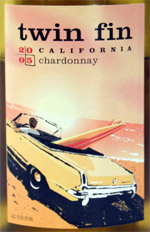 I’m not sure when twin fin was founded, but they haven’t been around very long. I couldn’t find an exact date, but they won accolades as the top new table wine brand in 2005… so, I’m guessing they started in 2005. The company owned by Pacific Wine Partners and is run by a couple Australian winemakers – Hugh Reimers and Sam Burton. Hugh and Sam have great winemaking credentials, but when they started twin fin they wanted it to be different frm other wineries. I think they’ve done an awesome job.
All twin fin wines have a suggested retail price of $9.99, but I can usually find them on sale for around $7.00.
I gave the 2005 twin fin chardonnay a shot as a part of my Chardonnay Challenge. (I’ve found myself giving stupid names to my tasting themes… I’m not sure if it’ll continue as a trend, but it probably will). And my verdict is: Tasty and tropical, a nice flavor with banana, pinapple and a touch of vanilla. Very enjoyable. It’s not the most exciting or interesting (but then what Chardonnay is?) It is a dependable, quaffable Chard. I gave it an 88. If you’re looking for something simple that your sure to enjoy, try twin fin.
Lesley Reidy of www.winefairy.co.nz writes about a topic near and dear to my heart, finding good cheap wines. The title says it all. I agree with all the recomendations in this article:
- Individuality
- Drinkability
- Not ’soft drink sweet’
- Tasty
- Look beyond the label
Of particular note: “smaller, lesser known vineyards are making some great value for money wine.” How true. Time and time again I’m finding myself more pleased by smaller vinyards than the larger one’s. I think I should start phasing out major vinyards from my reviews… they are just underdelivering, and I have some bad reviews for them in the queue.
There’s something about a great deal that gets me excited, so I was thrilled when I saw Dynamite Chardonnay marked $7.00 off. That brings it into my price range at $9.99, so of course I had to buy a bottle.
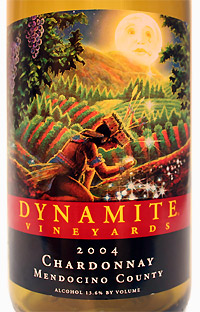 I’ve had the Dynamite Zinfandel on a night out to one of my favorite restaurants here in Cincinnati, Bella Luna. (I was about to link that until I saw how atrocious their website is — I’ll need to talk with Harry about that. If you want to see it, you’ll need to Google it yourself. But trust me, the food is awesome.) Anyway… I enjoyed the Dynamite Zin, and I’ve heard a bit of buzz about Dynamite wines so I was glad to see a bottle in my price range.
I also enjoyed reading about Dynamite on their website where in one paragraph they talk about how the name was derived from how they had to use dynamite to blast away the rocky slopes to plant the vinyard. Then a couple paragraphs later they highlight their “sustainable farming techniques.” When did dynamite become an ingredient for sustainability? lol
The arwork on the bottle is nice. They have a local artist design the labels for each vintage.
The Chardonnay was good, but not extraordinary. Minimal fruitiness (apple), slight oak, a bit nutty. Undynamic and uninspiring. I gave this wine an 83.
A drinkable wine, but it’s boring and not worth the price… especially at the original price. But even at the discounted price, I’d take the Veramonte Chardonnay over this one anyday and save a few dollars to boot.
One of my goals with Cheap Wine Ratings is to take some chances. Try wines that the average consumer may be afraid to try. I know there are some hidden gems out there, and I want to discover them and share them with all of you.
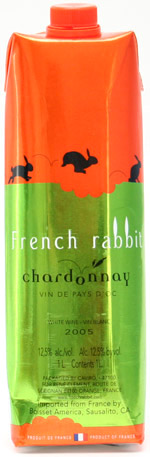 Today I tried something new: French Rabbit Chardonnay. French Rabbit comes in a box. What? You actually drank boxed wine? Yes, I did. I’m not one to get hung up on stereotypes. Most people assume that wine in a box is bad wine, but many also believe that just because a wine has a screw top or a plastic cork that it’s bad. I know I’ve had some fabulous wines with screw tops and plastic corks, so why not give this boxed wine a try? And technically this packaging isn’t a box, it’s a Tetra Pak.
French Rabbit is actually the next generation of boxed wine… or, um… Tetra Pak wine. It’s a bit different from the boxed wine of the 80’s and 90’s with the spigot on the box. French Rabbit is created by a company named Boisset America, and their focus is environmentally friendly wine producing. From the farming to the packaging, they strive to be ecologically friendly and I applaud them for that.
Unfortunately, while I admire their environmental aspirations, the wine didn’t win me over. It didn’t have much flavor to it. It had a bit of fruitiness, apple and citrus. But it also had a slightly plasticy flavor to it (I assume this was from the packaging). Perhaps it was a psychological thing, but I doubt it. I was actually really curious and was hoping that I would enjoy the wine more. The biggest problem was that the flavor lacks the personality of the marketing around it.
One thing I did like is that the package is a full liter versus 750ml. The packaging is also supposedly 100% recyclable, although if I put this into my recycling bin with a bunch of glass bottles, I would bet money that they recycling truck would take the glass bottles and leave this thing in the bin. I don’t know if I’ll try another varietal from French Rabbit. We’ll see.
Resources:
French Rabbit Website
‘Tis summer and that means it’s the season to enjoy some chardonnay, pinot grigio, and other whites. I generally am a red drinker, but in the summer I do enjoy some refreshing white wines. I hereby start the next series: Chardonnay.
My chardonnay exploration won’t be nearly as thorough as Project Garnacha, only because there are sooo many options with chardonnay. I think every wine maker has one. Why? Probably because of a couple reasons.
- It’s widely consumed. You can always find someone to drink your chardonnay.
- It’s a rather forgiving varietal to produce. I’ve made a bit of wine myself and the chardonnays I’ve created have always amazed me. With no formal training, I’m able to create a chardonnay that can stand up against professional vinyards any day. The reds I’ve made have been decent, but not as good as the chardonnay.
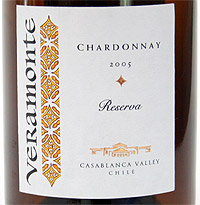 As I type this, I’m enjoying my first contender in the Chardonnay Challenge: Veramonte. I actually tasted some Veramonte wines a few months ago at the Cincinnati Wine Festival. I’ve been hearing a lot about Chilean wines recently, so I was curious about Veramonte. And I was impressed. There is a lot of investment going on in Chilean wine and I’m looking forward to exploring wine from Chile further. Perhaps that will be a future tasting theme.
The verdict on Veramonte Chardonnay: I give it an 89. It has very nice yellow delicious apple and pear flavors. The bouquet is totally apple. It has a nice crisp finish. This would go great with some smoked trout, a bit of gouda cheese & crackers, with a slice of apple or green grapes. It’s very good. I think I’ll head to the deck to relax and enjoy.
Resources:
Veramonte Chardonnay
More posts on chardonnay to come.
Cheers!
 Prev1...506070808182Next
  Page 81 of 82