My Quest for Good Cheap Pinot Noir continues with a cheapy from South Eastern Australia produced by the Little Penguin. This Penguin has a nice fruity center, but a little bit of funk at both ends. <pause for a visual>
OK… should I explain that, or let your imagination do the work? I’ll explain.
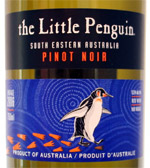 The Good
the Little Penguin Pinot Noir 2006 has a nice, fruity palate. Strawberry, blueberry and currant make it almost a fruit bomb. There is also a hint of spice, but it falls short. I would have liked a bit more spice. It also has a nice velvety mouth feel.
The Funk
The nose is a bit of a turn off. I can only describe it as a combination of sweaty socks and strawberries. I was almost afraid to taste it after my first wiff. (This is the point where if I were Gary Vaynerchuk I would stuff a sweaty sock into my mouth to prove that I know understand sweaty socks… but trust me, I know this smell.)
That is part of the funk, but I did say “funk at both ends.” One being the nose, the other end being the finish where the Little Penguin left me with a touch of a metallic aftertaste.
Net-net
While there were some funk-a-delics to this Pinot Noir, it only cost about $6. Not bad. And if you expect a $6 Pinot to totally kick ass you’re going to be disappointed. I didn’t dump this bottle, but it wasn’t awesome either. I gave it an 80. Give it a few minutes to open up and you’ll enjoy it a lot more. But I would recommend you waddle past this one, and try something else.
Wine: the Little Penguin
Varietal: Pinot Noir
Alcohol: 13.5%
Rating: 80
Scientist Roger Corder has just released “The Red Wine Diet ” a book that touts the benefits of drinking red wine. Corder recommends three glasses of red wine daily to stave off heart disease, diabetes and dementia.
He attributes the health benefits to a polyphenol chemical called procyanidin. This differs from some other scientists who credit resveratrol for the health benefits, but Corder argues that resveratrol levels are too low in wine to bestow such benefits.
He even gives some specific wine recommendations, the most affordable of which is Altos Las Hormigas Malbec Riserva (Argentina, ~$19).
read more
 This month Wine Blogging Wednesday is hosted by Tyler at Dr. Vino and the theme is Go Native, which means go with indigenous varieties. I knew I wanted to do something Italian for this and I thought about it for a while. Of course I make it more difficult with my own criteria.
The Criteria
- It has to be an indigenous variety
- It has to be in the $10 price range (this is Cheap Wine Ratings afterall)
- I have to be able to find it (duh !)
- I’d like to pick something that 4 other folks don’t pick
- It would be really nice if I could find an example of the varietal grown outside its native region for comparison
I considered several: Primitivo, Nero d’Avola, and Montepulciano d’Abruzzo to name a few but I felt it was just too likely that someone else would pick one of those. I also considered Aglianico, but the nativity of that varietal is questionable–it is believed to come from Greece. That said, I did pick up some bottles of each of those for some future tastings 😉
I finally made my choice, Negroamaro. But this choice is not without some controversy. Why?
- I had a hard time finding it and only ended up with two bottles to try.
- I absolutely couldn’t find an example of this grown outside its native region (I’d be surprised if it even exists). Oh well.
 Negroamaro is grown primarily in Puglia (or Apulia), which is often referred to as “the heel of the Italian boot” and in particular Salento where Negroamaro dominates the vineyards. The name comes from negro (black) and amaro (bitter), which describe characteristics of the grapes. The wine itself is very dark and does have a hint of bitterness to it, but in a good way.
It’s rare to find a pure Negroamaro as it is typically blended with other varietals. I was lucky enough to find a “pure play” to include in this review. Typically, Negroamaro is blended with Malvasia Nera, Sangiovese or Montepulciano. I tried two examples of Negroamaro for this review, one pure and one blend. Both were enjoyable, earthy wines.
Pure Negroamaro
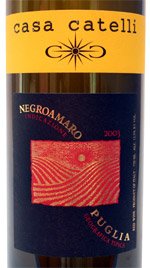 The first bottle I tried is Casa Catelli Negroamaro, which I picked up for $8.99 from Wines Til Sold Out. This again reiterates the “somewhat hard to find” factor as Wines Til Sold Out only offers a wine for a day (until it’s sold out), so I can’t just go back there to find more, I’d have to hunt.
I found the Casa Catelli Negroamaro 2003 to be a pretty good, earthy wine. Although I think it could stand a couple more years of bottle age. I picked up four bottles and I think I’ll let the others sit for a while. The Casa Catelli has a very nice bouquet of tobacco, plums and currants. It has a good mouth feel. The palate is cherry, currants, leather, earth and pepper. It’s very smooth with a hint of smokiness in the finish. The numbers came out to an 88 and if I can find it at the right price, I’ll definately buy more.
Wine: Casa Catelli
Varietal: Negroamaro
Alcohol: 13.5%
Rating: 88
Negroamaro Blend
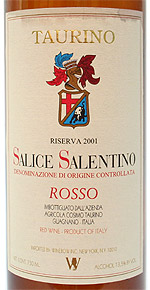 The next wine I tried is probably the best known example of Negroamaro, Taurino Salice Salentino, which is a blend of 80% Negroamaro and 20% Malvasia Nera . Salice Salentino is named after the town where it is produced, of course in the Apulia region of Italy. The second grape in this wine, Malvasia Nera is an ancient varietal thought to have originated in Greece.
On to the tasting… To be specific, the wine I tasted is Taurino Salice Salentino Riserva 2001. The color doesn’t have the greatest depth and I was afraid the wine would have a thin palate, but I was pleasantly surprised. Cherries, herbs and leather on the nose. Plum, apricot and earthy flavors with a peppery finish. A nice, earthy, old-style Italian red. This is an intense wine with interesting character. I gave it an 86. At $11.99 it’s still an affordable wine and probably worth a try. But if I had to pick between the two I’d go with the Casa Catelli. I think it’s a better wine and you’ll save a couple bucks, so how can you go wrong.
Wine: Salice Salentino
Varietal: Negroamaro / Malvasia Nera Blend
Alcohol: 13.5%
Rating: 86
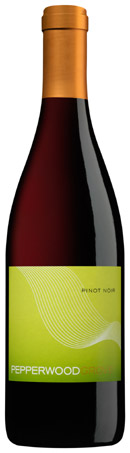 So… as I continue my quest for a good cheap pinot noir, I’m drinking this Pepperwood Grove Pinot Noir and I have the Doobie Brothers’ China Grove stuck in my head. I’m going to have to drink more of this and try to wash that song out of my head. And drinking more of this wouldn’t be a bad thing, as this wine is to my liking.
While the Doobie Brothers were produced by Ted Templeman, Pepperwood Grove wines are produced by Don Sebastiani & Sons, also known as Three Loose Screws. Sebastiani also produces Smoking Loon, Aquinas Napa Valley, s|k|n, and a few other brands.
The Pepperwood Grove Pinot Noir 2005 has a nice combination of roses and raspberries on the nose. It has a nice crisp acidity with raspberry and cherry fruit and a touch of earthiness. This finish has a lingering peppery / clove flavor that I like in a pinot.
I gave it an 87, but from other reviews I’m seeing on the blogosphere I’ll admit that I seem to be the only one who enjoyed this as much as I did. It’s only $7, so I’d say pick a bottle up and judge it for yourself. I think you’ll be pleased.
Try it with a poultry dish and if you like it, I think this is a decent low-cost wine to serve with your Thanksgiving turkey (or your Tofurky, if that’s your preference.)
Wine: Pepperwood Grove
Varietal: Pinot Noir
Alcohol: 13.5%
Rating: 87
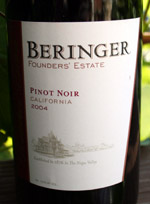 Yep… OK. That about sums up my opinion of this wine. Give another point to the naysayers.
The Beringer Founders’ Estate Pinot Noir 2004 from California is a fairly simple example of pinot noir, but nothing special. I couldn’t get much off the nose other than alchohol and a hint of strawberry. Flavorwise it has black cherries, plum and light pepper. Short finish. Not terribly complex, but decent. I gave it an 83.
If you’re looking for a decent $10 pinot noir, this will work. You’ll enjoy it, but you won’t be blown away. I, however, will keep searching. I know the ultimate value pinot is out there somewhere… just waiting for me to drink it.
Wine: Beringer Founders’ Estate
Varietal: Pinot Noir
Alcohol: 13.5%
Rating: 83
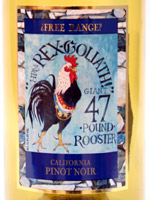 And in the left corner we have a Giant 47 Pound Rooster… this looks like a serious contender. Wait, is this a cock fight or a wine tasting? Can you imagine a 47 pound rooster? I’d run. But since it’s just pinot noir we’re talking about, I’ll stay and enjoy.
As far as the wine goes, I found the Giant 47 Pound Rooster Pinot Noir to be a serious contender as a good, cheap pinot noir (I picked it up for about $10). It’s produced by HRM Rex-Goliath! Wines and comes from Central Coast, California. It’s subtle and well-balanced. It has a nice bit of raspberry and cherry flavor with slight pepper overtones. Nice acidity. Very drinkable. I gave it an 88.
What I didn’t like is the fact that there is no vintage on this bottle. The lack of a vintage makes my rating virtually worthless. I’m sure there’s going to be inconsistency from one year to the next and there’s no way to know what you’re getting. Perhaps there is so much bottle variation that vintages are irrelevant for this brand. Perhaps I just got lucky?
I have so many other wines to try that I may not buy this one again for a while, if ever. So, I may never know if this wine is consistently good. I’d say it’s worth the ten bucks to give it a shot. Let me know how your experience goes.
Wine: Giant 47 Pound Rooster
Varietal: Pinot Noir
Alcohol: 13.5%
Rating: 88 (I think)
They say it can’t be done, but once again I’m taking on the naysayers. I’m am now officially starting my search for a good, inexpensive Pinot Noir.
OK… let’s get the Sideways crap out of the way. Everyone knows that you can’t talk about Pinot Noir anymore without addressing the movie Sideways. It is true, Pinot Noir was praised in this movie and the result was skyrocketing sales for Pinot Noir–followed by skyrocketing prices. Supply and demand kicked in. It seems that people crave guidance on wine, and why not get it from fictional characters in a movie?
It’s certainly arguable that many of the things said about Pinot Noir in that movie hold some validity. But are the masses of movie-goers really that sheepish? Yes, they are. In fact, it’s even become a tourist phenomonom to go on the Sideways wine tour, drink the wines they drank, and imitate the things they do. Like at the Foxen Winery, trying to pour a full glass when the server turns her back.
What cracks me up about all this is the fact that the characters people are imitating were a couple of loser douchebags (I realize that was redundant, but I felt the redundancy was justified). Why would anyone want to be like these guys?
I like Pinot Noir, but I’m not as passionate about it as the characters in this movie. But then, I’m not as passionate about anything in life as fictional movie characters appear to be. I just hope that we don’t get another movie praising my beloved Spanish Garnacha and driving those prices up too. I guess I’m passionate about getting a good deal on wine!
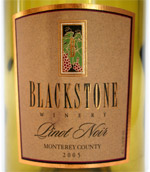 Anyway, my first cheap Pinot Noir that I tried is not a winner. Blackstone Pinot Noir 2005 from Monterey County, California is one point for the naysayers. This wine has made my “don’t buy it again” list. It was only about $8 where I bought it and I think I’ve seen it for less at Trader Joes. I’d say it’s worth about $3. It has an oaky bouquet with a hint of cherry, but not much. It lacks fruit… in fact it’s bland. There’s a bit of spice, but it’s understated. What really kills this wine is an underlying bitterness. It’s just not very enjoyable and I gave it a 73.
There’s one down. I’ll just hope the next one is the magic bullet. Cheers!
If you’re a regular reader, you know that I’ve been drinking a lot of chardonnay lately. I tried 16 in total and I’m finally ready to present the summary of results.
Overall, I was thrilled by how many of the chardonnays I tried were good. And I was even more thrilled by the diverse flavors I found. Some were the predictable buttery-oaky chards that everyone tells me they hate, some were mineral and crispy, while some were tropical and vibrant. Out of the 16 I tried, there are 6 that I would buy again and would recommend to others. Some of the other 10 are still good, but I’ve picked 6 that I think outshine the others.
Which one I would recommend to you? That somewhat depends on what your looking for, since there was a good variety in what I tried.
Top Picks
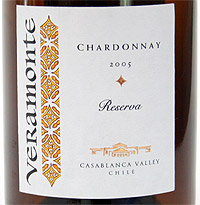 There are three different chardonnays that I gave 89 points and they are all different. My personal preference is the Veramonte Chardonnay Reserva from Chile. It has a nice, crisp fruity flavor at a decent price ($8.99). I had heard a lot of good things about Chilean wine, but hadn’t tried many of them before this one. Now I want to try more.
If the classic buttery-oaky chardonnay is what you’re interested in, then Concannon – Central Coast is a great choice. I’ve been getting crap from the anti-chardonnay crowd who don’t like this style of chardonnay for the past couple months for spending so much time on chards. But for those who are pro-butter and pro-oak, this is your pick.
For those who want an unoaked chardonnay, and are OK with spending a couple extra bucks, I’d recommend Monjardin Unoaked Chardonnay from Spain. It has a nice mineral, lime and pear flavor with a medium-long finish. This is a very enjoyable wine.
Best Value Chardonnay
My top pick for best value is the Twin Fin Chardonnay from California. I can usually find this wine for $6.99 and it is a really tasty chardonnay with a tropical edge. The flavors in this one are pineapple, banana and vanilla, which make this an interesting and good cheap wine.
Interesting and Worth a Try
There are two others from the list that I would recommend and they are both unoaked chardonnays and both priced at $9.99.
- Brampton Unoaked Chardonnay from South Africa is nice and light with apple, peach, pear and mineral flavors. It also has quite a long finish–particularly for a $10 wine.
- Brancott-Gisborne Unoaked Chardonnay from New Zealand is another wine with a tropical twist. The tropical flavors aren’t as prominent as the Twin Fin, but you’ll enjoy the pinapple and pear flavors that this wine presents.
Wine Ratings
There are other chardonnays that I tried that are decent, but you won’t go wrong with my top six. Here’s the full list of the wines I tasted for this challenge and how they rated. Cheers!
|
Brand
|
Year
|
Region
|
Rating
|
Price
|
|
Veramonte
|
2005
|
Chile
|
89
|
$8.99
|
|
Concannon – Central Coast
|
2004
|
California
|
89
|
$7.99
|
|
Monjardin
|
2005
|
Spain
|
89
|
$11.99
|
|
Twin Fin
|
2004
|
California
|
88
|
$6.99
|
|
Brampton
|
2006
|
South Africa
|
88
|
$9.99
|
|
Barefoot
|
N/A
|
California
|
87
|
$6.99
|
|
Brancott – Gisborne
|
2005
|
New Zealand
|
87
|
$9.99
|
|
Alice White
|
2006
|
Australia
|
86
|
$7.99
|
|
Razor’s Edge
|
2006
|
Austrailia
|
86
|
$12.99
|
|
Three Thieves
|
2005
|
California
|
84
|
$9.99
|
|
Smoking Loon
|
2005
|
California
|
83
|
$8.99
|
|
Dynamite Vineyards
|
2004
|
California
|
83
|
$9.99
|
|
French Rabbit
|
2005
|
France
|
77
|
$9.99
|
|
Ernest & Julio Gallo – Café
|
N/A
|
California
|
77
|
$4.99
|
|
Fetzer – Valley Oaks
|
2005
|
California
|
74
|
$7.99
|
|
Charles Shaw
|
2005
|
California
|
72
|
$3.39
|
Two Buck Chuck, or Three Buck Chuck depending on where you live. I kind of didn’t want to do this, but after Charles Shaw Chardonnay won top honors in the California State Fair wine competition I had to include it in my Chardonnay Challenge. It beat out 350 other California Chardonnays to win that award, so I at least have to give it its proper due.
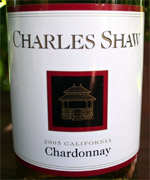 I’ll be up front, I’m not a fan of Charles Shaw wines. I’ve tried them. I’ve tried to have an open mind considering the fact that they are extremely cheap, but they just don’t do it for me. You can do much better without spending a lot more.
Most Chuck wines I’ve tried are drinkable. They aren’t absolutely disgusting, they just aren’t that good. If you insist on spending only $3 then fine, get a Two Buck Chuck.
All that said, I probably should have blind-tasted the Charles Shaw to eliminate any bias. But I tried to judge it honestly and if anything I was probably a bit generous.
Here’s my assessment of Charles Shaw Chardonnay 2005: The nose is rather weak and has a bit of an acid smell that reminds me of photography developing chemicals from my old black & white photo lab. It’s not a strong photo-chemical smell, but it’s there. The taste isn’t bad, but there’s also nothing exciting or interesting about it. The fruit is somewhat unripened… Green apples and a touch of mineral on the palate. It does have a bit of malolactic buttery-ness. The finish is exceptionally short, almost instant. The numbers broke out to a 72.
Wine: Charles Shaw
Varietal: Chardonnay
Alcohol: 13.5%
Rating: 72
The Real Deal
Here’s the deal… while Charles Shaw may have won top honors in the California State Fair you won’t find that same quality in every bottle of Charles Shaw. Charles Shaw wines are known to be inconsistent. The bottle(s) entered into the California State Fair competition were undoubtedly hand picked. While the bottle I picked up only got a 72, there are surely better bottles sitting in the store.
So how do you get a decent bottle of Charles Shaw chardonnay (or any varietal for that matter)? Here’s the trick, you need to be ready to buy a case to make it worthwhile and do a little work. And you need to be ready to admit defeat if it doesn’t work out.
- Go to Trader Joe’s with a marker in hand, a corkscrew in your pocket and a wine glass handy.
- Find the cases of Charles Shaw. They are usually stacked up on a side wall.
- Pull 4-5 bottles out of different cases. Mark the bottles as you pull them and mark the cases with a matching identifier.
- Buy the 4-5 bottles and head outside.
- Pop the corks and try each of the bottles.
- If you’ve found a good bottle go back in and buy the rest of that case.
Of course make sure you have a friend to drive you home after trying all that wine if you’re not spitting. I have a buzz after one glass– I guess I’m a light weight. Cheers and enjoy.
Ah, yes… another chardonnay. But I’m pleased to say that the chardonnay challenge is almost over. I will soon move on to some other varietals, and I can’t wait. Not that I mind chardonnay, I’m just more of a red wine guy and I need a change.
Also, before I get into this… sorry for the silence over the past couple weeks. I’ve been doing a lot of traveling for my day job over the past three weeks and it’s kept me away from the blog. I have had some great wine on the road, but it has been out of the price range for Cheap Wine Ratings. I almost posted about it anyway, but when I couldn’t get a decent photo off the phone-camera I decided to nix the idea.
OK, enough jabber. On to the Smoking Loon.
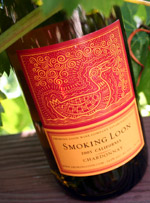 Smoking Loon is produced by Don Sebastiani & Sons, the same folks who create Pepperwood Grove, Aquinas Napa Valley and some other brands. I’ve had decent experiences in the past with Pepperwood Grove and Aquinas, although they’ve not made my favorites list yet. I have a hard time drinking the Aquinas brand without thinking about St. Thomas Aquinas, who as far as I can tell took the philosophy of Aristotle and re-branded it as Christian philosophy. For some reason that just annoys me when I see Aquinas wines, but maybe that’s just me.
The Smoking Loon Chardonnay 2005 is a so-so chardonnay. It doesn’t have any faults, but it’s nothing exceptional. Standard commercial chardonnay on the nose. Really buttery palate, but not over oaky. It has hints of vanilla, papaya and nectarine. A rather short finish.
It’s interesting to see how they describe it: “sweet spring flowers, green tea, and a touch of fresh pineapple” on the nose. I can give them the flowers and tea, but as hard as I try I can’t find any pineapple in it. “The palate is framed by flavors of lemon meringue, fresh papaya, limestone, and subtle nuances of clove finishing with nectarine and light vanilla oak tones.” They apparently want to convince you that it’s a lot more complex than I found it.
Wine Enthusiast gave it an 84, I gave it an 83. Basically the same. It’s an OK chardonnay, but for $8.99 you can find better.
Wine: Smoking Loon
Varietal: Chardonnay
Alcohol: 13.5%
Rating: 83
 Prev1...506070787980...82Next
  Page 79 of 82